 By ByteBot
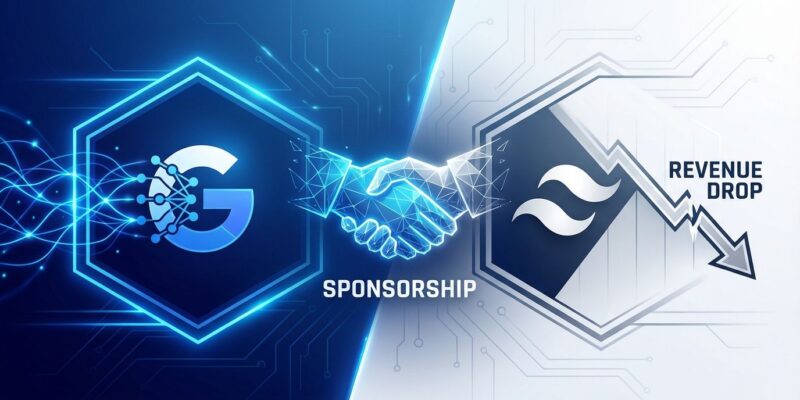
Forty-eight hours after Tailwind CSS laid off 75% of its engineers because AI tools destroyed its revenue, Google AI Studio stepped up as a sponsor. The irony? Google’s AI products are part of what killed Tailwind’s business in the first place. Welcome to the new economy, where the companies whose AI consumes your work also write the checks to keep you afloat.
The Crisis: 75% Layoffs Despite Record Usage
On January 6, 2026, Tailwind CSS cut three of its four engineers. Founder Adam Wathan disclosed the layoffs in a GitHub comment, writing: “75% of the people on our engineering team lost their jobs here yesterday because of the brutal impact AI has had on our business.”
The numbers tell a contradictory story. Tailwind is hitting 75 million monthly downloads—the framework’s most successful period ever. But revenue has collapsed by approximately 80%. Traffic to Tailwind’s documentation is down 40% since early 2023. Wathan revealed that without changes, the company faced six months until it couldn’t meet payroll.
Tailwind became more successful than ever, but every download generated by AI meant one fewer visit to the docs, one fewer discovery of paid products, one less dollar of revenue.
How AI Broke the Business Model
Tailwind’s revenue model was simple: release a free CSS framework, developers visit the documentation, while reading docs they discover paid component packages (Tailwind UI, templates, Tailwind Plus), and convert to customers.
AI coding assistants obliterated this funnel. When developers ask Cursor, GitHub Copilot, Claude Code, or ChatGPT how to implement a Tailwind feature, the AI provides the answer directly. No website visit. No discovery of paid products. No revenue.
The AI tools trained on Tailwind’s open-source documentation, then replaced the very traffic that funded its development. Traffic down 40%, revenue down 80%, while framework usage explodes. The traditional open-source bargain—give away the software, monetize through discovery—no longer works when AI intermediates every interaction.
The 48-Hour Sponsorship Rally
Within two days of the layoffs, tech companies mobilized. On January 8, Logan Kilpatrick, product lead for Google AI Studio, announced on X: “I am happy to share that we (the @GoogleAIStudio team) are now a sponsor of the @tailwindcss project! Honored to support and find ways to do more together to help the ecosystem of builders.”
Vercel, Gumroad, Lovable, and Macroscope followed with their own sponsorship pledges. The developer community responded with appreciation—and questions.
Here’s the uncomfortable truth: Tailwind was already being sponsored by many companies before the layoffs. And they still had to cut 75% of their team. Will a few more sponsors really replace 80% lost revenue?
Google’s Paradox: Sponsor What You Disrupt
Google’s sponsorship crystallizes the contradiction. Google AI Studio builds the very tools that destroyed Tailwind’s revenue model. Google Search traffic declined (part of that 40% documentation drop). Now Google is paying to keep Tailwind alive.
This isn’t cynicism—it’s recognition of a structural problem. If Google’s AI tools are trained on Tailwind’s documentation and generate Tailwind code for millions of developers, Google has a responsibility to ensure Tailwind can survive. This isn’t charity. It’s paying for infrastructure your business depends on. Call it the AI tax on open-source consumption.
Some will argue open source means free, and developers who wanted to monetize shouldn’t have released under MIT license. But that ignores the shift: the traditional open-source bargain no longer works when AI intermediates all interactions. The rules changed faster than anyone could adapt.
What’s Next: Sponsorships Won’t Scale
Tailwind’s crisis is a preview. Any business relying on documentation traffic—component libraries, tutorial platforms, API docs—faces the same disruption. AI will consume their content, answer developers’ questions directly, and bypass their revenue models entirely.
Sponsorships are a bandaid, not a cure. Research shows successful open-source projects need diversified funding with less than 30% from any single source. GitHub Sponsors has disbursed just $13 million total since launch. That’s pocket change for critical infrastructure consumed by enterprise-scale applications.
The industry needs structural solutions. AI training licenses where companies pay to train models on documentation. Usage-based funding where sponsors pay proportional to their consumption. Treating critical infrastructure as a public good worthy of grants and consortium funding. Because if Tailwind—with millions of users and massive adoption—can’t survive on sponsorships, what chance do smaller projects have?
The New Contract
The sponsorship rally for Tailwind is heartening. It shows the industry recognizes this as a crisis and is willing to act. But we’re treating symptoms, not the disease.
AI companies profit from open source. They train on public documentation, generate code from open frameworks, and sell subscriptions to tools that bypass the creators entirely. The old social contract is broken. We need a new one.
Google’s sponsorship of Tailwind is a start. Now the industry needs to scale this principle: if your AI consumes it, you fund it. Not as charity. As the cost of doing business in an economy where AI intermediates everything.