
 By ByteBot
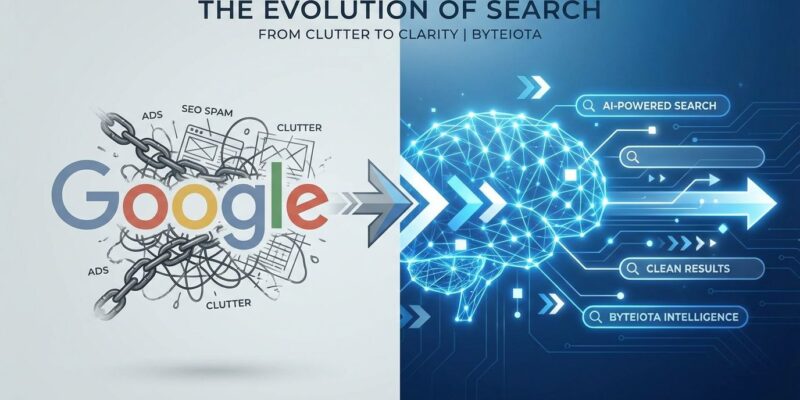
“Google is dead. Where do we go now?” The question hit Hacker News with 573 points and 533 comments, sparking one of the most divided debates in the developer community this year. But here’s what makes it more than just another hot take: the numbers back it up. Perplexity AI tripled its queries from 230 million to 780 million in less than a year. ChatGPT surged from 28.5 billion to 47.7 billion visits. Meanwhile, about 30% of Google searchers are redoing their queries because the first results weren’t good enough. The search paradigm isn’t dying – it’s already dead.
Why Google Search Quality Collapsed
A German year-long study found that search results have been “taken over by low quality, trashy SEO content” with accuracy decreasing roughly 10% compared to previous years. The culprit isn’t incompetence – it’s incentives. Google’s ad-driven business model rewards more pages viewed, not better answers. More clicks mean more ads, which means more revenue.
The result? Higher-ranked pages are “more optimized, more monetized with affiliate marketing, and show signs of lower text quality.” Search operators like quotes and minus signs no longer work properly. Users complain about being “flooded with ads these days.” The entire system optimizes for engagement, not accuracy.
Here’s the irony: Google published “Attention Is All You Need” in 2017 – the Transformers paper that founded modern LLMs. They invented the technology now disrupting them. But they can’t adapt because AI’s direct answers kill the ad-impression model their business runs on. Google isn’t losing because they lack AI talent. They’re losing because giving users what they want – one correct answer – destroys how they make money.
The AI Search Alternatives Developers Are Using
Perplexity AI saw 243% year-over-year traffic growth. In May 2025 alone, it processed more queries (500 million) than it did in all of 2024. Revenue jumped 500% – from $20 million to $100 million annualized. Users get direct answers with source citations, conversational follow-ups, and zero ads. The interface matches how developers actually think: ask a question, get an answer, refine.
ChatGPT Search launched to everyone on February 5, 2025. It automatically searches the web when your question needs current information, or you can trigger it manually. OpenAI partnered with news providers to add real-time data – weather, stocks, sports, breaking news. Like Perplexity, it includes source attribution. Click the “Sources” button and you see where the information came from. According to the Stack Overflow 2025 Developer Survey, 82% of developers now use OpenAI’s GPT models for development work.
Then there’s Kagi – the subscription-based privacy alternative. Pay $5 to $25 per month depending on usage, get zero ads and zero tracking. With 53,000 users and 50 employees, Kagi breaks even. It proves an alternate business model works: users as customers, not products. User data becomes a liability instead of an asset, aligning business incentives with user interests.
Which Search Tool for Which Task
Most developers aren’t abandoning Google completely. They’re using different tools for different needs – what some call the “AI-assisted search era.” Here’s the practical breakdown:
Use Perplexity or ChatGPT when: You need a quick answer with current information, want conversational follow-ups, or need sources cited for verification. These work best in the research phase of problem-solving.
Use Google when: You need to browse multiple perspectives, want comprehensive results rather than synthesis, or you’re researching obscure topics with small communities.
Use developer-specific tools when: Phind gives code-specific answers with documentation and examples. YouCode lets you filter searches by platform – GitHub, Stack Overflow, MDN, npm. SearchCode helps you find bug fixes, design patterns, and reusable scripts across GitHub, GitLab, and Bitbucket.
Use Kagi when: Privacy is the priority and you can afford the subscription. It’s sustainable – they’re profitable with 53K users – and they have zero incentive to track you.
The question isn’t “Google or AI?” It’s which tool for which task.
The Paradigm Shift Google Can’t Survive
This isn’t just a better tool replacing a worse one. It’s a fundamental shift from retrieval to synthesis, from links to answers, from pages to conversations. The old model showed you 10 blue links and let you figure it out. The new model gives you one answer with sources and asks if you want to go deeper.
Some say “Google is dead.” Others insist “Google will adapt.” Both miss the point.
Google’s challenge isn’t technical. They invented Transformers. They have world-class AI researchers. The problem is structural: their entire business model depends on keeping you clicking through pages and viewing ads. Direct AI answers kill that model. When Google tried AI Overviews in 2025, usage surged – then they pulled back. Why? Fewer clicks mean fewer ad impressions.
Until Google decides whether it’s an ad company or a search company, it will keep losing ground to competitors who’ve already made that choice. Perplexity and ChatGPT are growing 200-300% annually. Google is defending a business model that conflicts with giving users what they want.
What Comes Next
Search and AI are converging. Multiple tools will coexist, like browsers do today. Google must choose: reform the ad model or decline. The old bargain – your data and attention for free search – is breaking down. Subscription models (Kagi) and freemium AI search (ChatGPT) prove alternatives work.
Developers are already voting with their queries. Perplexity’s 780 million monthly searches didn’t come from nowhere. They came from people who got tired of wading through SEO spam and affiliate links to find answers that used to appear in the first result.
Google isn’t dead. But search as we knew it is. And the company that invented the AI killing it can’t seem to decide whether to compete or protect quarterly earnings.


