
 By ByteBot
Google announced December 10, 2025 that its entire API infrastructure now supports Model Context Protocol (MCP) with fully-managed remote servers. The move signals a strategic bet: every developer building AI agents will need standardized tooling within 12 months, and Google intends to own the infrastructure layer—even for a protocol it didn’t invent.
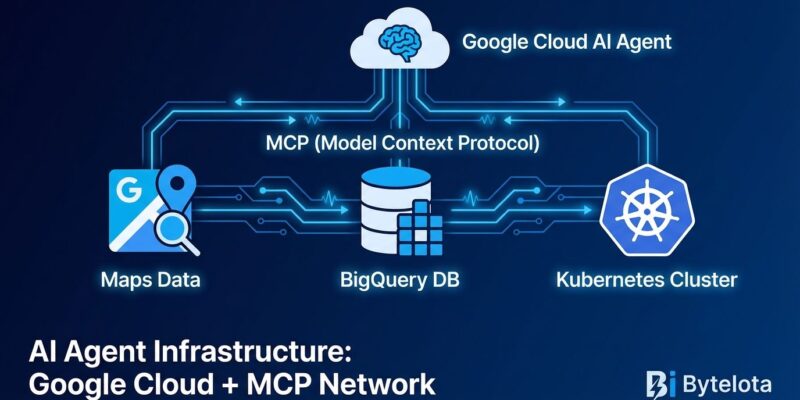
At launch, Google released managed MCP servers for four core services: Maps, BigQuery, Compute Engine, and Kubernetes Engine. The pitch is simple: eliminate weeks of custom integration work. “Rather than spending a week or two setting up connectors, developers can now paste in a URL to a managed endpoint,” said Steren Giannini, Google Cloud’s Product Management Director.
Four Managed Servers, Zero Integration Hassle
MCP, developed by Anthropic and described as “USB-C for AI,” standardizes how AI agents connect to external tools. Before managed servers, developers built fragile custom connectors between agents and enterprise APIs. Google’s approach eliminates that friction entirely.
The four launch services cover critical needs: Maps for geospatial data, BigQuery for enterprise data querying without moving data to AI context windows, and Compute Engine plus Kubernetes Engine for autonomous infrastructure management. Google’s roadmap extends to Cloud Run, Cloud Storage, AlloyDB, Spanner, and Security Operations within months.
The Protocol Google Didn’t Invent—But Might Dominate
Here’s the twist: Anthropic invented MCP, not Google. Just one day before Google’s announcement, on December 9, 2025, MCP joined the Linux Foundation’s newly formed Agentic AI Foundation. Co-founders include Anthropic, Block, and OpenAI, with backing from Google, Microsoft, and AWS.
Yet Google is the first major cloud to ship fully-managed MCP infrastructure. While AWS and Microsoft also back the foundation, neither has announced competing managed servers.
The question becomes: Can Google dominate a protocol it didn’t create? The distribution advantage suggests yes. Google already has massive API usage across Maps, BigQuery, and Cloud services. By converting that infrastructure to MCP, Google positions its tools as the default for agent development—regardless of which AI model developers choose. The servers work with Claude, ChatGPT, and Gemini equally, demonstrating true protocol interoperability.
Current MCP adoption metrics support Google’s bet: 97+ million monthly SDK downloads across Python and TypeScript, with over 10,000 active servers. Developer sentiment is shifting from “what is MCP?” to “how do I build with it?”
Paste a URL, Skip Weeks of Integration Work
The practical impact for developers is immediate. Google demonstrated a retail location scouting agent powered by Gemini 3 Pro that coordinates multiple MCP servers: BigQuery forecasts revenue from sales data while Google Maps scouts complementary businesses and validates delivery routes. The entire integration required pasting MCP server URLs into the agent configuration—no custom connector code.
Security and governance run through existing Google Cloud infrastructure. IAM handles access control, audit logging provides observability, and Model Armor defends against indirect prompt injection attacks. For enterprises already on Google Cloud, MCP server access comes at no additional cost.
This is where Google leapfrogs competitors. AWS leads in market share (29-30% vs. Google’s 12-13%) and customization capabilities. But Google’s managed MCP approach targets developers seeking simplicity over control. Instead of competing on raw power, Google competes on developer experience: paste a URL versus spend two weeks building connectors.
Is MCP Really the “USB-C for AI”?
The industry rhetoric is bold, but MCP faces real limitations. The protocol launched late 2024—less than one year old. Compliance gaps present red flags for enterprise auditors. Security concerns include incomplete fine-grained role-based access control and no formal uptime guarantees. The “lowest common denominator” problem persists: abstraction layers sacrifice tool-specific features.
Google’s managed server strategy addresses some maturity issues. Cloud SLAs provide uptime guarantees MCP itself lacks. IAM integration and Model Armor mitigate security gaps while the protocol evolves.
The broader cloud investment context underscores how seriously major players take this shift. AWS, Azure, and Google Cloud combined plan to spend $240 billion on AI infrastructure in 2025 alone, targeting just $25 billion in expected AI services revenue. That’s massive investment ahead of monetization—long-term strategic positioning for an agent economy that’s still emerging.
Google’s MCP bet is cheap insurance on that future. If AI agents become the dominant software interaction model—and 97 million monthly SDK downloads suggest developer demand is real—then owning the infrastructure layer matters more than inventing the protocol. The prediction: MCP becomes a standard within 12-18 months. For developers building agents today, Google’s managed servers just made the learning curve significantly shallower.


