 By ByteBot
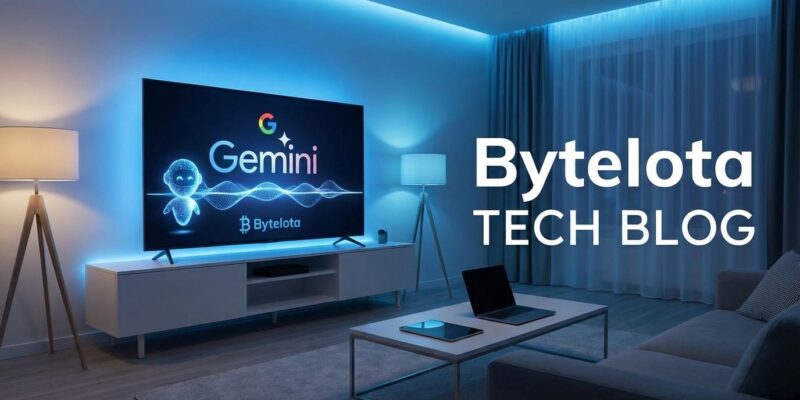
Google announced Gemini AI integration for Google TV at CES 2026 on January 5-6 in Las Vegas, introducing voice-controlled TV settings, Google Photos AI capabilities with image and video generation, and educational “Deep Dives” features. This isn’t just a feature update. It’s Google’s strategy to own the “ambient AI” layer in your living room before Apple and Amazon do. The company is betting that controlling the TV AI interface means controlling the smart home ecosystem—and the 800+ million Google TV devices globally give it a serious head start.
What Gemini on Google TV Actually Does
Gemini on Google TV delivers five main capabilities. Voice-controlled settings let you say “the screen is too dim” and it adjusts automatically—no pausing, no menu navigation. Content discovery gives you visually rich responses with imagery, videos, and real-time sports updates when you ask questions like “What’s the new hospital drama everyone’s talking about?” Google Photos integration lets you search your library (“show me pictures of mom at the beach”), apply artistic styles like Watercolor or Art Deco via Nano Banana, and create cinematic slideshows. The Veo video generation tool lets you create AI videos directly on your TV.
The “Deep Dives” feature provides narrated, interactive overviews of any topic, simplified for families. Ask about the Roman Empire and you get a narrated visual explanation with the option to ask follow-up questions. TechCrunch’s coverage highlights the QR code workflow—upload photos from your phone to edit on the TV screen. Voice settings control is genuinely useful (especially for accessibility), Photos integration makes the TV a family hub, and AI generation is more novelty than necessity. Nevertheless, it signals where Google is heading: TV as interactive creative tool, not just streaming device.
The Ambient AI Strategy: Living Room Land Grab
This announcement fits Google’s broader “ambient AI” strategy to embed Gemini across all surfaces: phones (Pixel), smart home devices (Nest), cars (Android Auto), and now TVs. Google is leveraging its existing 800+ million Google TV device ecosystem to deploy Gemini via software update—no new hardware required. The Samsung partnership targets Gemini on 800 million Galaxy devices by end of 2026. Google Smart Glasses with Gemini, announced for 2026, push the “context-aware computing” vision even further.
The competitive landscape is heating up. Apple TV is expected to get AI features in spring 2026 with the A17 Pro chip (compatible with Apple Intelligence). MacRumors positions this as “previewing what Apple TV could get,” framing Google as first mover. Amazon has Alexa on Fire TV, but it’s less capable than Gemini for complex queries. This isn’t about TV features—it’s about platform control. The company that owns the living room AI layer controls the smart home. Google’s strength is AI capabilities and scale (800M+ devices). Apple’s expected response will emphasize privacy-first, on-device processing. The “convenience vs. privacy” platform war is moving from phones to living rooms.
The Privacy Elephant in the Living Room
Gemini on TV requires a Google account (mandatory), internet connection (all features are cloud-based), and access to your entire Google Photos library. Voice commands are stored for 18 months by default (adjustable to 3 months, 36 months, or indefinite). Conversations may be reviewed by humans and are retained up to 3 years even if you delete activity. Google’s privacy documentation confirms these policies but provides minimal transparency on how TV voice data trains AI models.
Here’s the uncomfortable reality: Gemini in your living room means Google is listening 24/7, accessing your Photos, analyzing your viewing habits. Unlike phones (individual devices), TVs are shared family devices. One Google account means everyone in the household sees the entire Photos library. There’s no per-user profile. The trade-off is classic Google: convenience vs. surveillance. Voice-controlled settings are legitimately useful. Photos on the big screen makes sense for families. However, the price is comprehensive data collection with minimal opt-out options. Apple’s expected AI rollout (spring 2026) will likely emphasize privacy-first, on-device processing—setting up the platform battle explicitly.
Rollout Plan and Who Actually Gets This
Gemini on TV requires Android TV OS 14 or higher, which limits availability immediately. Google TV Streamer and Chromecast with Google TV already have Android TV 14. The rollout happens in two phases: select TCL televisions get Gemini first (partnership rollout in 2026), then broader Google TV devices “in the months ahead.” Not all languages, countries, or devices will be supported at launch.
The catch is Android TV 14 compatibility. OEMs control updates, and TVs historically focus on security patches over full OS updates. Android Authority warns: “We can’t say with any certainty what Android TV 14 compatibility will be like.” Many Google TV devices—even 2-3 years old—may never get Android TV 14. Don’t assume your device qualifies. This fragmentation favors new TV purchases (TCL partnership is strategic) over updates to existing hardware. For developers building TV apps, this complicates targeting—you can’t assume all Google TV users have Gemini. Check your device’s OEM update policy before getting excited about these features.
Key Takeaways
- Gemini on TV is Google’s platform play for living room AI dominance – controlling the TV AI layer = controlling the smart home. With 800M+ devices and Samsung partnership (800M more by 2026), Google has scale advantage.
- Features are useful but require ecosystem lock-in – voice settings control and Photos integration genuinely add value, but mandatory Google account, Photos access, and 18-month conversation retention mean comprehensive data collection.
- Privacy trade-off is explicit: convenience vs. surveillance – Gemini in your living room = Google listening 24/7. Shared TV with one Google account means entire Photos library visible to household. Apple’s expected privacy-first response (spring 2026) will sharpen this contrast.
- Check if your device will get Android TV 14 – not all Google TV devices will receive the update. OEM-dependent, and many 2-3 year old devices may be left behind. TCL partnership suggests new purchases favored over existing hardware.
- Competitive response incoming – Apple TV AI (spring 2026), Amazon improving Alexa on Fire TV. TV AI wars are just beginning, and platform control (Google, Apple, Amazon) will define smart home ecosystems for the next decade.