 By ByteBot
Google reimagined Gemini Deep Research on December 11, launching a new Interactions API designed to give developers granular control in the agentic AI era. The timing wasn’t subtle: released the same day OpenAI dropped GPT-5.2, signaling Google’s strategic shift from competing on model leaderboards to dominating agent infrastructure. While OpenAI chases benchmark scores, Google is betting that developer control—not performance metrics—will define the next wave of AI value.
The Interactions API: Developer Control Over Model Performance
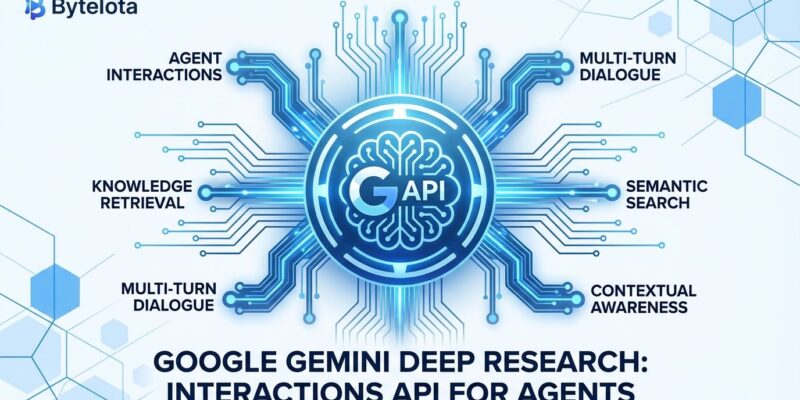
Google’s play isn’t another model upgrade—it’s new developer infrastructure. The Interactions API provides a single RESTful endpoint for models and agents, giving developers granular control over research agents that was previously locked behind black-box systems.
Key capabilities include report steerability via prompting, where developers can define structure, headers, subheadings, or specify data table generation. Every claim comes with detailed granular citations for verification—critical for enterprise use cases like due diligence or pharmaceutical research. The API supports JSON schema outputs for programmatic parsing and integrates File Upload plus File Search Tool, analyzing PDFs, CSVs, docs alongside public web data.
The pricing strategy reveals Google’s hand: $2 per million tokens commoditizes agentic AI compared to OpenAI’s expensive subscription model. The agent, currently available as deep-research-pro-preview-12-2025 in public beta through Google AI Studio, is built on Gemini 3 Pro with a 1M token context window—what Google calls their “most factual” model.
Real enterprise deployments are already running. Alex Beatson, co-founder of Axiom Bio, explains the impact: “Gemini Deep Research surfaces granular data and evidence at and beyond what previously only a human researcher could do.” Use cases span pharmaceutical toxicity safety research and due diligence operations, proving production readiness beyond demo territory.
Ecosystem Integration: Deep Research Goes Everywhere
Google isn’t stopping at a standalone API. Deep Research is integrating into Google Search, Finance, NotebookLM, and the Gemini App—a strategic ecosystem lock-in that OpenAI can’t match.
Google Search integration makes research accessible to billions, transforming how users interact with information. Google Finance gets real-time financial research agents, turning market analysis into an agentic workflow. NotebookLM enhances research workflows with deeper synthesis capabilities, while the Gemini App brings this power to consumer-facing assistants.
For developers, this means access to Google’s infrastructure through managed MCP servers for Maps, BigQuery, Gmail, and Drive. Gemini 3 is tightly integrated into Google’s product and cloud ecosystem, with multimodal and agentic workflows as the core focus. The competitive moat isn’t just the API—it’s Workspace dominance plus enterprise governance built-in.
Strategic Timing: The Agent Infrastructure War
December 11, 2025, marked a coordinated competitive messaging moment. Google launched Gemini Deep Research and the Interactions API. OpenAI launched GPT-5.2. Neither was coincidence—OpenAI’s “code red” memo, triggered by Gemini 3’s advances, set the stage for this same-day showdown.
The philosophical difference is stark. Google bets on infrastructure, integration, and developer control. OpenAI bets on model performance, velocity, and provider flexibility. Both strategies target the same reality: 99% of 1,000 enterprise developers surveyed by IBM are building AI agents. The market is projected to hit $7.38 billion in 2025 and balloon to $103.6 billion by 2032.
Google’s DeepSearchQA benchmark—open-sourced for multi-step information-seeking tasks—shows Google Deep Research leading on complex research, with OpenAI’s ChatGPT 5 Pro “surprisingly close” overall. But Google isn’t competing on benchmarks anymore. The bet is infrastructure wins when agents, not models, define the value layer.
What Developers Can Build Now
The Interactions API is live in public beta via Google AI Studio. Developers can build custom research agents with granular control, domain-specific tools for finance, legal, or scientific research, and integrate into existing workflows as Search, Finance, and NotebookLM APIs roll out.
Best practices are emerging fast from the agent development community. Start with single-responsibility agents with narrow scope—broad prompts decrease accuracy. Target high-value, low-risk use cases first to build organizational confidence. Test for accuracy, latency, and scalability before production deployment.
Real use cases prove the value. Pharmaceutical toxicity safety research at Axiom Bio, due diligence operations for M&A and legal analysis, and competitive intelligence automation are all running today. The 46.4% score on the “Humanity’s Last Exam” benchmark isn’t just a number—it’s proof of enterprise-grade capability.
The Agent-First Era Bet
Google’s Interactions API isn’t just about better research—it’s a bet that the next wave of AI value comes from developer control, not model leaderboards. The shift from “best model” to “best agent infrastructure” is underway. Infrastructure plus integration versus velocity plus flexibility—that’s the question developers face.
In 2025, agent-first development is the dominant paradigm. If you’re building agents, Google’s infrastructure is worth exploring. The public beta, $2 per million tokens pricing, and ecosystem integrations offer a compelling alternative to OpenAI’s approach. The arms race is accelerating, and the winner will be whoever best navigates the gap between AI possibility and enterprise practicality.