 By ByteBot
Google just launched CC, an AI agent that reads your email, scans your calendar, and sends you a “Your Day Ahead” briefing every morning—without you asking. The December 16, 2025 rollout to U.S. and Canada subscribers marks Google’s entry into autonomous AI agents, a shift from reactive assistants like Gemini that wait for prompts to proactive agents that work while you sleep. That convenience requires handing Google full access to years of email, calendar data, and Drive files.
What CC Actually Does
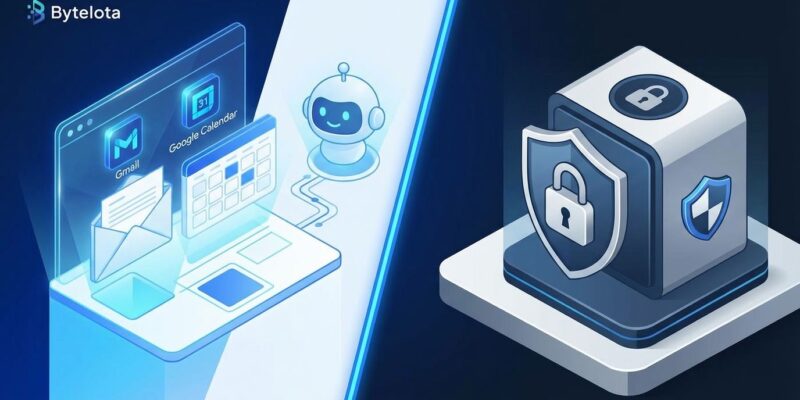
Google Labs announced CC as an experimental productivity agent built on Gemini. When you sign up, it connects your Gmail, Google Calendar, and Google Drive to deliver a daily “Your Day Ahead” briefing to your inbox every morning. The briefing synthesizes your schedule, key tasks, and updates into one summary. CC also prepares email drafts and calendar links when it thinks you’ll need them.
Unlike Gemini, which requires prompts, CC operates autonomously. You can steer it by replying or emailing directly—teach it about your routines, ask it to remember recurring tasks, adjust its focus. Think of it as a morning assistant who’s already read everything before you wake up.
There’s a catch. Availability is U.S. and Canada only, 18+, requiring Workspace “Smart Settings” enabled. Priority access goes to Google AI Ultra subscribers at $250 per month. Everyone else joins the waitlist at labs.google/cc.
The Privacy Cost Nobody’s Talking About
CC needs full access to your email history, every calendar event you’ve ever created, and all your Drive files. That’s not a bug—that’s the product. Autonomous agents require “something resembling root permissions” to function, and there’s no encrypted model for this type of access yet.
In March 2025, Signal President Meredith Whittaker warned that agentic AI has “profound security and privacy issues.” She wasn’t wrong. Privacy researchers found that users “instantly and irreversibly hand over rights to an entire snapshot” of years of inboxes, messages, and calendar entries. You’re also granting AI permission to act autonomously on your behalf—enormous trust in technology already prone to errors.
CC runs under a separate privacy framework. It’s not covered by Workspace or Gemini privacy policies. Google labels it a “standalone experimental service,” which means the normal rules don’t apply. For developers handling sensitive client data, internal communications, or proprietary code discussions, that’s a significant tradeoff for 5-15 minutes of daily time savings.
AI Agents Make Developers Slower, Not Faster
Here’s the uncomfortable data: METR studied developers using AI tools and found they take 19% longer to complete tasks than without AI. But developers estimated they were sped up by 20%. The perception gap is real—developers feel faster while moving slower.
Stack Overflow’s 2025 survey backs this up. AI adoption hit 84%, but trust crashed to 33%. Only 29% of developers actually trust the AI tools they’re using daily. Sentiment toward AI dropped from 70% in 2023-2024 to 60% in 2025. When researchers asked companies about production AI agent adoption, 45.8% cited performance quality as the single biggest blocker.
CC’s “Your Day Ahead” briefings may feel productive, but they could add overhead. Another summary to review. Drafts to verify. Links to validate. Information overload disguised as organization. The productivity promise needs validation, not marketing claims.
Google Is Late to the Agent Race
Microsoft launched Copilot’s autonomous agents earlier, but they’re struggling. The company slashed sales targets by up to 50% due to weak demand and underwhelming real-world performance. Microsoft’s AI CEO even admitted that Google’s Gemini 3 “excels over Copilot in multimodal tasks.” That admission didn’t help Microsoft’s case.
Meanwhile, Anthropic’s Claude captured 32% enterprise market share, overtaking OpenAI’s 25%. Claude Opus 4.5 is now considered the best model in the world for coding and agents. Anthropic’s Claude Code product hit $1 billion in annualized revenue, doubling from $400 million six months earlier. The competitive edge? Reliability, governance, and enterprise integration—not raw speed.
Google’s Gemini 3 is technically strong, but the company is late to autonomous agents. CC is Google’s attempt to catch up, launched as an experimental product with limited access. That’s not confidence. That’s testing the market.
What Developers Should Actually Consider
Before joining the waitlist, understand what you’re signing up for. CC is a Google Labs experiment, not a production Workspace feature. It operates under a separate privacy framework with unclear data handling. Priority access costs $250 per month through the AI Ultra tier. Not all developers need or want AI managing their calendars.
Weigh the tradeoff: manual workflow taking 5-15 minutes per day versus exposing years of email, calendar, and Drive data to an experimental AI agent. If you value privacy, wait for clearer disclosures. If you want autonomous agents, compare CC against Microsoft Copilot (low adoption problems) and Anthropic Claude (high enterprise trust).
The 2025 bet is that developers want proactive AI managing their workflows instead of just answering questions. But data shows 99% of developers are exploring AI agents while 45.8% cite quality as the top barrier to production use. Adoption doesn’t equal satisfaction. Autonomous doesn’t automatically mean better. Measure actual time saved, not perceived efficiency. And read the privacy policy carefully before handing over root access to your professional life.