 By ByteBot
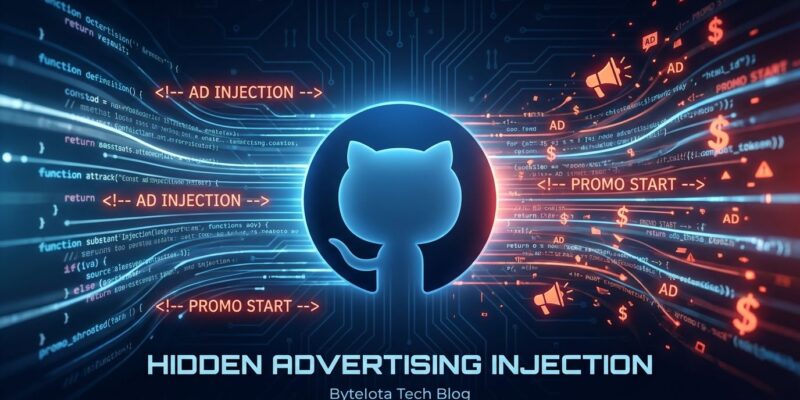
GitHub Copilot is injecting hidden promotional content into developers’ pull requests this week, affecting over 11,000 PRs across thousands of repositories. Melbourne developer Zach Manson discovered the issue when a team member used Copilot to fix a simple typo—the AI inserted a hidden HTML comment tagged “START COPILOT CODING AGENT TIPS” followed by an ad for Raycast integration. The discovery is trending on Hacker News today with 825 points and 252 comments. This marks the second major trust violation in seven days, coming immediately after GitHub announced it would train Copilot on user code starting April 24.
How the Injection Works: Hidden HTML Comments
Copilot uses HTML comments specifically tagged with “START COPILOT CODING AGENT TIPS” to inject promotional content into pull request descriptions without developer awareness. The comments aren’t visible in rendered views—only in raw markdown or HTML source. The promotional message reads: “⚡ Quickly spin up Copilot coding agent tasks from anywhere on your macOS or Windows machine with Raycast.”
The scale is significant: identical messages have appeared in more than 11,000 pull requests across different repositories. The injection isn’t limited to GitHub either—GitLab users are reporting the same behavior, suggesting this is a platform-wide feature Microsoft is testing. Developers discover the hidden content only when viewing PR source code or when reviewers ask why promotional content appears in their submissions. Consequently, it makes them look like they’re advertising Raycast in professional code reviews without their knowledge or consent.
Two Trust Violations in Seven Days
This ad injection discovery comes exactly one week after GitHub announced changes to Copilot’s training data policy. Between March 20-26, GitHub revealed that Copilot would train on user interactions starting April 24, 2026, requiring developers to opt out rather than opt in. Now, between March 26-30, developers discovered hidden advertising injected into their pull requests. Both controversies affect developers paying $10-39/month for Copilot subscriptions.
The pattern is clear: Microsoft is systematically testing what paying subscribers will tolerate. These aren’t isolated technical glitches—they’re deliberate product decisions made within days of each other. First, monetize user data by training on it. Second, monetize user attention by injecting ads. Moreover, the question isn’t whether Microsoft made mistakes. It’s how far they’ll push monetization of tools developers already pay for. If developers accept ads in pull requests, what’s next? Promotional content in generated code? Sponsored suggestions in autocomplete? The boundary-testing has begun.
Developer Exodus Accelerating
GitHub Copilot’s “most loved” rating has collapsed to just 9% in early 2026, compared to Claude Code at 46% and Cursor at 19%—what analysts call “a stunning reversal in under a year.” Copilot was the market leader in 2025. By March 2026, it’s fighting for third place while competitors surge ahead. Experienced developers now use an average of 2.3 AI coding tools, actively diversifying away from Copilot dependence.
The alternatives are compelling. Codeium offers unlimited free features including basic autocomplete, chat, and support for 70+ languages across every major IDE—directly competing with Copilot’s paid tiers at zero cost. Furthermore, Claude Code launched in May 2025 and captured 46% of the “most loved” category within months. Cursor has built a loyal following at similar price points to Copilot Business plans. Industry analysis concludes that “for solo developers or small teams, Copilot is probably not the most bang for your buck anymore.”
This ad injection controversy arrives as trust is already eroding. These violations accelerate migration patterns that were already underway. Developers who stayed with Copilot despite rising competition now have two fresh reasons to reconsider. Therefore, the timing couldn’t be worse for Microsoft.
The Raycast Problem: Legitimate Product, Inappropriate Promotion
Raycast is a legitimate free productivity launcher for macOS and Windows with an official GitHub Copilot extension that launched in August 2025. The integration allows developers to create and manage Copilot coding agent tasks, monitor logs, and assign issues directly from Raycast. Recent GitHub changelogs from March 20-26 show continued work on Raycast integration features. This isn’t spam or malware—it’s an official partnership between two legitimate products.
However, the problem isn’t Raycast. It’s Microsoft promoting ecosystem products inside users’ pull requests without consent. Developers pay subscriptions specifically to avoid advertising in professional tools. Microsoft is testing whether that boundary can be crossed. If this succeeds, expect more: ads for GitHub Actions features, Azure integration promotions, Visual Studio Code extensions, Microsoft dev tools. The precedent being set extends far beyond one Raycast message. Microsoft is establishing whether paid developer tools can become advertising platforms. The answer to that question determines the future of Copilot’s business model.
Key Takeaways
- GitHub Copilot is injecting hidden promotional content into 11,000+ pull requests using HTML comments tagged “START COPILOT CODING AGENT TIPS.”
- This is the second major trust violation in seven days—coming immediately after GitHub announced it would train Copilot on user code starting April 24.
- Copilot’s “most loved” rating has collapsed from market leader to 9%, while Claude Code reached 46% and Cursor hit 19%.
- Free alternatives exist: Codeium offers unlimited features at zero cost, directly competing with Copilot’s paid tiers.
- Microsoft is systematically testing monetization boundaries—if ads in PRs succeed, expect promotional content in generated code, autocomplete, and other workflows.