
 By ByteBot
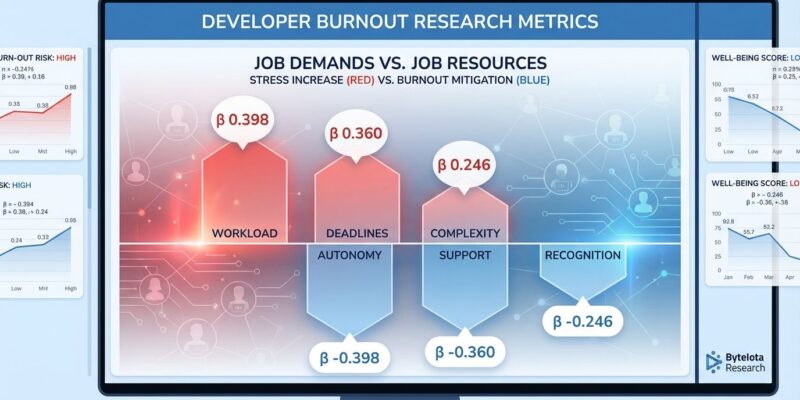
A groundbreaking research study published this month for the IEEE/ACM International Conference on Software Engineering confirms what many developers suspected: GenAI adoption is burning them out. Researchers surveyed 442 developers and used statistical modeling to prove that GenAI adoption increases burnout by elevating job demands (β=0.398, p<.001)—but job resources like autonomy and learning opportunities (β=-0.360, p<.001) significantly mitigate these effects. As 80% of enterprises race to deploy GenAI tools by 2026, the $300 billion annual cost of developer burnout now has a research-backed explanation and solution.
The Data Is Clear: GenAI Increases Burnout
The study used Partial Least Squares-Structural Equation Modeling (PLS-SEM) on 442 developers across diverse organizations to quantify relationships between GenAI adoption and burnout. Three findings stand out. First, job demands from GenAI adoption strongly increase burnout (β=0.398, p<.001). Second, job resources like autonomy and learning opportunities strongly reduce burnout (β=-0.360, p<.001). Third, positive AI perception moderately reduces burnout (β=-0.246, p<.001).
All three results are statistically significant at p<.001, meaning there's less than a 0.1% chance these patterns occurred randomly. This isn't anecdotal evidence from social media threads. It's peer-reviewed research with quantified relationships published for one of software engineering's top conferences.
The beta coefficients translate simply. A beta of 0.398 means job demands have a strong positive effect on burnout—as organizational pressure increases, burnout increases proportionally. Furthermore, a beta of -0.360 means job resources have nearly as strong an effect in the opposite direction. Autonomy and learning opportunities don’t just help a little—they’re powerful mitigators.
Why GenAI Creates Pressure
GenAI adoption creates elevated organizational pressure and workload intensification. Organizations see marketing claims that “AI makes developers 10x faster” and expect teams to deliver 10x more. More than 80% of enterprises are deploying GenAI-enabled applications by 2026, up from less than 5% in 2023. That’s a 16x increase in three years. Consequently, two-thirds of developers report increased pressure to deliver faster.
Moreover, entry-level developer jobs have declined 13-20% according to Stanford’s Digital Economy Lab. AI is automating simpler tasks, narrowing career ladders and creating job security fears. Capgemini forecasts that GenAI adoption among software engineers will reach 85% by 2026. The adoption curve is steep, the expectations are unrealistic, and the pressure is mounting.
The research describes it plainly: “Organizations are adopting GenAI at a rapid pace, and in the process escalating developer productivity expectations and job automations.” The tools themselves aren’t the problem. Instead, the organizational response—increased pressure, unrealistic timelines, fear-driven mandates—is what burns developers out.
What Actually Mitigates Burnout
The research identifies three mitigations, and the data shows they work. First, autonomy. Let developers control when and how they use AI tools. Mandating Copilot or ChatGPT for all code creates resentment. However, offering it as an opt-in tool with encouragement respects developer judgment. The research emphasizes that “autonomy reflects the degree of control developers retain over how they integrate AI tools into their work,” and it’s a well-documented factor in employee well-being.
Second, learning resources. Dedicate 10-20% of developer time to AI experimentation, training, and peer learning. Google’s famous 20% time policy led to Gmail. Developers need space to learn how AI tools actually help—not just mandates to use them faster. Additionally, hackathons, internal wikis documenting “when AI helps vs. when to skip it,” and protected deep work blocks all qualify as job resources.
Third, positive AI framing. Present AI as augmentation, not replacement. Address job security fears explicitly. Celebrate AI-assisted wins publicly. The beta coefficient of -0.246 for AI perception shows that how developers view AI tools matters for burnout. Therefore, frame AI as eliminating grunt work, not as performance surveillance tracking “percentage of AI code accepted.”
The beta coefficient for job resources (-0.360) is nearly as strong as job demands (0.398) but in the opposite direction. These mitigations aren’t nice-to-haves. They’re essential for healthy AI adoption.
The Financial Cost of Ignoring This
Developer burnout costs employers $300 billion annually through attrition and decreased productivity. Replacing a single software engineer costs $50,000 to $77,000 in direct recruitment and onboarding costs, with indirect costs reaching up to 250% of annual salary. Furthermore, 73-83% of technical employees cite burnout as a reason for leaving, and teams with high burnout show 18-20% lower productivity.
Tech turnover rates are brutal. The overall tech sector turnover rate is 13.2%, but it jumps to 21.7% for embedded software engineers. Workplace stress costs the U.S. economy $500 billion per year, and 550 million work days are lost annually to stress and burnout. The business case is straightforward: organizations can either invest in autonomy, learning resources, and positive framing now, or pay ten times more in attrition and productivity losses later.
The U.S. is projected to face a shortage of over 1.2 million software engineers by 2026. Retention is no longer optional. Organizations that adopt AI responsibly will win the talent war. Those that mandate AI without support will face a burnout crisis.
The Productivity Reality Check
Despite “10x productivity” marketing claims, actual measured results are far more modest. Businesses self-report an average 24.69% productivity increase from GenAI adoption. However, research on 39,000 developers found only a 2.1% overall productivity increase and 3.4% improvement in code quality. Software delivery performance actually declined 7.2% in some studies. Developers consistently report that GenAI “does not meaningfully change productivity across the five SPACE dimensions.”
The gap between expectation (24.69%) and reality (2.1%) explains why job demands are so high. Organizations expect dramatic gains based on marketing hype. When reality falls short, they blame developers: “You have AI tools—why aren’t you faster?” The unrealistic expectations drive the pressure that drives the burnout.
AI speeds code generation, but it doesn’t speed debugging and validation. Developers still spend time reviewing AI suggestions, fixing hallucinations, and ensuring correctness. Timelines don’t automatically shrink just because Copilot autocompletes boilerplate. In conclusion, setting honest expectations is part of healthy AI adoption.
GenAI Adoption Isn’t the Problem—How We Roll It Out Is
The research published this January provides a roadmap. GenAI adoption increases burnout by elevating job demands (β=0.398), but job resources (β=-0.360) and positive AI perception (β=-0.246) significantly mitigate these effects. The tools aren’t inherently harmful or beneficial. Indeed, the outcome depends entirely on whether organizations provide autonomy, learning resources, and supportive framing.
Companies racing to adopt GenAI without these supports are engineering a burnout crisis. The data is clear, the mitigations are known, and the business case is overwhelming. Organizations have a choice: invest in healthy AI adoption now, or pay for mass attrition later.


