 By ByteBot
Google launched “Personal Intelligence” for Gemini on January 14, connecting Gmail, Photos, Search, and YouTube to provide deeply personalized AI responses. Unlike previous assistants that retrieve individual pieces of data when asked, Gemini 3 can now “reason across your data” to surface proactive insights you didn’t explicitly request. It’s opt-in by default, available first to AI Pro and Ultra subscribers in the US, and directly challenges Apple Intelligence with a fundamentally different bet: users will trade data access for powerful results.
Cross-App Reasoning: Gemini 3’s Breakthrough
Personal Intelligence’s core capability is Gemini 3’s ability to “reason across complex sources” – connecting Gmail threads to YouTube videos watched, Search history to Photos, creating insights from relationships between your data. Previous AI assistants could retrieve individual emails or photos when directly asked. However, Gemini 3 analyzes relationships between data points across services automatically.
Google’s flagship example illustrates the power: A user needs new tires for their 2019 Honda minivan but doesn’t know the tire size. Gemini locates specs from photos or documents, suggests two options – daily driving versus all-weather – and references family road trips to Oklahoma found in Google Photos to recommend all-weather tires. The AI connected vehicle data, photos, and past behavior without being asked.
This represents the shift from reactive to proactive AI. Developers building AI-powered apps should pay attention – this is where Google’s ecosystem is heading. The Interactions API for developers launched simultaneously, signaling that these personalization capabilities will eventually come to third-party integrations.
The Privacy Trade-Off: Access vs Training
Google claims Gemini “doesn’t train directly on your Gmail inbox or Google Photos library” – but it does “reference” your data to generate responses. The distinction is murky. Consequently, your emails and photos are accessed and analyzed for every response, just allegedly not used to improve the base model. Google trains on “specific prompts and responses only after filtering or obfuscating personal data.”
Translation: Your data is read and used, just not in the way that improves the model for other users. Moreover, Google’s own privacy explanation states: “We don’t train systems to learn your license plate number, but to understand that when you ask for one, they can locate it.” That’s marketing speak obscuring reality – once enabled, Google reads your emails, photos, and browsing history for every Gemini conversation.
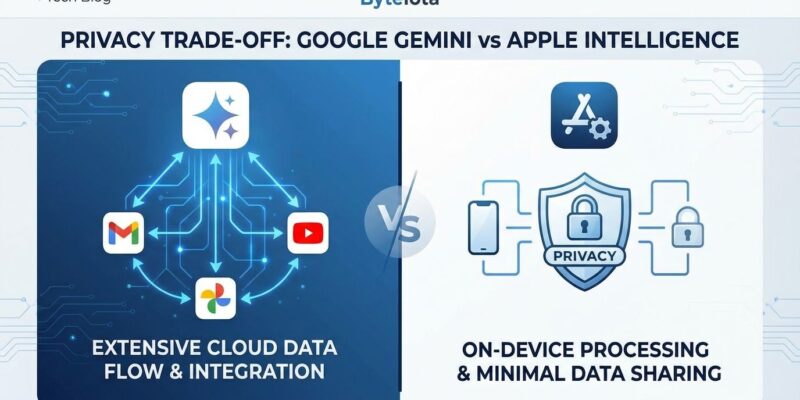
Compare this to Apple Intelligence, where most processing happens on-device, with selective cloud use only when absolutely necessary, strictly on Apple’s own hardware. Apple’s approach ensures “human-AI interactions will not be visible to anyone besides the user, not even to Apple.” In contrast, Google’s bet is opposite: users will accept cloud-based data access for deeper personalization.
The Walled Garden: Who Can’t Use Personal Intelligence
Personal Intelligence is US-only at launch, requires AI Pro ($19.99/month) or Ultra subscription, and critically: NOT available for Google Workspace accounts. That means many tech professionals, developers, and enterprise users can’t access the feature even if they pay for it. Furthermore, free tier access and international expansion are planned for “later in 2026” with no specific timeline.
The irony is stark: Many developers and tech professionals who would benefit most from personal AI use Workspace for better organization and unlimited storage. They’re locked out. Google is testing with personal accounts first, likely to avoid enterprise privacy scrutiny. Meanwhile, Apple Intelligence works across personal and enterprise iCloud accounts.
The Personal AI Arms Race
Personal Intelligence is Google’s move in the personal AI arms race. Apple launched Apple Intelligence in 2025 with tight on-device privacy and selective cloud processing. Microsoft Copilot integrates with Microsoft 365 for enterprise productivity. Additionally, OpenAI’s ChatGPT and Anthropic’s Claude remain data-agnostic, relying on user-provided context.
Every tech giant is racing to own your personal context – the one who knows you best becomes the default assistant. The philosophical split is clear: Google embraces cloud-based depth and productivity while Apple offers privacy-centric, on-device utility. Therefore, lock-in increases as AI learns your patterns. Switching costs rise when your assistant knows your entire digital history.
For developers: This signals where Google AI ecosystem is heading. Build for personalization, but understand the privacy trade-offs. The industry is forcing a choice between powerful customization and user privacy.
Key Takeaways
- Personal Intelligence is Google’s answer to Apple Intelligence – cloud-based personalization versus on-device privacy, fundamentally different philosophies
- Opt-in by default, but access is broad – once enabled, Google accesses all your Gmail, Photos, Search, and YouTube data for responses
- “Doesn’t train on your data” is marketing speak – technical distinction that obscures reality: your data is still fully accessed and read
- Limited availability reveals caution – US-only, paid tiers only, Workspace excluded. Many power users are locked out.
- This is the personal AI arms race – choose your side: Google’s convenience or Apple’s privacy. The one who knows you best becomes irreplaceable.