
 By ByteBot
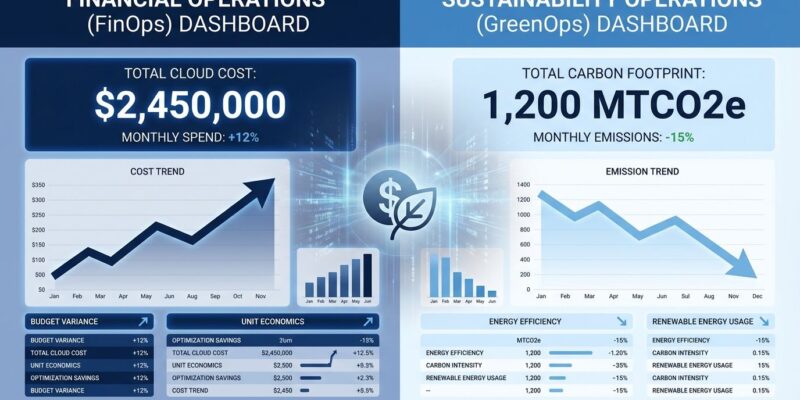
In 2026, the line between FinOps (cloud financial management) and GreenOps (cloud sustainability) has disappeared. Platform engineering tools now treat carbon tracking as inherent to cost tracking—your cloud dashboard shows both dollar costs and carbon emissions side by side. This isn’t a future trend; it’s happening now. The FinOps Foundation formalized Cloud Sustainability as an official framework capability, and tools like Greenpixie, CloudBolt, and Opencost ship with integrated carbon metrics by default.
The Business Case: Efficiency Cuts Cost AND Carbon
Cloud resource optimization delivers 25-40% cost reduction while proportionally reducing carbon emissions. When you eliminate an idle m5.xlarge instance ($1,500/year waste), you’re cutting both financial and environmental waste. This alignment creates a powerful ROI: sustainability isn’t a cost center, it’s a cost-saving strategy.
The data backs this up. Rightsizing reduces costs by 25-40% without impacting performance. Meanwhile, 49% of organizations report increased cloud spending due to Kubernetes, with 70% attributing it to overprovisioning. CloudBolt’s GreenOps initiative demonstrates this dual benefit: AI-driven Kubernetes optimization cuts both bills and emissions. As their team puts it, “Cost discipline inherently curbs emissions, positioning optimized clusters as dual wins for profitability and planet.”
This changes the sustainability conversation from “should we?” (ethical imperative) to “why haven’t we already?” (financial imperative). Engineering teams get budget approval because the ROI is immediate and measurable. Skip the moral argument—lead with the money.
The Scope 3 Problem: Cloud Emissions Are 80-97% of Your Total
For cloud consumers, ALL hyperscaler emissions fall under Scope 3 (indirect emissions from external services). These emissions represent 80-97% of total business emissions, yet most organizations overlook them. ESG reporting mandates are forcing transparency, and cloud carbon tracking has become essential for compliance.
The scale matters: data centers consume 1% of worldwide electricity and generate aviation-level emissions. Without intervention, ICT emissions could reach 10% of global emissions within a decade. Yet here’s the disconnect—92% of Fortune 500 companies use the GHG Protocol for carbon accounting, but many still ignore their cloud footprint.
You can’t manage what you don’t measure. Cloud carbon tracking isn’t optional anymore. Organizations that integrate it with FinOps dashboards gain competitive advantage in both cost management and sustainability credentials. If you’re not tracking cloud carbon, your ESG report is fiction.
Carbon-Aware Computing: Schedule Workloads for Cleaner Energy
Carbon-aware computing treats compute as a “steerable load”—instead of running workloads 24/7, you schedule them when renewable energy peaks. Temporally flexible workloads like AI model training, batch processing, and data pipelines can shift to low-carbon grid windows. California has periods of solar oversupply where clean electricity is curtailed (wasted)—run your jobs then.
Google’s Borg scheduler shows a significant fraction of jobs are temporally flexible (best-effort-batch tier). Research demonstrates 73.11% renewable energy utilization improvement through carbon-aware VM placement. Two strategies drive this: temporal shifting schedules jobs during cleaner energy times, while spatial shifting routes workloads to regions with greener grids.
This is actionable TODAY. You don’t need new infrastructure—just smarter scheduling. Start with batch jobs, model training, and data processing. The cost savings come from off-peak pricing; the carbon savings come from renewable energy alignment. It’s not either/or—it’s both.
Tools Ready Now: Greenpixie, CloudBolt, Opencost
The tool landscape has matured. 2026 platforms integrate carbon tracking by default. Greenpixie provides ISO-14064 verified hourly emissions data with usage-based carbon measurement across AWS, Azure, and GCP. CloudBolt acquired StormForge for AI-driven Kubernetes optimization that balances cost and carbon. Opencost integrated Cloud Carbon Footprint for open-source tracking.
Cloud providers offer native tools too: AWS Customer Carbon Footprint Tool, Google Cloud Carbon Footprint, and Azure Emissions Impact Dashboard. They’re free, integrated, and GHG Protocol aligned. Start there. If you need multi-cloud visibility or advanced optimization, layer in third-party platforms.
You don’t need to build this yourself. The ecosystem is ready for production use. The FinOps Foundation’s maturity model provides a roadmap: Crawl (track carbon separately), Walk (integrate some carbon metrics), Run (full cost+carbon integration). Most organizations are between Crawl and Walk in 2026. That’s fine—progress beats perfection.
Key Takeaways
Cloud costs are the #2 expense at midsize IT companies (after labor only). Cloud emissions (Scope 3) represent 80-97% of total business emissions for cloud consumers. You can’t optimize for one or the other anymore—you must optimize for both. The good news: efficiency drives BOTH goals simultaneously.
Here’s your action plan:
- Start with cloud provider native tools (AWS CCFT, Google Cloud Carbon Footprint, Azure Emissions Impact Dashboard)—they’re free and integrated
- Identify temporally flexible workloads (AI training, batch jobs, data pipelines) and implement carbon-aware scheduling
- Clean up idle resources first—one idle m5.xlarge costs $1,500/year in both financial AND carbon waste
- Rightsize aggressively—25-40% cost reduction is on the table without performance loss
- Integrate carbon metrics into existing FinOps dashboards—don’t create separate sustainability portals
The convergence of FinOps and GreenOps isn’t a trend to watch. It’s already standard practice in 2026. Your competitors are measuring both metrics. The question isn’t whether to track cloud carbon—it’s how fast you can catch up.


