 By ByteBot
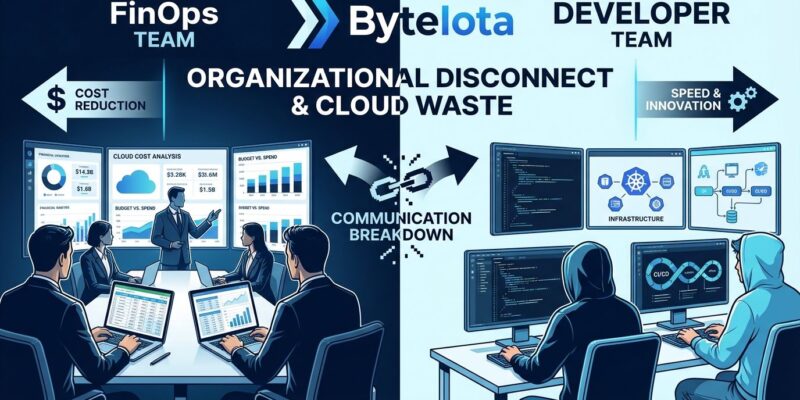
Enterprises will waste $44.5 billion on cloud infrastructure in 2025 due to one organizational problem: FinOps teams and developers don’t talk to each other. According to Harness’s “FinOps in Focus” report published this month, 52% of engineering leaders cite the FinOps-developer disconnect as the primary cause of waste. The numbers are damning: only 43% of developers can see idle resources, 39% can track orphaned resources, and 33% have access to over-provisioned workload data. The problem isn’t technology—it’s collaboration.
Developers Work Blind: The Data They Don’t Have
The Harness report reveals a visibility crisis. Only 43% of developers have access to idle resource data. Only 39% can see orphaned resources. Only 33% can view over or under-provisioned workloads. Worse, 55% of developers admit purchasing commitments are based on guesswork rather than data. This isn’t negligence—developers simply lack the tools to see costs in real-time.
The pattern repeats across thousands of teams: A developer needs to ship a feature fast, spins up a “t3.large to be safe” when t3.small would suffice. The staging environment runs 24/7 when it’s only used 40 hours per week. EBS volumes remain attached after EC2 instances are deleted. The monthly FinOps report arrives 30 days later saying “You spent $8,000 on idle resources last month.” By then, the developer has shipped three more features and forgotten the context. You can’t optimize what you can’t see.
Why FinOps and Developers Don’t Talk
The disconnect exists because FinOps teams and developers have fundamentally different goals and operate in different systems. FinOps teams are measured on cost reduction, use financial tools like spreadsheets and billing dashboards, and speak “finance language”—budgets, chargebacks, ROI. Developers are measured on shipping velocity, use engineering tools like GitHub and Kubernetes, and speak “code language”—containers, APIs, deployments.
This creates conflicting incentives: developers optimize for speed, FinOps optimizes for cost, and nobody optimizes for both. The waste cycle is predictable. Developer ships fast → resource oversized or idle → cost feedback delayed 30 days → developer moved on → FinOps creates cleanup ticket → developer context-switches → repeat next sprint. Organizational structure drives behavior. When developers are promoted for shipping features fast and penalized for slow delivery, they’ll choose speed over cost every time.
Shift Left: Cost Awareness Before Deployment
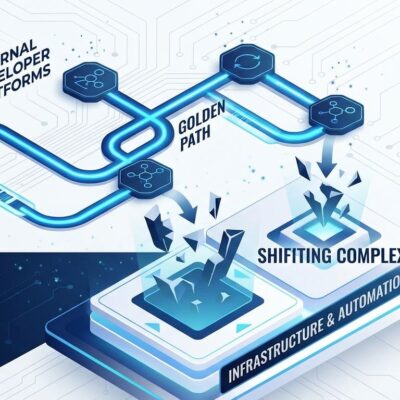
The industry is responding with “shift left” cost optimization—embedding cost awareness directly into developer workflows before deployment happens. Tools like Infracost show cost estimates in pull requests: “This PR will increase monthly costs by $450.” Moreover, platform engineering teams are building “golden paths” with cost controls baked in: pre-configured Terraform modules with sane defaults, service catalogs with cost tiers (small/medium/large), and policy-as-code that prevents spending above thresholds without approval.
The workflow looks like this: Developer writes Terraform for new infrastructure → opens pull request in GitHub → Infracost runs automatically in CI/CD → PR comment appears showing monthly cost estimate and percentage increase → team discusses whether it’s worth the money → policy check requires FinOps approval if increase exceeds $500 → cost discussion happens before deployment, not after. The parallel to security is obvious. Five years ago, security shifted from quarterly audits to automated scanning in CI/CD pipelines. Cost optimization is following the same path.
Real results back this up. IronScales reduced Kubernetes costs by 21% while cutting SLA breaches by 13% using automated pod rightsizing. Their DevOps team spent 18% less time on manual tuning. The FinOps market ($5.5 billion in 2025, growing 34.8% annually) is responding with developer-friendly tools that meet engineers where they work—in pull requests, Slack, and dashboards, not monthly PDF reports.
Automation Over Bureaucracy
The most effective solutions replace manual processes with automated policies. Instead of sending cost reports and creating cleanup tickets, successful organizations implement policy-based governance that prevents waste before it happens.
Three proven patterns work: First, auto-stopping non-production environments outside business hours. Policies auto-delete or stop dev/test resources after 5 days of inactivity. One enterprise cut non-production costs by 75%. Second, orphaned resource cleanup via AWS Lambda running daily to tag EC2 instances with under 5% CPU for 7 days, notify owners via Slack, stop instances after 48 hours without response, and terminate after 7 more days if still unused. One Microsoft customer saved $7,000 monthly just from deleting orphaned disks. Third, Kubernetes rightsizing by collecting 2 weeks of Prometheus metrics, setting pod requests at p90 usage and limits at 150% of requests, then enabling HPA and Cluster Autoscaler. Result: 21% cost reduction with fewer SLA breaches.
Automation eliminates human coordination overhead. Developers don’t attend cost review meetings. Resources clean themselves up based on policies. Costs adjust automatically based on usage. Furthermore, the FinOps team shifts from reporting to building guardrails. Reports don’t scale. Systems do.
What Developers Can Do Monday
Developers don’t need to wait for organizational FinOps initiatives. Three immediate actions help: First, request cost visibility tools integrated into existing workflows—Kubecost for Kubernetes, cost dashboards in Datadog or Grafana, Infracost for Terraform. Second, tag all resources with owner, project, environment, and auto-delete-date so orphaned resources can be tracked and cleaned up automatically. Third, use infrastructure-as-code with cost estimation to see financial impact before deploying.
The FinOps Foundation’s shared responsibility model clarifies ownership: developers own usage decisions (instance types, resource sizing, cleanup) while FinOps teams own rate optimization (Reserved Instances, Savings Plans, commitment planning). Additionally, platform teams can help by embedding cost controls in golden paths. Instead of developers choosing from 50 EC2 instance types, offer three tiers (small $50/month, medium $200/month, large $800/month) with guardrails requiring approval for anything beyond large.
The $44.5 billion waste isn’t inevitable. It’s the result of systems that separate cost from development decisions. Organizations that bring cost visibility into developer workflows, align incentives, and automate cleanup cut waste by 20-30% while maintaining delivery speed. This requires cultural change, but it starts with practical tools and shared accountability—not spreadsheets and meetings.