 By ByteBot
FinOps started as cloud cost optimization. In 2026, it’s becoming enterprise-wide technology value management. The State of FinOps 2026 report, surveying 1,192 organizations representing $83 billion in annual technology spend, reveals the discipline has fundamentally expanded its scope. The FinOps Foundation officially updated its mission from managing “value of cloud” to “value of technology.”
The buried lede: 98% of FinOps practitioners now manage AI spend—up from just 31% in 2024. That’s a 67-percentage-point increase in two years, making AI spend management the fastest technology cost adoption ever recorded. Organizations realized they couldn’t manage AI costs with cloud-only tools. The explosion of AI spending forced a complete rethinking of technology cost governance.
The Scope Explosion
FinOps teams are no longer cloud-only cost optimizers. According to the State of FinOps 2026 report, they’re managing a diverse portfolio of technology spend: 98% manage AI costs, 90% manage SaaS (up 25% year-over-year), 64% handle software licensing (up 15%), 57% oversee private cloud (up 18%), and 48% track data center costs (up 12%).
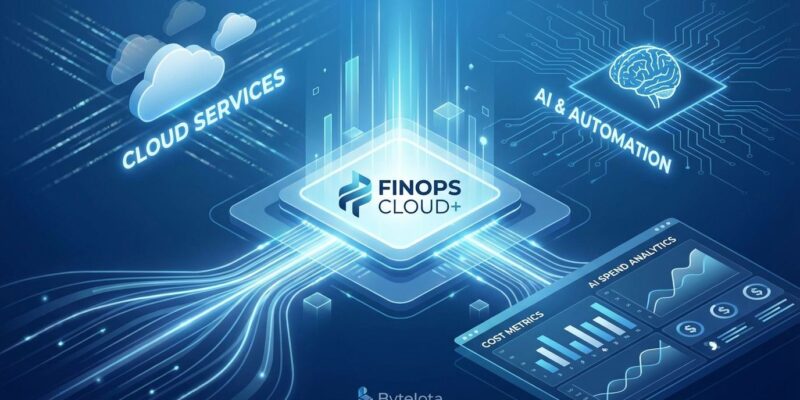
The FinOps Foundation introduced the term “FinOps Cloud+” to reflect this expansion. This isn’t a rebrand—it’s a formalization of what teams are already doing on the ground. The shift was driven by two forces: AI’s explosion into production at scale, and diminishing returns on traditional cloud optimization. Mature teams report hitting the “big rocks of waste” already, leaving only “high volume of smaller opportunities that require more effort.” As one practitioner put it: “once you fix it, it’s gone.”
AI: The Catalyst and the Crisis
AI went from experimental to production infrastructure in less than two years. That speed created a crisis. According to the State of FinOps 2026 data, AI spend management is now the top priority for the next 12 months (cited by 32.7% of teams). But visibility is a disaster: 53.4% don’t understand the full scope of their AI spending—the single biggest challenge. Another 40.1% can’t quantify AI value or ROI.
Here’s the uncomfortable truth: finance teams report an average 10% ROI from AI deployment, half the 20% target for 2026. One practitioner captured the problem bluntly: “Is your AI providing value? No one can answer that question yet.” The industry’s question shifted from “what did it cost?” to “did it produce value?”—and nobody has good answers.
The technical challenges compound the problem. AI doesn’t follow cloud economics. High-performance compute, GPU-heavy training, continuous retraining, and always-on endpoints create unpredictable usage patterns that traditional FinOps tools can’t handle. Worse, hidden costs like duplicate datasets and oversized feature stores inflate spend without improving model performance—and rarely surface in ROI conversations.
The 2027 outlook isn’t optimistic: G1000 organizations will face up to 30% rises in underestimated AI infrastructure costs due to under-forecasting and missing AI-specific expenses entirely.
From Finance to Technology Leadership
FinOps is no longer a finance function. It’s now a strategic technology capability. The data tells the story: 78% of FinOps teams now report to the CTO or CIO, up 18 percentage points since 2023. Only 8% still report to the CFO.
This matters for influence. Teams with VP/SVP/EVP/C-suite engagement show dramatically different impact compared to Director-level teams: 53% vs. 24% influence over cloud service selection, 47% vs. 16% over cloud provider selection, and 28% vs. 12% over cloud vs. data center decisions.
Organizations are professionalizing FinOps teams. The dominant model is centralized enablement (60%), followed by hub-and-spoke structures (21%) for scaling organizations. Large enterprises managing $100M+ in annual spend typically run teams of 8-10 practitioners plus 3-10 contractors.
The Payoff
The investment in structured FinOps delivers measurable outcomes. Enterprise case studies demonstrate significant savings: Capital One saved over $100 million through FinOps implementation, Siemens reduced cloud spending by 30% in just six months, Samsung saved $11 million, and McDonald’s cut $20 million in cloud expenses.
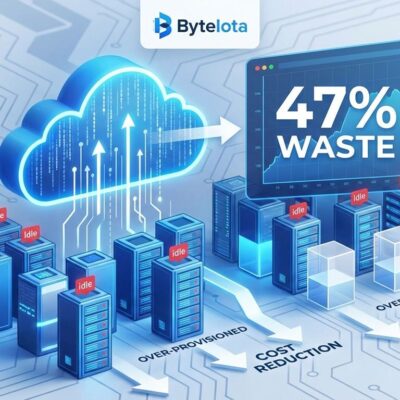
The gap between structured and unstructured approaches is stark. Organizations with FinOps programs report 25-30% reductions in monthly cloud spend. Organizations without structured cost management waste 32-40% of everything they spend. That’s not a rounding error—that’s an existential cost disadvantage.
The adoption numbers reflect this reality: 70% of large enterprises now maintain dedicated FinOps teams, and 75% will have automated FinOps by the end of 2026. Despite this growth, 72% of companies still exceeded their allocated cloud budgets in the last fiscal year, and 44% report limited visibility into their cloud expenditure even with tools in place.
The Technology Value Era
FinOps matured from reactive cost reporting to proactive value management. The FinOps Foundation’s mission change—from managing “value of cloud” to “value of technology”—signals where the discipline is headed. As AI infrastructure costs dwarf traditional cloud spend and span public cloud, SaaS, private cloud, and data centers, organizations need unified visibility across all technology investments.
The question is no longer “what did it cost?” It’s “did it produce value?” Organizations that can answer that question have a competitive advantage. Those that can’t are leaving 32-40% of their technology spend on the table.