 By ByteBot
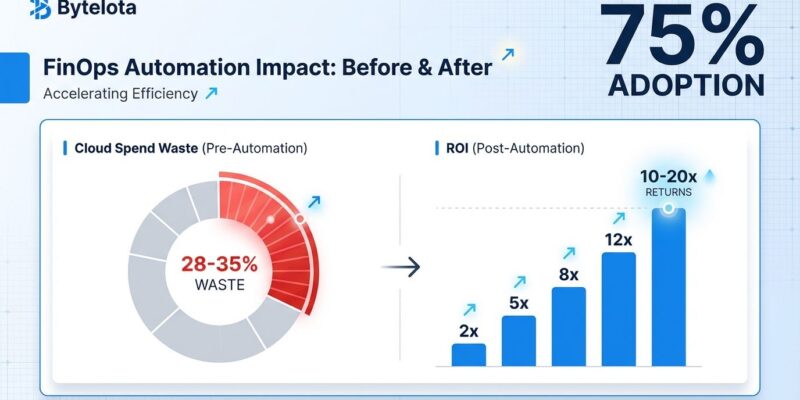
FinOps automation is reaching a critical inflection point in 2026, with 75% of enterprises projected to adopt automated cloud cost management—up from 46% growth in 2025. The driver? Compelling ROI: organizations implementing FinOps achieve 10-20x returns, slash cloud waste from an industry baseline of 28-35% down to single digits, and unlock $100 billion in potential global savings annually. But here’s the truth most vendors won’t tell you: success hinges less on technology and more on treating FinOps as a cultural shift, not a tooling project.
Cloud costs have become a board-level crisis. 48% of organizations cite rising cloud spend as their top challenge, yet most waste nearly a third of their budget on idle resources, over-provisioned compute, and orphaned storage. FinOps automation—powered by AI tools like ProsperOps and IBM Turbonomic—is finally making continuous optimization viable at enterprise scale, shifting the discipline from reactive firefighting to proactive, strategic governance.
FinOps ROI: 10-20x Returns Driving Enterprise Adoption
Capital One saved over $100 million in cloud expenses. McDonald’s cut $20 million. Siemens reduced spending by 30% in just six months. These aren’t marketing case studies—they’re documented results from enterprises implementing FinOps frameworks, and they represent why adoption is exploding.
The math is compelling: organizations using FinOps frameworks are 2.5 times more likely to meet or exceed cloud ROI expectations, with typical returns between 10-20x. One company achieved 150% ROI within the first week. A major coffeehouse chain saved $5 million annually—20% of their Azure spend—across 300 subscriptions. The pattern is consistent: 20-30% cost reductions in practice, with waste dropping from the 28-35% industry baseline to 20-25% (structured programs) or even lower (mature automation).
This ROI has elevated FinOps from “nice to have” to board-level priority. When 31% of organizations spend over $50 million annually on public cloud and 20% exceed $100 million, even a 20% reduction translates to millions recovered. The 75% enterprise adoption projection for 2026 isn’t hype—it’s the market recognizing that leaving a third of cloud spend on the table is no longer acceptable.
Cloud Waste Breakdown: Where 28-35% of Spend Disappears
Cloud waste isn’t a rounding error—it’s systemic inefficiency that compounds with every dollar of growth. The baseline sits at 28-35% across enterprises, driven by three predictable culprits: idle resources (10-15% of monthly invoices), over-provisioned compute (10-12% waste), and orphaned storage artifacts (3-6% avoidable spend). In 2022 alone, enterprises wasted $27.1 billion on idle resources and $16.2 billion on overprovisioning—$43.3 billion left on the table.
The patterns are familiar: engineers size instances one or two levels larger “to be safe,” capturing 50-75% cost savings potential. Non-production resources run 24/7 out of convenience, accounting for 44% of compute spend despite only needing a 40-hour work week. Container environments are even worse—80% of container spend goes to waste on idle cluster infrastructure and oversized workload requests. When projects end, zombie resources linger indefinitely.
Organizations with ad-hoc practices see 35-40% waste. Structured FinOps programs bring that down to 20-25%. Mature automation programs achieve 40% waste reduction. The gap between chaos and discipline is measurable, solvable, and worth millions annually.
Why 2026 Is Different: Automation as the Inflection Point
2026 marks the shift from “FinOps as manual discipline” to “FinOps as automated infrastructure.” You can’t manually optimize thousands of resources in real-time—that’s why 75% enterprise adoption hinges on automation becoming standard practice. AI-powered tools reduce waste by up to 30% through automated rate optimization, right-sizing, and anomaly detection, transforming FinOps from periodic cost reviews to continuous, proactive governance.
ProsperOps automates Reserved Instance and Savings Plan management based on real-time usage, only charging when it generates savings. IBM Turbonomic uses AI to prevent overprovisioning without manual intervention, modeling the IT environment as a marketplace where applications “bid” for resources. These tools handle the grunt work—tracking commitments, optimizing rates, right-sizing compute—freeing engineering teams to focus on usage optimization of their own environments.
Related: Davos 2026: AI Hype Ends, ROI Demands Begin
Continuous optimization and dynamic resource allocation unlock $100 billion in potential global savings annually. Predictive modeling and anomaly detection reduce overspend by 40% in mature organizations. Automated cost governance saves enterprises up to 20% annually without adding headcount. This isn’t incremental improvement—it’s a fundamental transformation of how enterprises manage cloud economics.
The Maturity Journey: Crawl, Walk, Run (But Run Isn’t the Goal)
The FinOps Foundation emphasizes something vendors won’t: “Getting to Run is not the goal.” Organizations should perform each capability at the appropriate maturity level for business value, not chase perfection across all areas. The maturity model—Crawl, Walk, Run—gives teams permission to start small and scale strategically.
Crawl means little reporting and tooling, basic KPIs, understanding current costs and allocation (35-40% waste typical). Walk brings capability understood organization-wide, automation in place, specific KPIs, and edge cases being addressed (20-25% waste). Run represents full alignment, robust model, high goals, and automation preferred (40% waste reduction achieved). The waste reduction proves the point: maturity delivers measurable value.
You don’t need enterprise-grade automation on day one. Start with standardized tagging and shared dashboards (Crawl), introduce automated right-sizing (Walk), and only invest in advanced AI-driven optimization where ROI justifies it (Run). Prioritize maturing capabilities that deliver the highest business value for your environment, not every capability across the board. This pragmatic approach prevents analysis paralysis and delivers incremental gains.
Related: Platform Engineering 80% Adoption: 70% Fail Within 18 Months
The parallels to platform engineering are stark: both require maturity-based adoption, both fail when treated as technology-first initiatives, and both succeed when aligned to business outcomes.
People Over Tools: Why FinOps Is a Cultural Challenge
McKinsey bluntly states the problem: “Most business leaders think of cloud as an ‘IT project’ and only get meaningfully involved when costs exceed $100 million annually—which is too late because the learning curve in understanding cloud’s economics is significant.” This delayed leadership involvement is one of many organizational failures that sink FinOps initiatives before they start.
The other common mistakes follow a predictable pattern: viewing FinOps as “only cost reduction” instead of value maximization, siloed teams with no cross-functional collaboration, tool-reliant approaches where teams don’t act on insights, and overly operational focus where 80% of effort goes to tagging and contract management instead of strategic programs like unit economics and forecasting. 54% of organizations lack visibility into cloud costs, 48% cite rising costs as their top challenge, yet 88% report unnecessary cloud costs. The tools exist—the problem is organizational.
ProsperOps and Turbonomic are powerful, but they’re worthless if finance, engineering, and business teams work in silos. FinOps requires genuine cross-functional collaboration: engineers own cost optimization of their environments, finance enables (not blocks) with guardrails, and executives genuinely commit beyond lip service. Organizations that recognize FinOps as a cultural transformation—not a tooling project—are the ones achieving 10-20x ROI. Technology is the enabler, not the solution.
Key Takeaways
- 75% enterprise FinOps automation adoption by 2026 represents the market recognizing that 28-35% cloud waste is no longer acceptable—documented ROI of 10-20x drives adoption, not vendor hype
- Cloud waste follows predictable patterns (idle resources, over-provisioned compute, orphaned storage) that automation solves better than periodic reviews—mature programs achieve 40% waste reduction
- The maturity journey is strategic, not perfectionist: Crawl with tagging and dashboards, Walk with automated right-sizing, Run only where business value justifies advanced AI optimization
- 2026’s inflection point is automation making continuous optimization viable at scale—tools like ProsperOps and Turbonomic handle rate optimization and right-sizing without manual intervention
- Success requires treating FinOps as cultural transformation: cross-functional collaboration (finance, engineering, business), executive commitment beyond lip service, and focus on value maximization over cost reduction alone
The organizations achieving $100 million savings didn’t buy better tools—they aligned teams around shared cloud economics and automated the operational toil. That’s the lesson 2026’s 75% adoption wave will learn: FinOps automation is powerful, but only when culture supports execution.