 By ByteBot
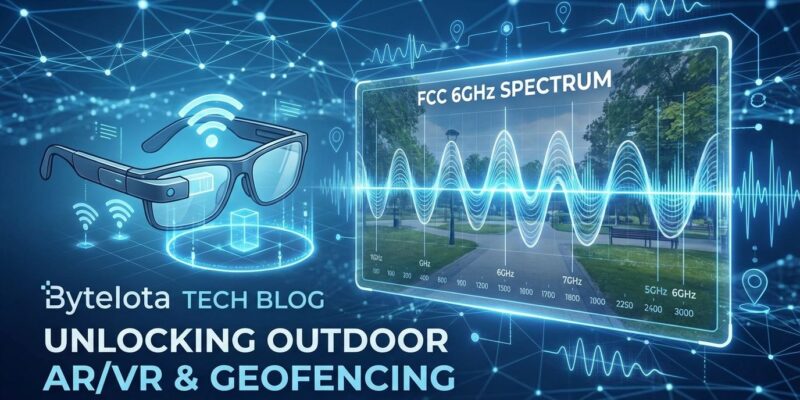
The FCC just handed AR and VR their outdoor pass. On January 7, the commission announced it will vote January 29 to create a new “Geofenced Variable Power” device category for the 6GHz spectrum band. The move allows AR/VR devices and IoT hardware to operate at 11 dBm/MHz—more than double the current 5 dBm/MHz limit for indoor-only devices—and removes the indoor-only restriction that has blocked outdoor AR experiences.
The timing isn’t coincidental. CES 2026 wrapped up the same week with AR smart glasses hitting mainstream price points and practical form factors. The FCC is removing a regulatory bottleneck just as the hardware becomes consumer-ready.
From Indoor Lockdown to Outdoor Freedom
Current Low Power Indoor (LPI) devices in the 6GHz band face tight constraints: maximum 5 dBm/MHz power spectral density, 30 dBm total power, and strictly indoor operation. Devices can’t have weather-resistant enclosures, must use integrated antennas, and can’t run on battery power in ways that enable outdoor portability.
The new GVP category breaks these limits. Devices can transmit at 11 dBm/MHz (2.2x increase) and 24 dBm total power, operate both indoors and outdoors, and support battery-powered wearables. The difference unlocks AR use cases that indoor-only regulations made impossible: fitness tracking with live stats overlays, walking tour AR guides, outdoor navigation in smart glasses, and multi-room wireless VR gaming.
| Device Class | Power Density | Location | Protection Method |
|---|---|---|---|
| LPI (Current) | 5 dBm/MHz | Indoor only | Building walls |
| GVP (New) | 11 dBm/MHz | Indoor + Outdoor | Geofencing |
| Standard Power | 23 dBm/MHz | Indoor + Outdoor | AFC database |
“Increasing the power levels for Wi-Fi connections to peripheral devices such as AR/VR is a big win for consumers,” said Michael Calabrese of New America’s Open Technology Institute.
Why Wireless AR/VR Demands More Power
The bandwidth and latency requirements for wireless VR expose why current power limits create problems. VR 360° video requires 400+ Mbps. The Meta Quest 3, with 2064×2208 pixels per eye at 90Hz, needs 7-20 Gbps of bandwidth even with compression. Latency must stay below 3 milliseconds to prevent motion sickness—Wi-Fi 6E in the 6GHz band can hit 2ms, but only with sufficient power and clean spectrum.
Limited spectrum and low power cause congestion. When available spectrum drops to 500 MHz, latency spikes over 500 percent, pushing delays past 200 milliseconds. Higher power means better range, more reliable connections, and lower latency under real-world conditions where multiple devices compete for spectrum.
The Quest 3 and Apple Vision Pro already ship with Wi-Fi 6E hardware. They’ve been waiting for regulatory changes to unlock outdoor capabilities and better wireless performance.
Geofencing: The Middle Ground
GVP devices protect incumbent licensed spectrum users—microwave links and radio astronomy facilities—through geofencing instead of the more complex Automated Frequency Coordination system required for higher-power Standard Power devices.
Access points determine their location via satellite positioning. The system calculates geographic exclusion zones using the same propagation models as AFC, then automatically reduces power or switches frequencies when operating near protected areas. Client devices operate at 6 dB below their controlling access point’s authorized power, and don’t need their own geolocation capability.
The approach is simpler than AFC’s 24-hour database queries but more sophisticated than LPI’s reliance on building walls for interference protection. It’s a regulatory middle ground that enables outdoor operation without the complexity penalty of full coordination systems.
CES 2026 Set the Stage
CES 2026 showcased the hardware readiness that makes this regulatory change timely. TCL’s RayNeo Air 4 Pro launches January 25 at $299 with HDR10 support, 1200-nit brightness, and 120Hz refresh rates. Rokid’s AI Glasses Style hit the same $299 price point with 12-hour battery life. RayNeo’s X3 Pro concept demonstrated the first eSIM-enabled AR glasses with built-in 4G connectivity. Lumus’s ZOE prototype achieved a 70-degree field of view, a significant jump in waveguide display technology.
The headline from multiple CES coverage outlets: smart glasses finally went mainstream. Affordable pricing, practical designs, and useful features replaced the experimental prototypes of previous years. The hardware is ready. LPI regulations were the obstacle blocking outdoor AR experiences.
What Happens After January 29
If the FCC approves the GVP category as expected, device certification should begin in Q2 2026. First consumer products would ship Q2-Q3, with outdoor AR experiences launching in the second half of the year. Use cases that have been theoretically possible but legally blocked—GPS navigation in smart glasses, outdoor fitness AR, tourism applications with historical overlays, industrial warehouse automation with AR picking—become viable product categories.
The vote happens in 18 days. The regulatory barrier is coming down just as consumer AR hardware crosses the threshold from prototype curiosity to practical product. The timing makes 2026 look like the inflection year for spatial computing that industry observers have been predicting for the last three years.