 By ByteBot
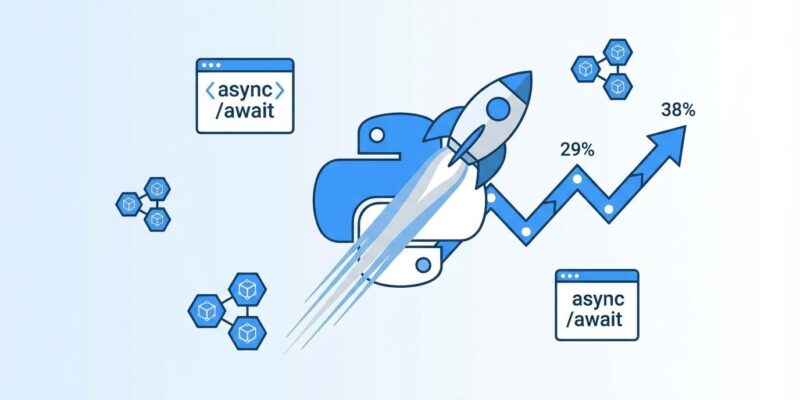
FastAPI adoption jumped from 29% to 38% in just one year. That’s a 30% year-over-year growth that makes it one of the fastest-growing Python frameworks in 2025. This isn’t hype. Stack Overflow and JetBrains surveys confirm it: developers are switching to FastAPI in droves, and for specific, technical reasons that go beyond trends.
Framework choice impacts productivity, performance, and technical debt for years. Understanding why FastAPI is winning helps you make informed decisions about your stack. Here’s why 38% of Python developers chose FastAPI, when you should use it over Django or Flask, and how to get started.
The Growth Is Real – and Driven by Three Shifts
The numbers tell the story. FastAPI reached 38% developer adoption in 2025, up from 29% in 2024, according to the JetBrains Python Developer Survey. That +5 percentage point jump makes it “one of the biggest winners in the Python web framework landscape.” It’s not just surveys – FastAPI hit 78.9k GitHub stars, surpassing Flask’s 68.4k by late 2024.
Three forces are driving this growth:
New developer demographics. Exactly 50% of Python developers have less than two years of professional experience, according to JetBrains. Many come from ML, AI, and data science backgrounds with no Flask or Django legacy. They’re choosing FastAPI first.
The AI/ML boom. FastAPI became the de facto choice for machine learning model deployment. Companies like Uber use it for high-concurrency backend systems. Over 175 companies across North America, Europe, and Asia run FastAPI in production. It integrates naturally with TensorFlow, PyTorch, and Hugging Face for async inference pipelines.
The async-native era. The industry is shifting toward async architectures for real-time apps, microservices, and event-driven systems. FastAPI was built for this world. Django and Flask weren’t.
Why Developers Choose FastAPI – 3 Technical Reasons
The growth makes sense when you look at FastAPI’s architecture. Three technical advantages separate it from WSGI frameworks.
1. Async-Native Architecture (ASGI vs WSGI)
WSGI frameworks like Flask and Django process one request per thread. The thread blocks until the request completes. This thread-per-request model limits concurrency. When your app spends time waiting – for database queries, external API calls, file I/O – WSGI wastes resources.
FastAPI runs on ASGI (Asynchronous Server Gateway Interface). It handles thousands of lightweight async tasks without thread overhead. For I/O-bound workloads, ASGI delivers “significantly higher throughput” than thread-based concurrency. Real-world impact: developers report FastAPI runs “3 times faster than Django” for I/O-heavy applications.
ASGI isn’t just faster. It scales differently. A single FastAPI instance handles far more concurrent connections than a WSGI server because async I/O doesn’t block threads while waiting for external responses.
2. Type Hints + Automatic Validation with Pydantic
FastAPI uses Python’s type hints for automatic request validation. You define Pydantic models with type annotations. FastAPI validates incoming data, converts types, and generates clear errors – all automatically.
Here’s what that looks like:
from fastapi import FastAPI
from pydantic import BaseModel

app = FastAPI()

class Item(BaseModel):
    name: str
    price: float
    is_offer: bool = False

@app.post("/items/")
async def create_item(item: Item):
    return {"item_name": item.name, "price": item.price}
FastAPI validates the JSON payload against the Item model. Invalid data returns detailed error messages. Your editor gets autocomplete and type checking. Swagger UI at /docs displays the schema automatically. Zero boilerplate.
Developers on Hacker News say “Pydantic for serialization is way nicer than Django Rest Framework.” Django’s serializers require more manual work. FastAPI’s approach feels cleaner.
3. Auto-Generated Documentation
Every FastAPI app includes built-in Swagger UI and ReDoc. No manual work. The docs generate from your code and type hints. Developers can test endpoints directly from /docs in the browser.
This speeds up prototyping, keeps docs in sync with code, and improves onboarding. One developer reported they “built a complex backend in 12 days with a 2-person team” using FastAPI. The auto-docs helped them move fast.
FastAPI vs Django vs Flask: When to Use Each
FastAPI isn’t always the right choice. Here’s when to use each framework.
Choose FastAPI When:
You’re building APIs, microservices, or AI/ML services. You need high performance, async I/O, or real-time features. You’re deploying machine learning models or starting greenfield projects with a modern stack. Your team is comfortable with async programming.
Pros: Best-in-class performance (on par with NodeJS and Go). Async-native, type-safe, great developer experience. Lightweight with fast startup times.
Cons: Younger ecosystem with fewer third-party extensions. No batteries included – you need to add your own auth, admin, and ORM. Learning curve for async programming and type hints.
Choose Django When:
You’re building full-stack monoliths, content management systems, or admin-heavy applications. You need batteries included: ORM, admin panel, and authentication out of the box. You’re working on enterprise-grade applications with complex business logic and prefer Django’s opinionated structure.
Pros: Mature, stable, comprehensive ecosystem. Built-in ORM, admin, and authentication. Strong for relational data and complex queries.
Cons: WSGI-based with slower async support. Heavier footprint and slower startup. Overkill for simple APIs.
Choose Flask When:
You’re building simple APIs, prototypes, or learning projects. You need maximum flexibility or you’re migrating legacy systems gradually.
Pros: Lightweight, flexible, and mature. Easy to learn with minimal magic. Good for small to medium projects.
Cons: Less structure means more manual work. Not async-native, so performance lags behind FastAPI. Fewer built-in features compared to Django.
The 2025 consensus from developers: “FastAPI wins in performance and modern developer experience, Django REST for enterprise, Flask for flexibility but lags in async and scaling.”
Getting Started with FastAPI
Here’s a minimal FastAPI app:
# Install FastAPI and Uvicorn (ASGI server)
pip install fastapi uvicorn

# main.py - Basic endpoint
from fastapi import FastAPI

app = FastAPI()

@app.get("/")
async def read_root():
    return {"message": "Hello, FastAPI!"}

# Run server
uvicorn main:app --reload
Visit http://localhost:8000 to see the response. Visit http://localhost:8000/docs for interactive Swagger UI.
For production, run FastAPI with Gunicorn and multiple Uvicorn workers:
gunicorn main:app --workers 4 --worker-class uvicorn.workers.UvicornWorker --bind 0.0.0.0:8000
Deploy with Docker and Kubernetes for scalability. The official FastAPI documentation includes full-stack templates with Docker Compose, PostgreSQL, and CI/CD.
Migrating from Flask or Django
Switching from Flask to FastAPI is straightforward. The routing syntax is similar (decorator-based). Testing is nearly identical. Replace requests with httpx for async HTTP calls. For gradual migration, use WSGIMiddleware to run Flask alongside FastAPI.
Moving from Django requires more work. You’ll switch from Django REST Framework serializers to Pydantic models. FastAPI is lighter weight – no built-in ORM or admin panel. But developers on Hacker News say it “works great for a quick and dirty API server.”
Check out TestDriven.io’s migration guide and Real Python’s FastAPI tutorial for detailed walkthroughs. The Awesome FastAPI repo lists ecosystem tools, extensions, and resources.
The Async-Native Future
FastAPI’s 38% adoption reflects a broader industry shift. Async-native architectures are becoming the standard for APIs, microservices, and real-time applications. For AI apps and ML deployments, FastAPI is becoming the default – and for good reason.
Choose your framework based on your use case, not hype. If you’re building modern APIs, need high performance, or deploying machine learning models, FastAPI makes sense. If you’re building a full-stack monolith with Django’s batteries, stick with Django. If you need Flask’s flexibility for a small project, that’s fine too.
But the numbers don’t lie. 38% of Python developers chose FastAPI. The async-native era is here.