
 By ByteBot
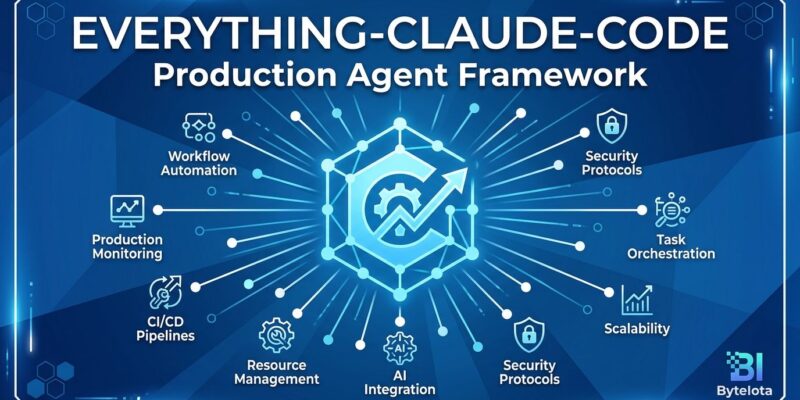
Everything-Claude-Code—a production agent harness built at the February 2026 Anthropic/Cerebral Valley Hackathon—gained 3,735 GitHub stars in a single day (March 22, 2026). The framework transforms Claude Code, Cursor, and Codex from suggestion engines into orchestrated development systems with 28 specialized agents, 116 skills, 59 commands, and security scanning backed by 1,282 tests and 98% coverage. What 86% of organizations already know became obvious to developers this week: AI coding tools need more than autocomplete.
Most developers use GitHub Copilot like advanced tab completion, lacking infrastructure for production workflows—orchestration, security gates, testing automation, and memory persistence. Everything-Claude-Code delivers what enterprises need: auditable agent workflows with mandatory security checkpoints and continuous learning from past sessions. Doctolib reported 40% faster feature shipping after full team adoption. The difference between prompting and production is infrastructure.
What Makes Everything-Claude-Code Different: Production Infrastructure, Not Prompting Templates
This isn’t configuration templates—it’s a complete production ecosystem with five architectural layers. Agents (28 specialists including code-reviewer, security-scanner, and test-generator) handle specific responsibilities with defined inputs, outputs, and success criteria. Skills (116 reusable workflows) cover Django, Next.js, Go, and Rust patterns that agents invoke to accomplish tasks. Commands (59 slash tools like /tdd and /security-scan) trigger specific agent workflows with language-specific variants for Python, Go, and TypeScript.
The architecture goes deeper with Hooks (automated triggers for memory persistence and context optimization) and Memory (JSON-based context tracking preferences, writing styles, and learned patterns across sessions with confidence scores). Together, these layers enable what GitHub Copilot and bare Claude Code don’t provide: infrastructure for real software development, not just code suggestions.
Anthropic demonstrated production viability by using 16 Claude Opus 4.6 agents to build a Rust-based C compiler from scratch—agents worked in parallel on a shared repository, coordinating changes to produce a compiler capable of building the Linux 6.9 kernel. With 150+ GitHub App installations, 747 commits, and 30+ contributors across six languages, this framework moved past experimental status months ago.
Real Numbers from Enterprise Deployments: 40% Faster Shipping, Zero Security Incidents
86% of organizations deploy agents for production code in 2026, with 57% running multi-stage workflows across teams. Doctolib rolled out Claude Code with this framework across their entire engineering team, replacing legacy testing infrastructure in hours instead of weeks and achieving 40% faster feature shipping. The shift from “autocomplete” to “agent orchestration” produces measurable results: companies report cutting project timelines from several months to just weeks.
Security-first design shows real value through AgentShield integration running 102 security rules via the /security-scan command. The system catches vulnerabilities before deployment by scanning for secrets (14 detection patterns covering API keys, tokens, and credentials), performing permission auditing, analyzing hook injection risks, and profiling MCP server configurations. Mandatory security gates prevent deployments with vulnerabilities—the framework claims zero security incidents across 10+ months of production use.
These aren’t marketing claims. 40% faster shipping, hours-to-weeks infrastructure replacement, and documented security results demonstrate production readiness beyond the hype cycle most AI coding tools never escape.
How to Get Started: From Installation to Your First Agent Workflow
Installation takes two minutes via plugin marketplace, with selective language support that prevents bloat. Installing only TypeScript, Python, and Go instead of all six languages keeps CLAUDE.md under the critical 2000-token threshold where Claude starts ignoring rules. The framework auto-detects package managers through priority-based selection: environment variable, project config, package.json field, lock file detection, then global config fallback.
# Plugin marketplace install (2 minutes)
/plugin marketplace add affaan-m/everything-claude-code
/plugin install everything-claude-code@everything-claude-code

# Selective language install (avoid bloat)
./install.sh typescript python golang

# First agent workflow
/plan "Build user authentication with JWT"
# System decomposes → Frontend agent → Backend agent → Security scan → Tests
The /plan command decomposes your feature request into subtasks, delegating to specialized agents (frontend for React components, backend for API endpoints, security for vulnerability scanning, testing for E2E validation). Your first workflow demonstrates the core value: orchestrated, auditable development instead of prompt-and-pray coding.
Production Lessons: What 10+ Months of Commercial Development Taught Us
Practitioners learned critical lessons through real-world use. Keep agent teams to 3-4 specialists maximum—more agents create coordination overhead that eats productivity gains faster than parallel execution provides them. Maintain CLAUDE.md under 2000 tokens or Claude ignores half your rules because important guidelines get lost in noise. Use business-goal prompts instead of technical specifications: explain what users need and why, letting agents figure out implementation details like senior engineers do.
Enable hooks selectively via ECC_HOOK_PROFILE settings (minimal for fast iterations, strict for production builds) and leverage language-specific agents like /python-review that understand Python idioms better than generic /code-review can. The best practices guide makes the constraint explicit: “Claude’s context window fills up fast, and performance degrades as it fills. If your CLAUDE.md is too long, Claude ignores half of it.”
Developers report combining Cursor for daily coding and tab completions with Everything-Claude-Code agents for complex refactoring and orchestrated workflows. This combination covers the full spectrum from quick edits to autonomous multi-file work. The smart money isn’t on choosing one tool—it’s on knowing which tool fits which task.
The Broader Trend: Agent Orchestration Is Eating AI Coding
Everything-Claude-Code represents part of a broader trend where agent harnesses become standard practice, not experimental tools. Competitors include DeerFlow 2.0 (ByteDance’s #1 GitHub trending repository on February 28, 2026, offering general-purpose agent harness with LangGraph/LangChain architecture) and TradingAgents (domain-specific framework for financial trading with seven specialized roles). The industry shifts from “autocomplete tools” to “agent orchestration” to “autonomous development” as 57% of organizations run multi-stage workflows and 16% operate cross-functional processes across teams.
Claude Code achieved something remarkable: zero to #1 AI coding tool in eight months with a 46% “most loved” rating among developers, surpassing GitHub Copilot in complex tasks. The comparison analysis explains why: “Claude Code produces the most architecturally sound code for complex tasks—when asked to design a system, it thinks through edge cases, error handling, and maintainability like working with a senior engineer.” This architectural advantage multiplies when combined with agent orchestration frameworks that coordinate multiple specialists.
Developers who learn agent orchestration now gain advantage as the industry standardizes on multi-agent workflows. Five years from now, “AI coding without agent orchestration” will sound like “web development without version control” sounds today—technically possible but professionally questionable.
Key Takeaways
- Everything-Claude-Code delivers production infrastructure (28 agents, 116 skills, security scanning) beyond basic autocomplete, transforming AI coding tools into orchestrated development systems
- Enterprise deployments show measurable results: 40% faster feature shipping at Doctolib, hours-to-weeks infrastructure replacement, zero security incidents with 102 automated rules
- Two-minute install with selective language support; limit to 3-4 agents maximum to avoid coordination overhead eating productivity gains
- Best practices from 10+ months of production use: keep CLAUDE.md under 2000 tokens, use business-goal prompts, leverage language-specific agents, combine tools strategically
- Agent orchestration becomes standard practice as 86% of organizations deploy agents for production code—learning this now provides advantage as the industry standardizes multi-agent workflows
Explore the GitHub repository to examine production templates for Next.js, Go, Django, and Rust applications, or review the coding agents analysis for broader industry trends in agent-based development.


