 By ByteBot
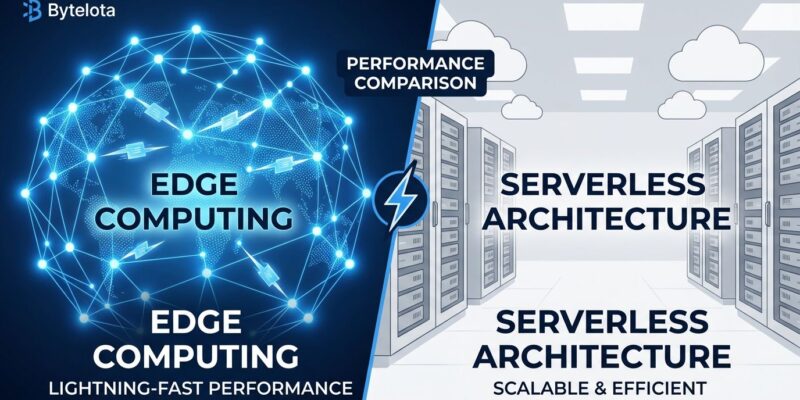
The cold start debate is over, and edge functions have won the performance battle. With Cloudflare Workers achieving sub-5ms cold starts and running 210% faster than AWS Lambda@Edge, the question isn’t if you should use edge functions, but when. Yet traditional serverless isn’t dead—it’s evolving into a complementary architecture. Here’s what the latest 2025 benchmarks reveal.
The Performance Gap is Undeniable
Edge functions are 9 times faster during cold starts, with platforms like Cloudflare Workers initializing in under 5 milliseconds versus 100ms to over a second for AWS Lambda. For warm executions, edge maintains a 2x advantage—real-world Vercel tests show 167ms for edge versus 287ms for serverless.
What makes edge compelling is geographic consistency. Traditional serverless suffers from regional latency—users far from your deployment region wait longer. Edge functions eliminate this by executing at the nearest CDN point of presence, delivering similar latency worldwide.
Cloudflare’s “Shard and Conquer” innovation achieved a 99.99% warm start rate through intelligent traffic coalescing. The result? Cloudflare Workers now run 210% faster than AWS Lambda@Edge and 298% faster than standard Lambda.
AWS Just Made Cold Starts a Cost Problem
In August 2025, AWS began billing for the Lambda INIT phase—the cold start initialization period. For functions with heavy startup logic, this change can increase Lambda spend by 10-50%. Cold starts are no longer just a performance annoyance; they’re hitting your wallet.
At 10 million requests per month, Cloudflare Workers cost roughly $5, while AWS Lambda@Edge runs about $17—a 70% difference. Lambda@Edge charges $0.60 per million requests with no free tier.
Add optimization opportunities—ARM64 processors offer 20% cost savings, and Lambda Power Tuning can cut compute costs by 75%—and the economics become critical. If your serverless functions have frequent cold starts, you’re now paying twice.
Use Case Determines the Winner
Neither architecture is universally superior. The right choice depends on what you’re building.
Edge Functions Excel At
Authentication and authorization. Validating requests at the nearest edge location means faster sign-ins globally. No round-trip to a distant data center for JWT verification.
A/B testing and feature flags. Route users to different experiences based on location or device—all at edge speed with minimal latency.
API gateway and middleware. Request transformation, header manipulation, and rate limiting are natural edge use cases. Handle these at the perimeter before requests reach your origin.
AI at the edge. The 2025 trend: edge-optimized AI inference with platforms like Vercel pushing AI gateways closer to users for real-time personalization.
Traditional Serverless Wins For
Heavy computation. Data processing, image manipulation, complex algorithms requiring significant CPU and memory—these workloads need traditional serverless resources.
Deep cloud integrations. Direct VPC access, database connections to RDS or DynamoDB, AWS service orchestration—Lambda excels for tight cloud ecosystem integration.
Large dependencies. Full Node.js API access, TCP/UDP connections, native binaries—if your code needs these, edge runtimes won’t cut it.
The Hybrid Approach
Modern applications increasingly use both, not either/or. Edge functions handle initial request processing—auth, routing, personalization—while traditional serverless manages heavy computation. This captures edge performance benefits without sacrificing serverless capabilities.
Developer Experience Trade-offs
Edge functions offer simpler deployment with frameworks like Next.js, SvelteKit, and Nuxt providing native support. Vercel’s 2025 improvements include type-safe configuration and enhanced logging through OpenTelemetry.
The trade-off? Runtime constraints. Edge environments use lean runtimes without full Node.js support. Vercel limits request sizes to 1MB and function bundles to 4MB. No TCP/UDP connections.
Here’s the contrarian take: these constraints are features, not bugs. They force leaner, more modular code. When you can’t load massive dependencies, you think harder about architecture.
The Edge-First Future
The paradigm shift happened quietly in late 2024 and throughout 2025. Vercel and Netlify led the transformation from regional serverless to edge-first architecture, where code executes at CDN points of presence by default.
Platform maturity validates this shift. Cloudflare’s 99.99% warm start rate and sub-5ms cold starts represent enterprise-grade reliability. AI at the edge emerged as a legitimate use case, not just buzzword.
By 2026, edge will be the default, not the exception.
Your Decision Framework
Start with edge functions for routing, authentication, and personalization. The performance and cost benefits are too significant to ignore. Add traditional serverless when you need heavy computation, deep cloud integrations, or capabilities beyond edge runtime constraints.
If you’re building a global application with authentication, you’re leaving performance and money on the table by not using edge functions. If you’re processing large datasets or orchestrating AWS services, Lambda remains the right tool.
Most importantly: stop treating this as a binary choice. The winning architecture in 2025 leverages both, deploying each where it provides the most value.