 By ByteBot
eBay updated its user agreement on January 20, 2026, explicitly banning AI shopping agents—including “buy-for-me agents, LLM-driven bots, or any end-to-end flow that attempts to place orders without human review” unless the company grants specific authorization. The policy, effective immediately for new users and February 20 for existing accounts, targets autonomous AI systems like Amazon’s Buy for Me that complete purchases without platform approval. This isn’t about user safety or experience. It’s about protecting eBay’s commission-based revenue model from AI agents optimized to find deals at minimum prices.
Why eBay is Blocking AI Agents: Follow the Money
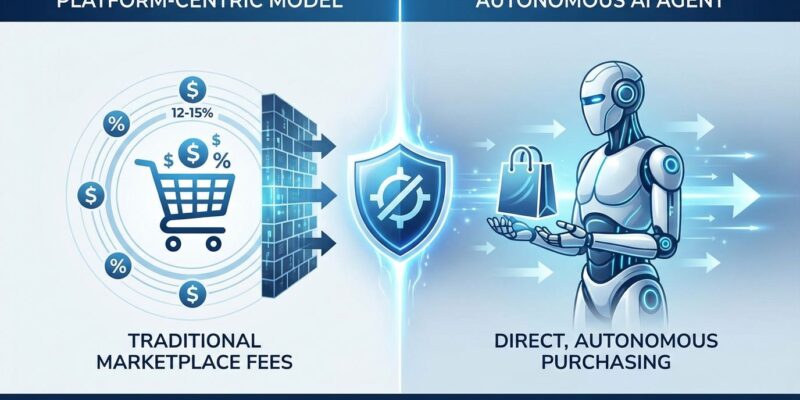
eBay charges sellers a variable “final value fee” based on sale prices—typically 12-15% of the total transaction plus a $0.30-$0.40 per-order charge. Most categories take a 13.6% cut, with books and media hitting 15.3%. These fees are calculated on the item price plus shipping and other charges, meaning every dollar a buyer saves through AI-driven deal-hunting is a dollar eBay loses in commission.
AI shopping bots are designed to win auctions at minimum bid and find the lowest available prices. When an autonomous agent swoops in to snag an item for less, eBay’s revenue takes a direct hit. Moreover, the platform built its business on facilitating transactions and taking a percentage. AI agents threaten to turn eBay into a commodity backend while another platform—say, Amazon—captures the customer relationship and transaction value.
Amazon’s Buy for Me: The Real Target
Amazon launched Buy for Me in April 2025, and it’s exactly the kind of AI agent eBay fears most. The tool lets customers purchase items from third-party brand websites without ever leaving Amazon’s app. Users search within Amazon, tap a “Buy for Me” button, and Amazon’s AI—powered by Nova and Anthropic’s Claude models—completes the entire transaction on the brand’s site using the customer’s encrypted payment data.
Here’s the threat from eBay’s perspective: Amazon captures the shopping experience, the customer data, and the relationship—while the actual sale happens on a competitor’s platform. eBay becomes a fulfillment backend. Furthermore, Amazon currently takes no commission on Buy for Me purchases, but that’s irrelevant. Amazon isn’t interested in eBay’s 15% fee; it wants to own the shopping interface itself.
Buy for Me exemplifies agentic AI in commerce—autonomous systems that act on behalf of users with minimal input. It’s the future Amazon is building, and eBay is trying to wall off.
Selective Enforcement Reveals the Strategy
eBay didn’t just update its user agreement. In fall 2025, it modified its robots.txt file to block AI crawlers from Perplexity, Anthropic, and Amazon. However, there’s a notable exception: Google’s shopping bot gets full access.
This reveals eBay’s real strategy. The company isn’t anti-AI on principle—it’s anti-AI that captures transaction value. Google Shopping drives traffic TO eBay by showing comparison results that lead to eBay listings. Meanwhile, Amazon Buy for Me keeps users AWAY from eBay by handling transactions within Amazon’s ecosystem. Perplexity’s in-chat shopping with PayPal integration? Same threat—purchases happen without eBay seeing a commission.
The Google exception proves this isn’t about protecting users from automated purchases. It’s about protecting revenue from automated bypassing. Traffic-generating AI is welcome. Revenue-threatening AI gets blocked.
The Beginning of Platform vs AI Agent Wars
eBay is the first major e-commerce platform to explicitly ban AI purchase agents, but it won’t be the last. The data points to an inevitable collision: shopping searches on AI platforms jumped 4,700% between 2024 and 2025, while AI-driven e-commerce traffic surged 693% during the 2025 holiday season compared to 2024. Forrester predicts that one in four shoppers will use retail chatbots in 2026.
Consumers want AI agents to handle shopping research, comparison, and transactions. Platforms want to protect their commission-based business models. Consequently, there’s no middle ground here—platforms will either ban AI agents to preserve revenue or embrace them to stay relevant.
Expect marketplace platforms like Etsy, Poshmark, and Mercari to follow eBay’s lead with similar bans in 2026. Meanwhile, OpenAI is taking the opposite approach: partnering directly with retailers like Target, Instacart, and DoorDash to enable in-chat purchasing through ChatGPT. That’s the cooperation model—work with platforms, not around them.
What This Means for Developers Building AI Shopping Tools
If you’re building AI shopping agents, eBay’s ban makes the scraping-and-automating approach legally and practically untenable. The days of autonomous bots crawling e-commerce sites and completing purchases without platform approval are ending. Additionally, platforms are adding explicit bans to user agreements, blocking crawlers via robots.txt, and building technical enforcement at the server level.
The viable path forward is partnership, not circumvention. OpenAI’s deals with Target and Instacart show the model: negotiate access, integrate via official APIs when available, and provide value that platforms can’t ignore (like traffic or enhanced discovery). Alternatively, focus on AI-friendly platforms that welcome autonomous agents rather than fighting hostile ones.
Developers who ignore this shift will build products that get banned, blocked, or hit with legal action. Indeed, eBay’s policy isn’t an outlier—it’s a preview of what’s coming across e-commerce in 2026.