
 By ByteBot
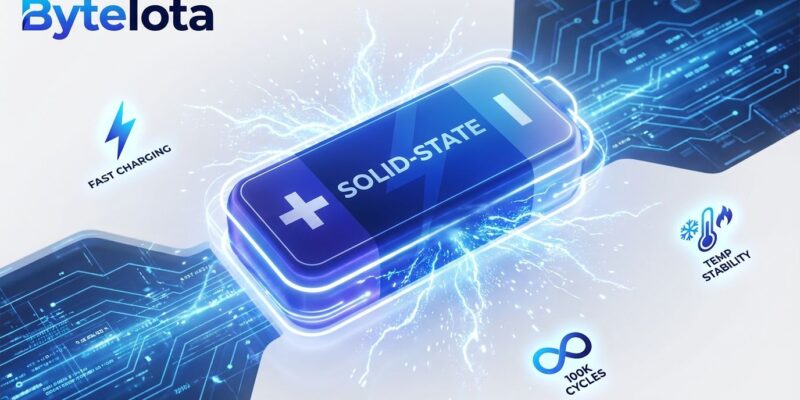
Donut Lab announced this week at CES 2026 that it has the world’s first production-ready solid-state battery, shipping in Verge Motorcycles by March 31, 2026. The Finnish startup’s timeline puts them 1-2 years ahead of Toyota, BMW, and QuantumScape—all of whom have billions in R&D and a decade of development behind them. The specs read like an EV fantasy: 400 Wh/kg energy density, 5-minute full charge, and 100,000 cycle lifespan. This is either the biggest EV battery breakthrough in decades, or another bold CES claim that fades into obscurity.
We’ll know by March 31. That’s 82 days away.
The Holy Grail Specs (That Seem Too Good to Be True)
Solid-state batteries are the EV industry’s holy grail—safer, faster-charging, and longer-lasting than lithium-ion. The challenge is that most prototypes struggle to optimize even ONE of these metrics. Donut Lab claims to nail all three simultaneously.
Their numbers: 400 Wh/kg energy density (compare to Tesla’s ~260 Wh/kg lithium-ion), 5-minute full charge at 200 kW (versus 30+ minutes for Superchargers), and 100,000 charge cycles that retain 99% capacity from -22°F to 212°F. For context, lithium-ion batteries degrade after 1,000-2,000 cycles and lose 20-40% capacity in extreme cold. If these specs hold up in production, it’s not incremental improvement—it’s a generational leap.
The technology eliminates lithium-ion’s three main pain points: range anxiety, long charging times, and battery degradation. That’s why every major automaker is racing to ship solid-state batteries. The problem is, nobody has done it yet. Solid-state battery technology replaces flammable liquid electrolytes with solid materials, enabling higher energy density and safer operation.
Solid-State Production Timeline: Donut Lab vs Industry Giants
Donut Lab’s Q1 2026 timeline beats the entire automotive industry to market. Toyota, with 10+ years of solid-state R&D and billions invested, targets 2027-2028. Factorial Energy, backed by Mercedes and Stellantis, aims for 2027 with 375 Wh/kg and 18-minute charging. QuantumScape, which received $260 million from VW’s PowerCo, is looking at 2028 or later despite achieving 844 Wh/L energy density in prototype Ducati race bikes.
Donut Lab is a small Finnish startup fully owned by Verge Motorcycles, run by brothers Marko and Tuomo Lehtimäki. They’re not a Silicon Valley unicorn with billions in funding. They’re not a global automaker with decades of battery expertise. And yet, if their March 31 deadline holds, they’ll have beaten Toyota to solid-state battery production by 12-24 months.
That timeline gap raises an obvious question: If a Finnish startup can achieve this, why can’t Toyota with its $250 billion market cap and 10+ years of R&D? Either Donut Lab found a breakthrough approach that eluded the giants, or they’re making claims their production line can’t support.
Healthy Skepticism (and CES Vaporware History)
Solid-state batteries have been “5 years away” for the past 15 years. CES hosts battery breakthroughs every year, most of which never make it past the prototype stage. Journalists covering the announcement are cautiously optimistic at best. Electrek’s headline reads “Verge unveils 370-mile electric motorcycle with solid state battery; sounds too good to be true?” That question mark is doing heavy lifting.
The tech community is watching closely with familiar skepticism. Hacker News discussions praise the impressive specs but question scalability beyond 350 bikes. The core concern isn’t whether Donut Lab built a functioning prototype—it’s whether they can manufacture it reliably at even small scale. There’s a massive gap between “test bikes running for months” and “350 production vehicles shipped to paying customers.”
CES has earned its vaporware reputation. Moreover, bold claims announced in January often turn into “manufacturing challenges” by summer and “revised timelines” by the following year. Battery startups in particular have a pattern of announcing extraordinary specs that never materialize in customer hands.
The March 31 Test: Verge Motorcycles EV Production
Here’s what makes this different: the deadline is verifiable and imminent. Verge Motorcycles will ship 350 bikes in Q1 2026—175 to Europe, 175 to California. CEO Marko Lehtimäki claims “these batteries are real, in production vehicles” and that Donut Lab waited to announce “until the technology was fully tested, validated, and already operating in vehicles.”
Starting with motorcycles is strategically sound. Verge’s TS Pro needs only 20-33 kWh battery packs versus 60-100+ kWh for cars, making manufacturing more manageable at small scale. Donut Lab already supplies the in-wheel Donut Motor to Verge, so the business relationship and integration expertise exist. The brothers’ companies can coordinate faster than partnerships with major automakers navigating bureaucratic approval processes.
By April 2026, we’ll have answers. Either 350 bikes shipped with batteries that charge in 5 minutes and deliver 370-mile range, or they didn’t. Either the specs hold up in Minnesota winters and Arizona summers, or they don’t. There’s no wiggle room for delays or excuses. March 31 forces accountability.
Stakes Are High for the EV Battery Breakthrough
If Donut Lab delivers, the EV industry timeline collapses. Lithium-ion manufacturers face obsolescence. Every automaker will scramble to license or acquire the technology. Toyota’s “first to market” 2027 narrative becomes “two years late.” Range anxiety ends if charging takes 5 minutes instead of 30. Charging infrastructure pressure eases if vehicles spend less time plugged in.
If they fail, it’s another CES vaporware story that increases investor skepticism for all solid-state startups. The “solid-state is always 5 years away” narrative continues. Established players’ timelines remain the credible benchmarks. The hype cycle spins on.
Either outcome is significant. A small, agile company beating global giants validates the startup model and vertical integration strategy. Failure reinforces that battery development at scale requires the resources of Toyota and Mercedes, not a Finnish motorcycle manufacturer.
Show us the bikes by March 31. Until then, cautious skepticism is warranted—but so is close attention. This deadline is worth watching.








[…] Donut Lab Solid-State Battery: Q1 2026 or CES Vaporware? […]