 By ByteBot
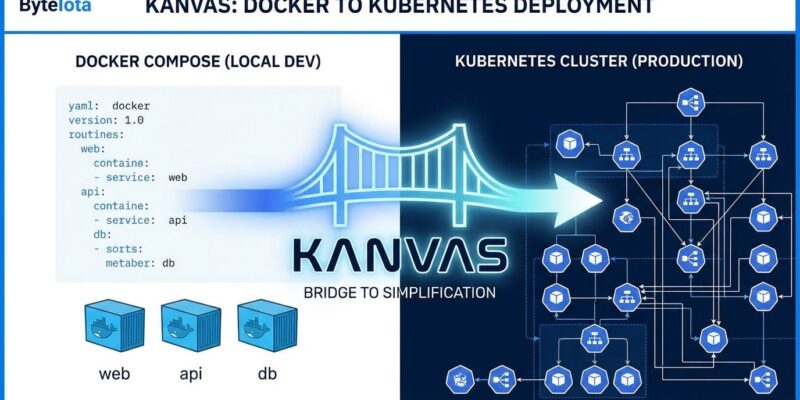
Docker launched Kanvas on January 6, 2026, a platform that automates the conversion of Docker Compose files into Kubernetes deployment artifacts, directly challenging Helm and Kustomize. Developed with Layer5, Kanvas introduces “Infrastructure as Design”—a visual, collaborative approach to managing cloud-native deployments using the familiar Docker Compose syntax developers already know. While 93% of organizations use Kubernetes, operational complexity causes 80% of incidents. Kanvas aims to bridge the dev-to-prod gap that slows teams down.
The Problem Kanvas Tries to Solve
Developers use Docker Compose for local development because it’s simple and familiar. Production requires Kubernetes manifests with complex YAML configurations. Manual conversion is time-consuming, error-prone, and demands deep Kubernetes expertise most dev teams lack.
Helm and Kustomize solve this through templating and patching, but their steep learning curves create barriers. According to recent industry analysis, “newcomers face not only Kubernetes’ learning curve but Helm’s own syntax and quirks.” Teams spend days mastering Helm’s Go templating or Kustomize’s overlay system when they just want to deploy apps.
Kanvas eliminates manual conversion by automatically generating Kubernetes manifests, Terraform, and Pulumi IaC from Compose files. If it delivers on this promise, it could dramatically lower the Kubernetes adoption barrier for teams already comfortable with Compose.
Infrastructure as Design: Kanvas’s Visual Approach
Kanvas introduces two integrated modes that separate design from operations. Designer Mode provides a visual “blueprint studio” with drag-and-drop components—1000+ versioned Kubernetes resources, 55+ AWS services, 50+ Azure components, and 60+ GCP services. Teams can visually design infrastructure, validate configurations, and collaborate in real-time.
Operator Mode transforms static diagrams into live, managed infrastructure. Deploy designs, monitor with real-time logs and metrics, analyze traffic, access container terminals—all from the same interface. The platform bills itself as “Google Workspace for DevOps,” enabling multiple team members to edit infrastructure designs simultaneously.
Visualization isn’t just aesthetics—it’s cognitive leverage. Understanding service dependencies and data flows in YAML files is brutally difficult, especially during incident response. Architecture diagrams make complex systems comprehensible faster. For onboarding new engineers or debugging production issues, visual tools cut troubleshooting time significantly. The collaborative features address the multi-stakeholder problem: ops, security, and platform teams can review designs before deployment.
Docker’s Comeback—Or Too Late to Matter?
Docker lost the container orchestration wars to Kubernetes years ago. Kanvas represents a strategic pivot: instead of competing with Kubernetes, Docker positions itself as the easiest on-ramp to the K8s ecosystem. By leveraging its Docker Compose legacy and Docker Desktop install base, Docker aims to become the default bridge between local development and cloud production.
The timing is deliberate. In 2026, Kubernetes complexity drives teams toward alternatives—Nomad, Docker Swarm, and PaaS platforms see renewed interest as teams flee K8s operational overhead. Industry analysts report that “as the industry continues to move towards platform engineering, tools that abstract infrastructure complexity are becoming increasingly vital.”
The question is whether Docker is too late. If teams are already abandoning Kubernetes entirely, simplifying K8s deployment might be solving yesterday’s problem. But if Kubernetes remains table stakes for cloud-native development—as 93% adoption suggests—making it accessible to Compose-familiar developers could be Docker’s comeback play. It’s a bet that teams want better tools around Kubernetes, not alternatives to it.
Does Simplification Solve Complexity or Just Hide It?
Every tool added to the Kubernetes ecosystem claims to “simplify” complexity, but abstraction layers hide critical details and create new dependencies. Kanvas adds a visual layer, a conversion engine, and Docker Desktop dependency on top of an already-complex stack: Compose → Kanvas → Kubernetes → Cloud. The risk is teams become dependent on Kanvas without understanding what’s actually deployed.
Docker Compose wasn’t designed for production orchestration. Advanced Kubernetes features—StatefulSets, Custom Resource Definitions, Operators—don’t map cleanly to Compose syntax. Teams will still manually configure these in Kanvas, limiting the “automated” promise. And Docker Desktop as a requirement means Kanvas isn’t viable for headless CI/CD servers, restricting it to design and planning phases rather than full deployment automation.
The Kubernetes ecosystem already suffers from tool sprawl. Helm, Kustomize, Tilt, Skaffold, Okteto, Garden—each solves a piece of the puzzle but adds cognitive overhead. If Kanvas empowers teams without hiding critical details, it’s valuable. If it becomes another black box that breaks mysteriously, it’s just complexity in a different form.
Where Kanvas Fits Among Helm and Kustomize
Helm dominates with 75% adoption, offering package management, reusable charts, and dependency management. Its strength is the chart repository—thousands of pre-built application packages. Kustomize is Kubernetes-native (built into kubectl), using patches and overlays instead of templating. Its strength is simplicity: plain YAML, no new syntax to learn.
Kanvas differentiates with visual design and Compose familiarity but competes against established, proven tools with large ecosystems. For teams already proficient in Helm, the switching cost is high. For teams starting fresh or stuck in Compose-land, Kanvas offers an attractive alternative.
Tool choice depends on team maturity and use case. Helm for package management, Kustomize for environment-specific patches, Kanvas for visual design and dev-to-prod transitions. Smart teams might use all three: Kanvas for design, Helm for deployment, Kustomize for environment tweaks. The ecosystem is becoming less “one tool to rule them all” and more “pick the right tool for each job.”
Key Takeaways
- Docker Kanvas launched January 6, 2026, automating Docker Compose to Kubernetes conversion with visual design and multi-cloud IaC generation.
- It targets the dev-to-prod gap, solving the painful transition from familiar Compose syntax to complex Kubernetes manifests.
- Visual collaboration is the differentiator, not just automation—Designer and Operator modes enable team alignment and faster debugging.
- Timing raises questions: Is Docker’s Kubernetes simplification play a comeback or too late as teams abandon K8s entirely?
- Abstraction risks remain: Kanvas simplifies conversion but doesn’t eliminate Kubernetes complexity—teams still need K8s expertise for advanced features and troubleshooting.