
 By ByteBot
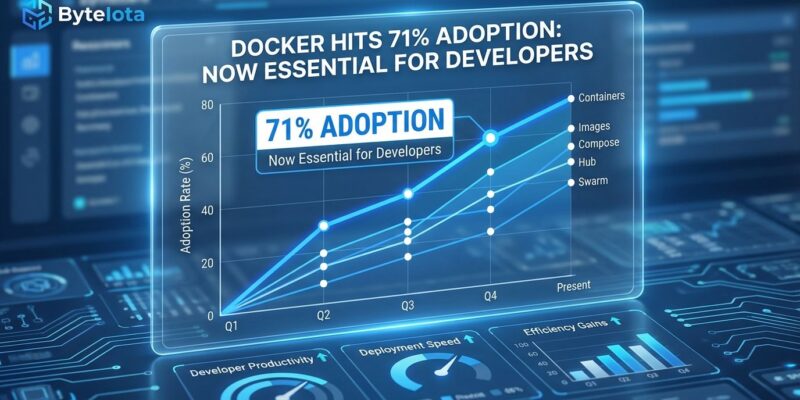
Docker’s adoption jumped 17 percentage points to reach 71.1% in the 2025 Stack Overflow Developer Survey—the largest single-year increase of any technology surveyed across 314 technologies and 49,000+ developers from 177 countries. This isn’t gradual growth. It’s the inflection point where Docker crossed from “popular tool” to “essential developer infrastructure.”
The numbers tell a stark story: Docker now surpasses npm (57%) and AWS (43%), making it more universal than major cloud platforms. Professional developers hit 73.8% adoption, while developers using AI tools reached 75%. The +17 point jump (from 54% in 2024) represents the fastest technology adoption acceleration in Stack Overflow survey history—and it affects hiring requirements, developer salaries, and career prospects.
The Unprecedented Jump
No other technology surveyed—not AI tools, not cloud platforms, not programming languages—saw this level of year-over-year growth. The Stack Overflow 2025 Developer Survey explicitly notes Docker’s transition “from a popular tool to a near-universal one.” The data backs this up across every developer segment: professionals (73.8%), AI tool users (75%), even developers learning to code (52.5%).
Docker’s #1 ranking in the cloud development category reveals something deeper. Developers adopted Docker faster than they adopted AWS, the dominant cloud platform. This suggests Docker solved a more urgent, universal problem than cloud migration—and that problem became critical in 2025.
The implications are clear: Docker knowledge is no longer specialized DevOps expertise. It’s baseline developer competency, assumed in the same way Git knowledge is assumed.
Three Trends Converged in 2025
Docker’s surge wasn’t sudden—it reflects three infrastructure trends reaching critical mass simultaneously. First, microservices architecture matured, with 68% of IT organizations now running microservice-based systems (versus 31% in other industries). Microservices require container isolation—there’s no alternative path that scales.
Second, CI/CD pipelines became universal, and reproducible builds became mandatory. Popular CI/CD tools—GitHub Actions (40%), GitLab (39%), Jenkins (36%)—all integrate deeply with Docker. Teams can’t ship reliable software without containers providing environment consistency across dev, test, and production.
Third, remote work fundamentally changed development workflows. The 2025 Docker State of Application Development report revealed 64% of developers now use non-local environments as their primary dev setup, up from 36% in 2024. Distributed teams need identical environments regardless of local machines—Docker provides that standardization.
These three trends explain why 2025 was the inflection point. Companies can’t do microservices without containers, can’t do reliable CI/CD without reproducible builds, and can’t support distributed teams without environment parity. Docker went from solving one problem (“works on my machine”) to enabling three critical infrastructure patterns.
Supporting evidence: Container usage in the IT industry jumped from 80% in 2024 to 92% in 2025. That’s not incremental adoption—that’s the technology becoming mandatory.
Career Implications: Table Stakes, Not Optional
The career impact is stark. Companies now pay 25% higher salaries for Docker-proficient developers compared to those without container experience. Docker knowledge shifted from specialized DevOps skill to baseline developer expectation—hiring managers assume competency rather than asking about it.
Onboarding data reveals why this matters. 71% of executive buyers report new developer onboarding takes at least two months. Docker standardization reduces this to days or weeks—new hires run docker-compose up instead of manually installing dependencies, databases, and services. Independent research found Docker Desktop users achieve 50% faster build times and reclaim 10-40+ hours per developer monthly.
For developers, this creates career barriers. Not knowing Docker means struggling to contribute to modern codebases that assume container competency. Job postings now list Docker alongside Git and programming languages—it’s not a “nice-to-have” skill anymore. It’s a requirement.
The shift mirrors Git’s evolution. In 2010, Git was a specialized tool progressive teams used. By 2015, it was universal. Docker just made that same transition—and developers without container experience now face the same disadvantage as developers who didn’t learn version control.
The Docker-Kubernetes Symbiotic Ecosystem
Docker’s 71% adoption runs parallel to Kubernetes’ enterprise dominance—96% of enterprises use Kubernetes, with 76% of developers having personal K8s experience. These aren’t competing technologies. They’re symbiotic infrastructure: Docker creates containers, Kubernetes orchestrates them at scale.
Understanding this relationship clarifies Docker’s role in cloud-native development. Learning Docker isn’t the endpoint—it’s the foundation for Kubernetes competency, which leads to cloud platform expertise (AWS ECS, Azure AKS, Google GKE). It’s the first step in modern infrastructure skill progression, and skipping it creates compounding knowledge gaps.
The industry consensus reinforces this: “Docker and Kubernetes use in development and production environments is expected to continue to rise as the technology and ecosystem mature.” Docker adoption accelerates Kubernetes adoption, which drives cloud-native architecture adoption. The flywheel effect is clear in the data.
Key Takeaways
- Docker’s +17 point jump is unprecedented: Largest single-year increase in Stack Overflow survey history across 314 technologies—no other tech (AI tools, cloud platforms, languages) saw this acceleration
- Three infrastructure trends converged: Microservices maturity (68% of IT orgs), CI/CD ubiquity, and remote work standardization (64% non-local dev environments) all require Docker
- Career impact is immediate: 25% salary premium for Docker-skilled developers, assumed baseline competency in hiring, and critical for onboarding speed (71% of orgs report 2+ month onboarding without standardization)
- Docker + Kubernetes = cloud-native foundation: 96% enterprise K8s adoption shows symbiotic relationship—Docker creates containers, K8s orchestrates them, together they enable modern infrastructure


