 By ByteBot
Disney invested $1 billion in OpenAI on December 11, 2025, licensing 200+ characters—Mickey Mouse, Marvel heroes, Star Wars—for Sora AI video generation. The same day, Disney sent a cease-and-desist letter to Google for AI copyright infringement “on a massive scale.” This isn’t about protecting intellectual property. It’s about who pays.
The Deal: What Disney Gets, What Users Get
Disney’s $1 billion equity investment in OpenAI includes warrants for additional equity and a three-year licensing agreement. Starting early 2026, Sora users can generate short-form AI videos featuring more than 200 Disney, Marvel, Pixar, and Star Wars characters. The official announcement names Mickey Mouse, Cinderella, Iron Man, and Darth Vader among the licensed characters.
Moreover, Disney+ will stream selected user-generated videos, and Disney becomes a major OpenAI API customer—deploying ChatGPT for employees and building new AI-powered products. The deal excludes talent likenesses and voices, with a joint steering committee monitoring for brand violations. Users generate content, but Disney retains copyright on all outputs.
The Hypocrisy: Sue Google, Partner with OpenAI—Same Day
Disney’s 2025 copyright war timeline exposes the double standard. In June, Disney and Universal sued Midjourney for copyright infringement, seeking over $20 million in damages for 150+ allegedly infringed works. Disney called Midjourney a “virtual vending machine generating endless unauthorized copies.”
Furthermore, in September, Disney sued Chinese AI firm MiniMax for “large-scale piracy” and sent a cease-and-desist to Character.AI. Then December 11 happened. Disney announced the $1 billion OpenAI partnership. The same day—not a coincidence—Disney sent Google a cease-and-desist letter claiming copyright infringement to train AI models. Apparently, piracy is only piracy when you don’t pay licensing fees.
Writers Guild Calls Out the Contradiction
The Writers Guild of America didn’t mince words. WGA said Disney’s deal “appears to sanction” OpenAI’s “theft of our work,” adding that “companies including OpenAI have stolen vast libraries of works owned by the studios and created by WGA members and Hollywood labor to train their artificial intelligence systems.”
However, Disney gets $1 billion while the writers who created the scripts, dialogue, and stories behind those characters get nothing. SAG-AFTRA is “closely monitoring” the deal after securing AI protections in 2025 contracts, but the fundamental issue remains: corporations profit from licensing while creators who built the IP are excluded.
Iger’s Bet: Creativity Is the New Productivity
Bob Iger’s business calculus is pragmatic. “We’ve always viewed technological advances as opportunity, not threat,” Iger told CNBC on December 11. “We’d rather participate than be disrupted by it.” His new philosophy: “Creativity is the new productivity.”
Additionally, Disney already runs internal AI tools—”DisneyGPT” for IT support and project management, plus “Jarvis,” an agentic AI in development. The Sora deal targets younger audiences by turning Disney+ into a “portal to all things Disney,” including games, commerce, and user-generated AI content. Iger made a smart bet. Nevertheless, the problem isn’t his strategy—it’s the system it exposes.
Two-Tier Copyright: Pay to Play, Sue to Block
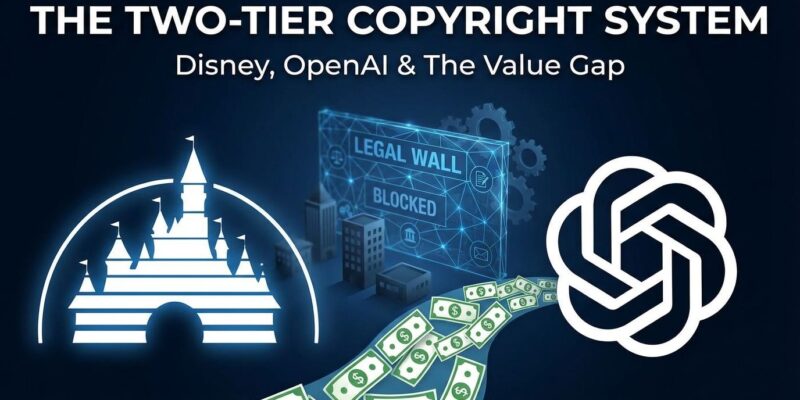
Disney’s 2025 actions reveal the two-tier copyright system now governing AI. Tier 1 companies like OpenAI pay licensing fees and get IP access. Tier 2 companies like Midjourney, MiniMax, and Character.AI get sued and face $150,000 per work in damages.
Furthermore, the Copyright Office ruled in January 2025 that human authorship is essential—meaning users making Sora videos with Disney characters don’t own the output. Disney does. Fair use doesn’t exist if you can’t afford billion-dollar licensing deals.
For developers building AI tools, the message is clear: content licensing costs are now a barrier to entry. Consequently, enterprise APIs become the only viable path for character use. Small AI startups can’t compete without deep pockets. Google gets sued. OpenAI gets licensed. What changed? Who pays.
What This Means for Developers
Disney’s OpenAI deal isn’t a partnership—it’s a business model. Media companies will license IP to AI platforms that can afford it and sue those that can’t. Hollywood’s copyright war ends with consolidation: big AI companies pay, small ones get crushed, and indie developers are priced out entirely.
In conclusion, the deal launches early 2026 when Sora users can generate videos with Disney characters. Other studios are watching. If Disney’s model succeeds, expect licensing deals with Google Veo and Runway next. Copyright is now pay-to-play. Fair use is dead for everyone except those who can write nine-figure checks.