
 By ByteBot
The developer productivity industry is booming. Gartner predicts 80% of large software organizations will have platform engineering teams by the end of 2026, each costing an average of $600,000 annually. Companies are hiring DevProd specialists at a ratio of 1 for every 20 engineers. The investment is massive and accelerating.
Yet 29.6% of these platform teams don’t measure any success metrics at all, according to the 2026 Platform Engineering Maturity Report. Worse, 66% of developers don’t believe the metrics that do exist reflect their actual contributions, per DX Research’s 2025 survey. The industry is spending billions on productivity improvements while flying blind on whether they work. At mid-scale—20 clusters, 200 apps—platform team labor costs accumulate to over $780,000 by year three. Without measurement, companies have no idea if they’re getting value or lighting money on fire.
The Measurement Gap Isn’t an Edge Case—It’s the Industry Standard
Platform engineering is reaching critical mass, but measurement maturity is failing catastrophically. Only 13.1% of organizations achieve optimized, cross-functional platform ecosystems, while 45.5% operate reactive, budgeted teams without strategic measurement. The minimum platform team costs $600,000 per year—three senior engineers at $200K each—and that figure climbs past $780,000 by year three at mid-scale.
This isn’t a small oversight. It’s a systemic industry failure at scale. Billions of dollars are being invested in productivity improvements with no accountability, no proof of ROI, and no way to determine what works. Companies are making $600K+ annual bets with zero data on whether previous bets paid off. That’s not strategic investment—that’s hope-based budgeting.
Developers Don’t Trust the Metrics That Do Exist
Even when companies measure productivity, developers reject the metrics as invalid. The 2025 DX Research survey found 66% of developers don’t believe current metrics reflect their contributions. Atlassian’s 2025 research confirmed that most leaders admit their metrics are inefficient at measuring developer productivity. When survey response rates drop below 80%, it indicates fundamental trust problems. The main challenge: developers don’t believe responses will be used constructively.
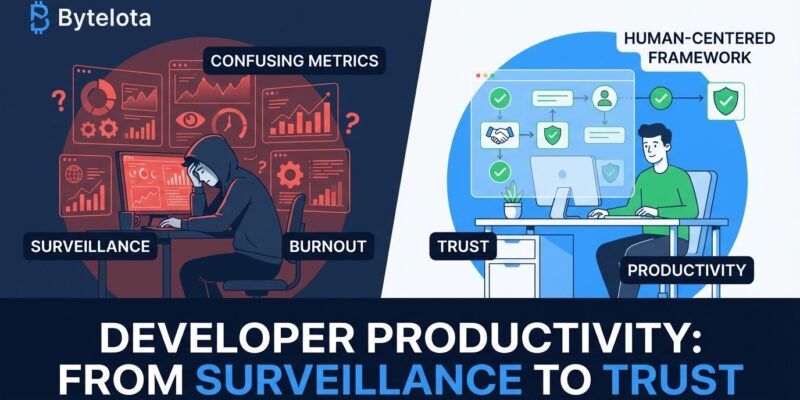
The real problem is that current metrics measure activity—lines of code, pull requests, commits—rather than outcomes like business value, quality, or impact. Developers know their actual contribution isn’t captured, so they stop caring about the metrics. This creates a vicious cycle: bad metrics lead to developer mistrust, which drives gaming or disengagement, producing worse outcomes, prompting leadership to double down on surveillance metrics, deepening mistrust further.
The business impact is severe. 97% of developers lose significant time to inefficiencies, with 69% losing 8+ hours per week—20% of their time. When 63% of developers consider developer experience important for job retention and two out of three consider leaving when dissatisfied, the cost of broken measurement extends far beyond wasted platform budgets. It’s driving attrition.
DORA Metrics Break Down in the AI Era
The most popular measurement framework—DORA metrics—has fundamental limitations that AI code generation exposes brutally. DORA metrics are too high-level to be actionable, oversimplify complex work, don’t account for context, encourage speed over quality, and can’t explain why values change. They have infrastructure blind spots, assuming infrastructure is always ready when needed.
The AI era of 2026 makes these problems worse. Deployment frequency climbs artificially because AI writes code faster, not because systems improved. Lead time drops but doesn’t reflect better processes. LinearB’s 2026 benchmarks show AI pull requests wait 4.6 times longer before review and have an acceptance rate of 32.7%, compared to 84.4% for manual PRs. When 84% of developers use or plan to use AI tools, the most popular measurement framework can’t handle the reality of how code is actually being written.
The question nobody can answer: When AI writes the code, what are you measuring? Developer skill? AI capability? Human judgment in directing AI? The framework breaks down. DORA added a fifth metric in 2025—rework rate, measuring unplanned fixes to production—to address speed-over-quality problems, but it doesn’t solve AI measurement challenges.
We’re Measuring 51% of What Matters and Ignoring 62%
There’s a fundamental mismatch between what matters to developers and what metrics capture. JetBrains’ 2025 State of Developer Ecosystem survey found that 62% of developers prioritize non-technical factors—internal collaboration quality, clear communication, project clarity, psychological safety, work-life balance, and autonomy. Only 51% prioritize technical factors like tool quality, fast build cycles, low cognitive load, and effective debugging.
Non-technical factors matter more than technical factors. Yet we measure almost exclusively the technical: deployment frequency, lead time, build times. We’re measuring 51% of what matters and ignoring 62%. You can’t improve what you don’t measure. If collaboration, clarity, and trust matter more than deployment speed, but we only measure deployment speed, we’re optimizing the wrong thing.
The unmeasured factors have measurable ROI. Each 1-point improvement in the Developer Experience Index—which does measure collaboration, clarity, and obstacles—saves 13 minutes per developer per week. At 100 developers, that’s $100,000 annually. We’re leaving that value on the table by measuring the wrong things.
What Actually Works: Proven Alternatives with ROI
Several frameworks successfully address DORA’s limitations and measure what developers actually value. The DX Core 4 framework from Developer Experience Research measures four dimensions: Speed, Effectiveness, Quality, and Business Impact. It combines quantitative metrics with qualitative surveys, and developers trust it because it measures obstacles they actually face. The proven ROI: 1-point DXI improvement equals 13 minutes per week saved, or $100,000 per year per 100 developers.
The SPACE framework from GitHub and Microsoft Research covers five dimensions: Satisfaction, Performance, Activity, Communication, and Efficiency. It explicitly emphasizes that no single dimension is sufficient and that Activity is the least important dimension alone. It integrates developer wellbeing and collaboration alongside delivery metrics.
The Unit Economics approach from FinOps measures cost per deployment, cost per feature shipped, and cost per team, environment, or service. This creates a common language between Engineering, Finance, and Business, allowing engineers to see the financial impact of their architectural decisions and tying engineering work directly to business value.
Martin Fowler’s Humans Over Metrics framework emphasizes outcomes over activity, measuring systems rather than individuals through developer self-report surveys, regular retrospectives, and qualitative assessment alongside quantitative data. The guiding principle across all successful frameworks: measure systems, not individuals; measure outcomes, not activity; combine quantitative with qualitative; and act on feedback to build trust.
When measured properly, platform teams deliver results. Organizations using internal developer platforms report 40% faster updates and operational overhead cut nearly in half. 81% of GitOps adopters report higher infrastructure reliability. These gains are real—but only when you measure the right things and act on the data.
Flying Blind at $780,000 Per Team
The industry is at 80% platform engineering adoption but sub-30% measurement maturity. Companies are investing $600,000 per year minimum—$780,000 by year three at mid-scale—with 29.6% measuring nothing and 66% of developers mistrusting the metrics that do exist. That’s not a sustainable model.
The path forward requires measuring systems instead of running surveillance, focusing on outcomes instead of activity, combining quantitative metrics with qualitative feedback, and acting visibly on that feedback to rebuild trust. Alternative frameworks with proven ROI exist: DX Core 4 delivers $100,000 per year per 100 developers for each 1-point improvement. SPACE integrates satisfaction and collaboration with performance. Unit economics ties engineering decisions to business value.
The question every engineering leader funding a platform team should answer: Can you prove your $600,000 annual investment delivers value? If the answer is no, you’re not alone—71% of the industry can’t either. But that’s not a reason to continue flying blind. It’s a reason to fix measurement before the next budget cycle asks harder questions.


