 By ByteBot
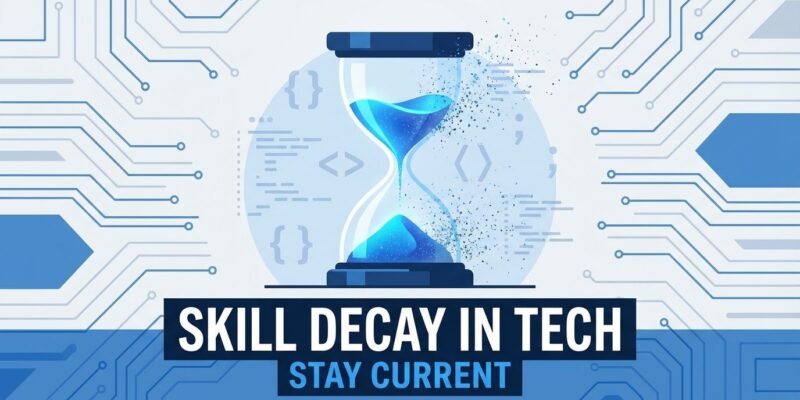
McKinsey and General Catalyst executives declared this week that the era of “learn once, work forever” is over. They are not exaggerating. Developer skills now have a half-life of just 2.5 years, down from 10 years in the 1990s. MIT research confirms that technical knowledge loses 50 percent of its value in that timeframe. This means the React expertise you earned in 2023 is half as valuable in 2026. The framework you mastered 18 months ago is already obsolete. The continuous learning crisis is not a future problem. It is happening now.
The Exponential Collapse
The skill decay is not linear. It is exponential. In the 1990s, a developer could learn C++ and use it productively for 15 years. The language syntax, standard library, and best practices remained stable. By the 2010s, that window had shrunk to 5 years as mobile platforms (iOS, Android) and cloud architectures demanded new skills. Today, the half-life is 2.5 years and dropping. An IEEE survey found that 73 percent of developers say skills from 3 years ago are somewhat obsolete.
The difference between 1990s stability and 2026 churn is stark. In the 1990s, you learned C++ once. In the 2010s, React paradigm shifted from classes to hooks to server components in 5 years. In 2026, build tools are replaced every 12 months. Webpack dominated from 2015 to 2020. Vite replaced it in 18 months. Now Turbopack, Rspack, and Farm compete for the same space. Developers are learning tools that are deprecated before they master them.
The collapse is not a natural evolution. It is driven by forces external to technical necessity. AI tools like GitHub Copilot lower the learning barrier, making framework adoption faster. Venture capital incentivizes novelty over stability. Startups launch frameworks to differentiate (Vercel creates Next.js, Shopify pushes Remix). Hype cycles amplify on Twitter and at conferences. The result is a fragmented ecosystem where best practices change every 18 months.
Which Skills Decay Fastest
Not all skills decay equally. Frameworks die fast. Fundamentals live forever. This is the most important strategic insight for developers navigating the churn.
Frontend frameworks have the shortest half-life: 6 to 18 months. React hooks became standard in 2019. Server Components were introduced in 2023. Next.js App Router followed in 2024. Each shift required relearning core patterns. CSS methodologies follow fashion cycles. BEM gave way to CSS-in-JS, then Tailwind became dominant, now Atomic CSS frameworks are rising. State management libraries churn even faster. Redux dominated, then Context API, then Recoil, Zustand, Jotai. Build tools replace each other annually.
Languages decay more slowly but still steadily. JavaScript evolves from ES6 to ES2023 with incremental but constant changes. Cloud platforms like AWS launch thousands of new features annually, requiring continuous upskilling. Backend frameworks like Express, Fastify, and Hono compete on a 2 to 4 year replacement cycle.
Fundamentals, however, decay slowly. Computer science fundamentals like algorithms and data structures are timeless. Systems concepts like memory management, concurrency, and networking evolve gradually over decades. Problem-solving skills such as debugging, system design, and trade-off analysis transfer across technologies. Core protocols like HTTP and TCP/IP have remained stable for decades. The decay rate difference is extreme. Fundamentals decay 5 to 10 times slower than frameworks.
The implication is clear. Developers who master fundamentals deeply and learn frameworks shallowly adapt faster than framework specialists. As one r/ExperiencedDevs commenter put it: If you know HTTP well, you can learn any web framework in 2 weeks. Framework expertise has diminishing returns in a high-churn environment.
The AI Paradox
AI tools create a paradox. They simultaneously accelerate and mitigate skill decay.
On one hand, AI accelerates decay. GitHub Copilot and ChatGPT lower the learning barrier for new frameworks. A developer can write code in an unfamiliar stack with AI assistance, making framework switching easier. Easier switching means faster adoption cycles. Faster adoption means frameworks compete more aggressively. The result is shorter framework lifecycles. AI tools are making your skills obsolete faster while claiming to help you keep up.
On the other hand, AI mitigates decay. Developers no longer need to memorize syntax or API documentation. GitHub Copilot autocompletes implementation details. ChatGPT provides just-in-time usage examples. The shift is from knowing how to write code to knowing when to use a technology and why. Memorization becomes less valuable. Conceptual understanding becomes more valuable.
The net effect favors generalists over specialists. A developer with broad conceptual knowledge across multiple paradigms can use AI to execute in any of them. A developer with deep expertise in a single framework loses that advantage as AI democratizes that knowledge. The new skill hierarchy is understanding trade-offs, not memorizing APIs.
The Economic Reality
Continuous learning is not optional. It is mandatory economic self-defense. Stack Overflow data shows developers who invest in continuous learning earn 15 to 25 percent more than those who do not. The math is clear.
The investment required is substantial. Developers spend 4 to 6 hours per week on learning according to Stack Overflow 2025 survey. That is 200 to 300 hours annually. Add courses, conferences, and books, and the financial cost is $1,700 to $4,000 per year. The opportunity cost is personal time: evenings and weekends.
The return on investment justifies it. A developer earning $120,000 who invests 5 hours weekly in learning will earn $150,000 after 3 years, a $30,000 salary increase for 900 hours of effort. That is a $33 per hour return. Continuous learners are also 3 times less likely to be laid off and experience 2 times faster career progression.
But the psychological cost is real. IEEE data shows 45 percent of developers report learning fatigue. 38 percent feel constant pressure to learn causes stress. 27 percent have quit jobs due to tech stack churn burnout. The learning requirement is economically rational but psychologically unsustainable. The industry is heading toward a breaking point.
Sustainable Strategies
Three strategies can help developers survive the crisis without burning out.
First, adopt T-shaped skills. Go deep on fundamentals and shallow on frameworks. Master JavaScript fundamentals, web performance, and accessibility. These skills transfer across frameworks. Stay surface-level familiar with React, Vue, Svelte, and Angular. When a project requires one, use AI tools to fill syntax gaps. Depth in fundamentals plus breadth across frameworks is more sustainable than framework specialization.
Second, choose boring tech. Mature, stable technologies change slowly. React is established. PostgreSQL is stable. Node.js is mature. Contrast that with Svelte 5, SurrealDB, and Deno. The bleeding edge requires constant relearning. The boring edge is productive. As one Indie Hackers user put it: I chose Laravel plus Postgres in 2026 because it will work in 2030. Trading hype for longevity is a strategic advantage.
Third, embrace just-in-time learning. Do not learn frameworks until you need them. Focus on concepts, not comprehensive courses. When a project requires a new technology, use AI tutors like ChatGPT and Claude for interactive guidance. The goal is not to know everything. It is to learn fast when needed. Learning velocity matters more than current knowledge.
The Fundamentals Premium
The trend is clear. As framework churn accelerates, the value of fundamentals increases. CS degrees are becoming more valuable, not less. Bootcamp ROI is declining as curriculum becomes outdated in 18 months. Employers are prioritizing learning velocity over current tech stack expertise. The senior developer title is shifting from years of experience to adaptability.
McKinsey and General Catalyst are right. Learn once, work forever is over. But the response is not to learn everything. It is to learn the right things. Master fundamentals. Stay shallow on frameworks. Use AI for syntax. Choose boring tech when possible. Focus on trade-offs, not memorization. The developers who thrive in the 2.5-year half-life era are not the ones who know the most. They are the ones who learn the fastest.