 By ByteBot
GitHub Copilot makes developers complete tasks 55% faster in controlled studies. Duolingo reports a 67% reduction in code review turnaround time. The 2025 DORA Report shows developers completing 21% more tasks and merging 98% more pull requests. By every measurable metric, AI tools are making software engineers dramatically more productive.
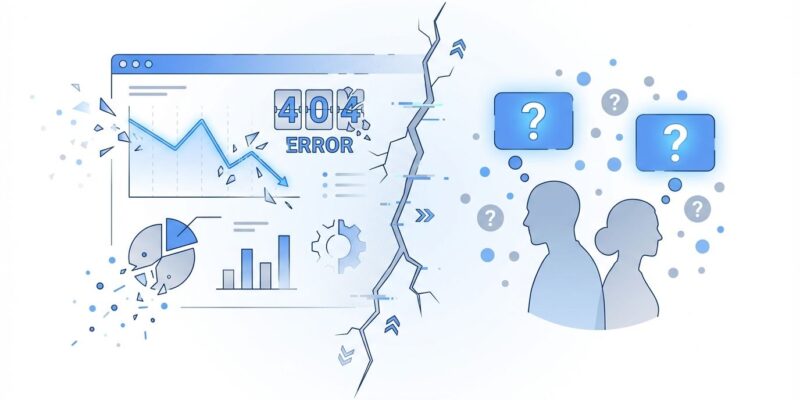
Except 66% of developers don’t believe the metrics. According to JetBrains’ State of Developer Ecosystem 2025 survey of 24,534 developers, two-thirds don’t trust that current productivity measurements reflect their actual contribution. Only 33% of developers trust AI accuracy, despite 84% adoption rates.
If AI measurably boosts productivity, why do developers reject the measurement? The answer reveals what’s fundamentally broken in how engineering work gets evaluated—and why the AI revolution is forcing a reckoning.
The 66% Trust Crisis
This isn’t a technical disagreement. It’s an organizational crisis. Two-thirds of the software engineering workforce don’t believe in the systems evaluating them for promotions, raises, and hiring decisions.
The JetBrains 2025 survey found that developers consistently request “greater transparency and clarity in measurement processes.” They want to understand what’s being measured, why it matters, and how it connects to business outcomes. Instead, most companies measure productivity in secret, then wonder why engineers don’t trust the results.
The disconnect runs deeper. Developers want transparency, constructive feedback, and clarity of goals. Tech decision-makers want reduced technical debt—prioritizing it twice as much as developers do—and higher velocity. Management optimizes for activity metrics like story points and commit frequency. Developers want outcome metrics like business impact and value delivered.
Teams aren’t just measuring different things. They’re speaking different languages about what “productive” even means.
Why AI Breaks Traditional Metrics
The productivity paradox becomes visible when you separate individual from organizational performance. At the individual level, the gains are real: GitHub’s controlled studies show 55% faster task completion, Duolingo achieved 67% faster code reviews, and DORA 2025 measured 98% more merged pull requests.
At the organizational level? Delivery metrics stay flat. The 2025 DORA Report states it directly: “AI magnifies the strengths of high-performing organizations and the dysfunctions of struggling ones.” When deployment pipelines are fragile and test suites are flaky, generating code faster just moves the bottleneck from writing to review, integration, and deployment.
Meanwhile, quality metrics show regression. GitClear’s analysis of 211 million lines of code found a 4x increase in code cloning since AI tools proliferated. Copy-pasted code rose from 8.3% to 12.3% between 2021 and 2024, while code refactoring—moving and restructuring code for maintainability—declined sharply.
Lines of code per developer grew from 4,450 to 7,839 with AI adoption, a 76% increase. Does that make developers 76% more productive? No. It makes the metric meaningless. AI generates millions of lines of boilerplate while humans write hundreds of lines of critical business logic. Volume tells you nothing about value.
Andrew Ng, one of AI’s most prominent advocates, admitted at a May 2025 conference: “When I’m coding for a day with AI coding assistance, I’m frankly exhausted by the end of the day.” The cognitive load of reviewing AI-generated code that’s “almost right, but not quite” is invisible to traditional metrics. That exhaustion doesn’t show up in lines of code, velocity, or commit counts.
What Metrics Get Wrong
Traditional productivity metrics measure four things poorly: volume instead of value, activity instead of outcome, individual performance instead of organizational flow, and output instead of quality.
Velocity and story points count work done, not value delivered. High deployment frequency combined with high failure rates equals net negative productivity. Individual developers coding 55% faster don’t improve organizational delivery when bottlenecks exist in code review, integration, or deployment.
The backlash against story points intensified in 2025. Ron Jeffries, one of the creators of Extreme Programming, argues that “the obsession with estimating effort detracts from Agile’s focus on value delivery.” Stack Overflow’s analysis explains why velocity is considered “the most dangerous agile metric”: it was designed for capacity planning, not performance evaluation.
When misused for evaluation, velocity metrics create destructive incentives. Teams inflate estimates to maintain higher numbers. Quick hacks score more points than thoughtful architecture. One company implemented individual velocity tracking and watched developer satisfaction drop 60% while 40% of the team quit within six months.
The Organizational Cost
Flawed metrics create a doom loop. Metrics show “low productivity.” Management sets tougher expectations. Developers work longer hours. Quality suffers and delivery slows. Metrics show “low productivity.” The cycle repeats.
Stack Overflow’s 2025 Developer Survey found burnout is now “routine” among software engineers. For the first time, senior developers report lower job satisfaction than junior developers. An earlier 2021 study found 83% of software engineers suffering from burnout.
The economic consequences manifest in unexpected ways. A new job category emerged on LinkedIn in late 2025: “Vibe Coding Cleanup Specialist.” These developers charge upwards of $200 per hour to fix AI-generated code, with demand increasing 300% in six months. Companies “save money” by letting anyone generate code with AI tools, then pay premiums for experienced developers to untangle the chaos.
Expertise didn’t become obsolete. It became more valuable.
What Should Replace Broken Metrics
The industry is shifting from DORA metrics alone to combined frameworks that measure both systems and humans. The DevEx (Developer Experience) framework, authored by Abi Noda, Dr. Margaret-Anne Storey, Dr. Nicole Forsgren, and Dr. Michaela Freiler, offers an alternative.
DevEx measures three dimensions. Feedback loops track how quickly developers get responses from CI/CD pipelines, code reviews, and tests—fast loops enable flow, slow loops cause friction. Cognitive load examines the mental burden from tools, architecture, and accidental complexity. Flow state measures whether developers can achieve uninterrupted, energized focus or face constant context switching.
The DevEx framework recommends combining system data (DORA-style metrics for delivery pipeline health) with perceptual data (developer surveys on satisfaction and experience) and business KPIs (revenue, user engagement, retention). The JetBrains survey found that “many organizations combine operational metrics with human-centric dimensions to get a complete picture.”
The 66% trust gap won’t close until measurement becomes transparent. Developers need to understand what gets measured, why it matters, how it connects to business outcomes, and what they should do differently. Secret measurement breeds distrust.
The Reckoning AI Forced
AI didn’t break productivity metrics. It exposed that they were always broken. When typing speed was the bottleneck, measuring commits and lines of code felt reasonable. AI made typing instantaneous, revealing that engineering judgment—invisible to traditional metrics—was always the actual work.
The developers succeeding with AI aren’t the ones generating the most code. They’re the ones who can review AI output, spot edge cases, catch security flaws, and make architectural decisions. Those skills don’t show up in velocity or story points. They show up in code that works, systems that scale, and products that deliver value.
The 66% who don’t trust metrics aren’t wrong. The metrics are measuring the wrong things. DevEx frameworks, transparency, and outcome-based evaluation offer a path forward. But only if organizations are willing to admit that what they’ve been measuring never actually mattered.