
 By ByteBot
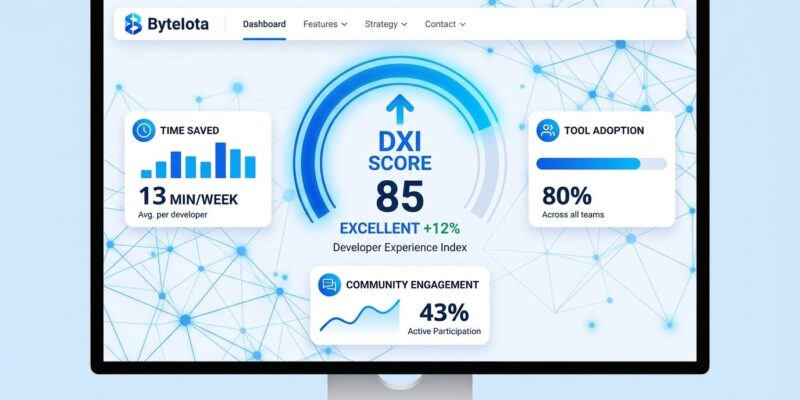
Developer experience (DX) platforms have evolved from vague “happiness surveys” to measurable business investments in 2026. The Developer Experience Index (DXI) shows that each 1-point improvement saves 13 minutes per developer per week—10 hours annually. This shift from subjective feelings to concrete ROI metrics coincides with Gartner’s prediction that 80% of large software engineering organizations will establish platform teams by 2026, up from 45% in 2022.
At 100 developers, a 1-point DXI improvement equals roughly $100K annually in saved developer time. Platform engineering is no longer a “nice to have”—it’s measurable, justifiable infrastructure.
From Happiness Surveys to Hard ROI: The DXI Breakthrough
DX platforms combine system metrics (DORA: deployment frequency, lead time, change failure rate) with qualitative developer sentiment data through surveys and experience sampling. The DX Core 4 framework unifies DORA, SPACE, and DevEx research into four dimensions: speed, effectiveness, quality, and business impact. Built on data from over 40,000 developers across 800 organizations, DXI is the first validated engineering effectiveness measure directly linked to business outcomes.
The index evaluates 14 critical dimensions: build and test processes, change confidence, code maintainability, deep work capability, and collaboration quality. Top-quartile DXI scores correlate with 43% higher employee engagement. Pfizer reduced lead times by 6x and doubled software delivery rates using DX platform insights. This isn’t measurement theater—it’s identifying actual bottlenecks like slow CI/CD pipelines and unclear requirements rather than blaming individuals.
However, that oddly specific “13 minutes per week” metric raises questions. Is this meaningful productivity or marketing precision? While the research backing is solid, organizations should validate ROI in their own context rather than accepting vendor claims at face value.
The 80% Tipping Point: Platform Engineering Goes Mainstream
Platform engineering adoption is accelerating faster than predicted. Gartner’s 80% target (up from 45% in 2022) represents 135% growth in four years. Internal Developer Platforms (IDPs) provide self-service infrastructure through “golden paths“—preconfigured workflows that reduce cognitive load and eliminate ticket-driven provisioning. Backstage, Spotify’s open-source IDP, holds 89% market share among organizations that have adopted an IDP.
Consider the shift: A developer selects “Create New Service” from an IDP template, and the system auto-provisions the repo, CI/CD pipeline, and staging/production infrastructure. Deploy to production in under a day versus 2-3 weeks with traditional ticketing. Organizations using IDPs deliver updates up to 40% faster and cut operational overhead nearly in half. Moreover, over 65% of enterprises have built or adopted an IDP.
Related: Platform Engineering ROI in 2026: Business Metrics Win
This is no longer experimental. The 80% prediction signals a fundamental shift in how organizations build software—self-service with guardrails replaces approval workflows.
The AI Productivity Paradox: Feel Faster, Measure Slower
By late 2025, 75% of DevOps teams integrated AI into CI/CD workflows, and 85% of developers regularly use AI coding tools. The assumption? Massive productivity gains. The reality? A stark mismatch between perception and measurement.
Recent research from METR reveals developers using AI tools take 19% longer to complete tasks but estimate they’re 20% faster. This isn’t a small discrepancy—it’s a fundamental disconnect between how developers feel and what actually happens. The culprit: AI generates code quickly, but the subtle bugs it introduces take longer to debug, extending end-to-end task completion.
DX platforms now include dedicated AI measurement frameworks tracking three dimensions: utilization (tool adoption), impact (time savings and satisfaction), and cost (ROI). Organizations investing in Copilot, Cursor, and similar tools need objective measurement, not vendor claims or developer sentiment. Indeed, the 19% slower reality challenges the productivity narrative and justifies spending on proper measurement infrastructure.
Measurement vs. Surveillance: Getting the Balance Right
Developer concern about productivity measurement centers on surveillance. Tracking individual commits, lines of code, or hours worked creates perverse incentives. The Hacker News community is blunt: “Don’t measure productivity with commits or hours—pay attention to whether people get big important things done.”
Research confirms surveillance is one of the three most frequently experienced privacy harms, with 37% of developers reporting weekly experiences. Consequently, when metrics are tied to performance reviews, developers optimize for metrics rather than outcomes—breaking large pull requests into artificially small ones to improve cycle time, gaming deployment frequency with trivial changes.
The solution: Focus on team-level metrics (DORA metrics, team DXI scores) rather than individual output. DX platforms succeed when they identify systemic improvements—fixing slow CI/CD pipelines—not assigning blame. Privacy-preserving measurement approaches like Clean Insights advocate collecting minimum data with explicit consent and transparency about scope. Furthermore, making metrics transparent helps: developers can see their team’s data, understand what’s being measured, and trust the intent is improvement, not surveillance.
The tension is real. Organizations need measurement to improve, but misuse destroys developer trust. Getting this balance right determines whether DX platforms become valuable tools or expensive sources of cynicism.
The Vendor Landscape: DX, Jellyfish, LinearB, Backstage
The DX platform market has matured rapidly. Gartner created the “Developer Productivity Insight Platforms” category in 2024, signaling industry consolidation. Leading vendors offer different approaches:
DX (built by the former Google DORA team) provides research-backed DXI scoring combining quantitative and qualitative data. It works across organizational levels—VPs, platform teams, and managers. Jellyfish focuses on aligning engineering with business objectives, emphasizing project-level metrics and resource allocation, but stays at the leadership layer with less focus on individual developer experience. LinearB emphasizes workflow automation with the WorkerB bot assistant and gitStream automations, though it lacks customization for complex business metrics and doesn’t incorporate self-reported data.
Backstage dominates the open-source space with 89% market share among IDP adopters. It’s highly customizable with a large plugin ecosystem, but requires an internal platform team to maintain. It doesn’t include DX measurement out-of-box, focusing instead on IDP infrastructure.
No one-size-fits-all solution exists. Organizations should match platforms to priorities: research-backed measurement (DX), business alignment (Jellyfish), automation (LinearB), or open-source customization (Backstage).
Key Takeaways
- DX platforms moved from vague sentiment tracking to concrete ROI (13 minutes/week per DXI point), making platform engineering investments quantifiably justified rather than “nice to have”
- Platform engineering adoption is accelerating toward 80% by 2026, driven by self-service IDPs and golden paths that cut provisioning time from weeks to days
- AI coding tool adoption is nearly universal (85% of developers), but measurement reveals a stark paradox: 19% slower in reality despite feeling 20% faster—objective measurement is critical
- The surveillance problem is real: individual tracking creates perverse incentives, while team-level metrics and transparency enable improvement without destroying trust
- The vendor landscape is maturing with specialized platforms (DX, Jellyfish, LinearB) and open-source dominance (Backstage 89%), but success depends on organizational commitment to act on insights, not just collect metrics
The fundamental shift: developer experience is now a measurable business investment with concrete ROI, not a vague aspiration. Organizations that combine measurement with action will see genuine productivity gains. Those that measure without improving will just generate expensive cynicism.


