The software development industry faces a striking paradox in 2026: While 84% of developers use or plan to use AI coding tools—up from 76% in 2024—trust in these tools has collapsed to just 29%, down 11 percentage points from last year. According to Stack Overflow’s 2025 Developer Survey of 49,000+ developers published in December, this growing chasm between adoption and trust is creating real workflow problems. Moreover, developers now spend up to 24% of their work week verifying, fixing, and validating AI output, with 45% citing “AI solutions that are almost right, but not quite” as their top frustration. This isn’t a hypothetical future problem—it’s reshaping how developers work right now.
Trust Plummets While Adoption Soars
Developer trust in AI coding tools has collapsed. Stack Overflow’s 2025 survey shows trust dropped from 40% in 2024 to just 29% in 2025—an 11-point decline in a single year. Furthermore, only 3% of developers report “highly trusting” AI output. Meanwhile, distrust grew from 31% to 46%, with positive sentiment falling from over 70% in 2023-2024 to just 60% in 2025.
The trust erosion hits hardest on security. Veracode’s evaluation of AI-generated code across 100+ large language models found that 45% of samples failed security tests and introduced OWASP Top 10 vulnerabilities. One developer on Hacker News captured the sentiment: “Like having a very enthusiastic intern who types really fast but doesn’t actually understand what they’re doing.”
This isn’t a temporary dip—it’s a fundamental erosion of confidence at the exact moment AI code is becoming ubiquitous. With AI already accounting for 42% of committed code in 2026, expected to hit 65% by 2027, declining trust while increasing adoption creates a perfect storm for quality and security issues.
96% Distrust, 48% Don’t Verify: The Verification Gap
Sonar’s 2026 State of Code Developer Survey, published in January, reveals a dangerous disconnect: While 96% of developers don’t fully trust that AI-generated code is functionally correct, only 48% state they always check their AI-assisted code before committing it. Consequently, this “verification gap” means nearly half of AI-generated code enters codebases without full review.
The reasons for skipping verification are revealing: 38% of developers say reviewing AI-generated code requires more effort than reviewing code written by human colleagues. As a result, time pressure drives risky behavior—developers commit unverified AI code because thorough verification would negate the productivity gains.
Those who do verify spend significant time on it. Nearly all developers (95%) spend at least some effort reviewing, testing, and correcting AI output, with 59% rating that effort as “moderate” or “substantial.” Estimates range from 9% of work time focused on verification to 24% when including debugging “almost right” code.
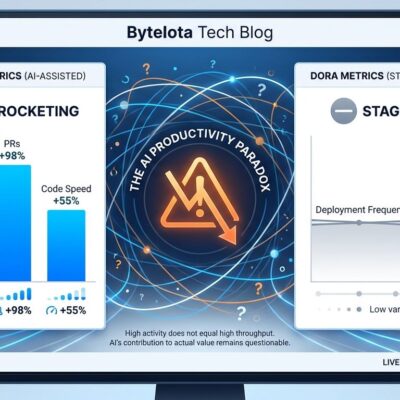
The ultimate productivity paradox emerged from research: A randomized controlled trial by METR found developers using AI tools were actually 19% slower than those coding without assistance, despite believing they were 20% faster. The verification and debugging burden offset generation speed.
This verification gap is where “verification debt” accumulates. Werner Vogels, AWS CTO who coined the term, explains it “can accumulate compound interest over time as unverified AI outputs become relied upon, copied and re-used in downstream workflows.” When 48% of developers skip verification, and that unverified AI code becomes the foundation for other code, errors compound exponentially.
Four Reasons Developers Can’t Trust AI—But Use It Anyway
Stack Overflow’s February 2026 analysis identifies four fundamental barriers explaining why developers can’t trust AI coding tools—and why adoption continues despite distrust:
The determinism problem violates foundational engineering expectations. Developers are trained in reproducible, predictable code where the same input yields the same output. However, AI’s probabilistic nature—where identical prompts produce different results—creates fundamental workflow incompatibility. Developers expect “compile once, run anywhere” reliability. AI delivers “compile many times, get different results” uncertainty.
Hallucination reality creates constant verification burden. AI generates “plausible-looking code that simply doesn’t work,” references nonexistent APIs, and produces subtle security vulnerabilities requiring extensive manual review. The code looks right, reads right, but fails in production.
The newness factor breeds uncertainty about fault attribution. Many developers lack competence in effective prompting and AI evaluation frameworks, creating confusion about whether issues stem from tool limitations or user skill. Is this bad AI or bad prompting?
Job security concerns create cognitive dissonance—developers use AI despite perceiving it as a livelihood threat. When Stack Overflow asked what would make developers seek human help over AI in the future, 75% cited “When I don’t trust AI’s answers.” The psychological barrier runs deeper than tool capability.
Understanding these barriers explains the adoption paradox: Developers use tools they don’t trust because NOT using AI feels riskier to careers than code quality concerns. Productivity pressure, management expectations, competitive advantage worries, and FOMO drive adoption even as trust declines. Therefore, the external pressure exceeds internal confidence.
Related: AI Code Quality 2026: 1.7x More Bugs Than Human Code
Verification Is the New Development
The industry is undergoing a fundamental job transformation. Developers are shifting from “code writers” to “code validators.” As Addy Osmani, Google engineer, puts it: “AI writes code faster. Your job is still to prove it works.” In fact, verification, not generation, is becoming the core developer competency.
Teams succeeding with AI at high velocity aren’t blindly trusting it—they’re building verification systems that catch issues before production. Best practices emerging: Keep PRs under 500 lines (teams see 30-40% cycle time improvements versus 1,000+ line diffs that overwhelm AI reviewers). Question “What assumptions is this making?” not “Does this look reasonable?” when reviewing AI code. Additionally, combine traditional rule-based tools like SonarQube (catches known patterns) with AI-powered context-aware review—together they catch 70-80% of issues automatically. Maintain hard accountability lines: “No matter how much AI contributed, a human must take responsibility.”
The market is responding. GitHub code review became the bottleneck in 2026 with AI-assisted coding pushing PR volume up 29% year-over-year. Consequently, AI code review tools are growing 45% annually to address the verification crisis.
This is career-defining for developers. The skill set is changing: Less value in typing code quickly, more value in architecting systems and validating implementations. Developers who master verification will thrive; those who rely on AI generation without verification skills will struggle as verification debt undermines their codebases.
The Security Risk of Unverified AI Code
With AI code expected to reach 65% of commits by 2027, and 45% of AI-generated code containing security vulnerabilities according to Veracode, the industry faces a looming security crisis. The combination of high AI adoption, low trust, and the 48% verification gap creates systemic risk.
Beyond code quality, shadow AI creates compliance risks. One survey found 38% of employees shared confidential company data with unapproved AI systems. Security experts are unanimous: “Human oversight is absolutely non-negotiable” for security review. Even if AI-generated code passes functional tests, security implications require human judgment. Questions like “What threat model does this code assume?” and “What happens if an adversary provides malicious input?” cannot be answered by AI verification alone.
A major security incident from unverified AI code could trigger industry backlash, regulatory intervention, or adoption plateaus. The current trajectory—more AI code, less verification, declining trust—is unsustainable. Either verification practices must improve dramatically, or the industry faces a reckoning.
Key Takeaways
- Trust in AI coding tools dropped from 40% to 29% (2024-2025) while adoption rose to 84%—a dangerous 55-point gap between usage and confidence that’s widening 25 points in two years.
- 96% of developers don’t trust AI code, yet 48% don’t verify before committing—”verification debt” compounds as unverified AI outputs become relied upon in downstream workflows.
- “Almost right, but not quite” code costs more to debug than it saves in generation time—developers are actually 19% slower with AI tools in controlled trials despite believing they’re 20% faster.
- Developer job shifting from writing code to validating code—verification is the new core competency as AI accounts for 42% of commits in 2026, expected to hit 65% by 2027.
- With 45% of AI-generated code containing security flaws and 48% of developers skipping verification, the industry faces a quality reckoning—current trajectory is unsustainable without dramatic verification practice improvements.