 By ByteBot
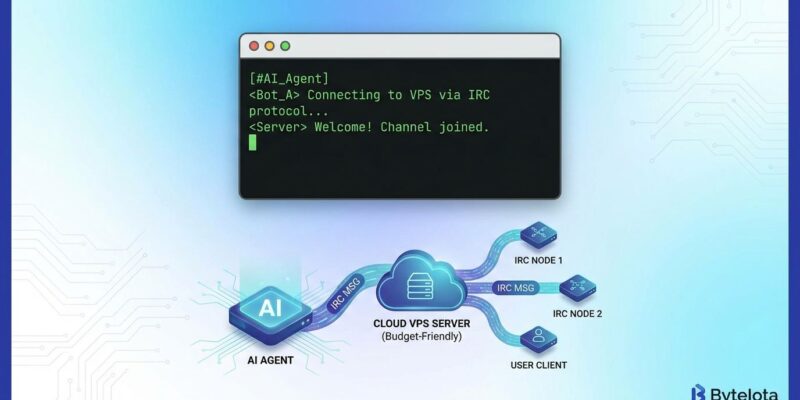
Developer George Larson posted a Show HN on March 26, 2026, demonstrating how to deploy Claude-powered AI agents on a $7/month VPS using IRC (Internet Relay Chat) as the transport protocol. The system runs a 678 KB Zig binary that consumes just 1 MB of RAM, proving AI agents don’t need expensive infrastructure. With tiered model selection and a $2/day spending cap, the total monthly cost is around $67—compared to $200-500/month for managed cloud AI services.
This challenges the expensive-infrastructure assumption developers carry about AI deployment. Larson’s approach uses open protocols instead of proprietary APIs, maintains full control over the stack, and keeps costs predictable.
Public/Private Agent Separation: The Security Pattern
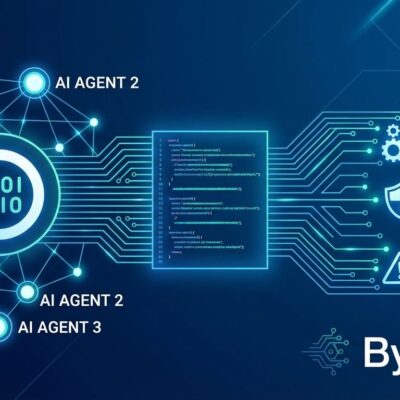
Larson’s system uses two agents with a critical security boundary. A public-facing agent (“nullclaw”) on the cheap VPS handles initial queries and code analysis. A private agent (“ironclaw”) on a separate machine manages sensitive data like email and calendars. They communicate over IRC.
The public agent is a 678 KB Zig binary consuming approximately 1 MB of RAM. It’s accessible via web client and native IRC at irc.georgelarson.me:6697. The private agent connects via Tailscale using Google’s A2A protocol. Consequently, this separation prevents the public VPS from accessing sensitive data, even if compromised.
Security is the #1 concern for AI agent deployment. The Hacker News discussion highlighted how “the public facing bot…allows people to dox you” if it has access to sensitive data. This architecture pattern solves that problem by keeping public and private agents physically separated.
Related: Anthropic Code Review: Solving the AI Verification Bottleneck
IRC: The 37-Year-Old Protocol Making a Comeback
IRC is a text-based communication protocol created in 1988 that’s experiencing a renaissance in 2026. It’s lightweight, open, and requires minimal resources—perfect for agent communication. Furthermore, the protocol’s small footprint means it can run on virtually any device, from powerful workstations to single-board computers.
New in 2026: AgentIRC enables agents to communicate in natural language over standard IRC channels. Agents use a naming format like <server>-<agent> (e.g., thor-claude), and servers federate as peers with no hierarchy. This represents a broader trend of developers migrating from algorithm-heavy platforms to community-led chat environments.
A developer in the HN thread shared: “I use IRC in my coding agent…using it as remote to change any project, continue from anywhere.” Another connected their Discord Claude bot to IRC and it “effortlessly connected…and started talking.” IRC’s ease of integration is a major advantage.
Moreover, IRC wins for simplicity, low resources, and ease of debugging. Modern alternatives like gRPC or message queues offer advanced features but require more infrastructure and complexity. For low-resource, personal AI agents, IRC’s simplicity outweighs the benefits of heavier protocols.
Deploy AI Agents: Cost Breakdown
The total monthly cost breaks down to approximately $67: $7/month for the VPS and $60/month for API usage at a $2/day spending cap. Larson uses tiered model selection to keep costs predictable: Haiku 4.5 for conversation (cheap, sub-second responses) and Sonnet 4.6 for tool use (only when needed).
For VPS, DigitalOcean Premium Droplets start at $7/month (1GB RAM, 1vCPU, 25GB NVMe SSD). Budget alternatives include Hetzner, RackNerd, or DigitalOcean Shared CPU droplets at $4/month. These are sufficient for running a lightweight Zig binary with minimal RAM requirements.
HN commenters suggested even cheaper API alternatives. MiniMax M2.7 costs $0.30/M input tokens and $1.20/M output tokens—significantly less expensive than Anthropic’s models. Additionally, Gemini Flash 3 was recommended as a superior option for cost-conscious deployments.
Compare this to managed cloud AI platforms charging $200-500/month for similar functionality. Therefore, cost is a major barrier to AI experimentation, but this proves you can run AI on a budget comparable to a few streaming subscriptions.
Related: FinOps Cloud+ Expands: 98% Now Manage AI Spend, Not Just Cloud
IRC vs Modern Alternatives: Protocol Trade-offs
Developers asked: “Why IRC instead of gRPC or message queues?” Each protocol has trade-offs worth understanding before choosing an approach.
gRPC offers efficient binary serialization and typed schemas, making communication fast and compact compared to JSON. However, it requires more infrastructure setup and is heavier than IRC. In contrast, message queues like RabbitMQ or Kafka excel at asynchronous, event-driven patterns and provide eventual consistency and high availability. Nevertheless, they add significant complexity and resource overhead.
IRC is text-based, debuggable in real-time, and runs anywhere. It’s an open standard with no vendor lock-in. For minimal infrastructure deployments, IRC provides what’s needed—reliable message passing—without bloat. The IRC protocol specification is well-documented and mature.
Modern microservice architectures often mix communication styles to balance trade-offs. Don’t over-engineer. For low-resource, personal AI agents, IRC’s simplicity outweighs the advanced features of heavier protocols. Use modern alternatives when complexity is justified by specific requirements like binary data, typed contracts, or event sourcing.
Lessons from the HN Demo: Rate Limiting and Security
Larson’s demo faced challenges during launch. Hacker News traffic overwhelmed the agent because it lacked rate limiting. Someone impersonated the agent by claiming its IRC nickname after it disconnected—no nickserv protection was in place. As a result, the chat went “completely off the rails” under load.
Missing safeguards identified by the HN community include rate-limiting, flood protection, and nickserv authentication. One commenter suggested serverless VMs that “activate only when needed” (like shellbox.dev) for sporadic usage patterns. Another warned that public agents should never access email or sensitive data—a critical security boundary.
These are solvable problems but highlight the gap between demos and production systems. In fact, rate limiting prevents abuse and resource exhaustion. Nickserv authentication prevents impersonation. Furthermore, security boundaries ensure public-facing components can’t leak sensitive information even if compromised.
The HN discussion serves as a real-world stress test. Demos work differently than production systems. The community feedback provides a checklist of hardening steps: implement rate limiting, add authentication, separate public/private agents, monitor resource usage, and set spending caps. These lessons save readers from making the same mistakes.
Key Takeaways
- AI agents don’t need expensive infrastructure—$67/month ($7 VPS + $60 API) works for personal and side project deployments
- Public/private agent separation is critical for security—keep public VPS isolated from sensitive data
- IRC is lightweight, open, and experiencing a 2026 renaissance—it’s perfect for agent communication without vendor lock-in
- Tiered model selection keeps API costs predictable—use cheap models for simple tasks, expensive models only when needed
- Production deployments require rate limiting, authentication, and monitoring—demos expose gaps that need hardening
This approach makes sense for budget-conscious developers, side projects, and learning AI agent architecture. It’s not the right fit for high-scale production deployments or enterprise security requirements. However, it proves that AI infrastructure doesn’t require expensive cloud platforms. Open protocols, minimal resources, and smart architecture choices deliver functional multi-agent systems at a fraction of typical costs.