
 By ByteBot
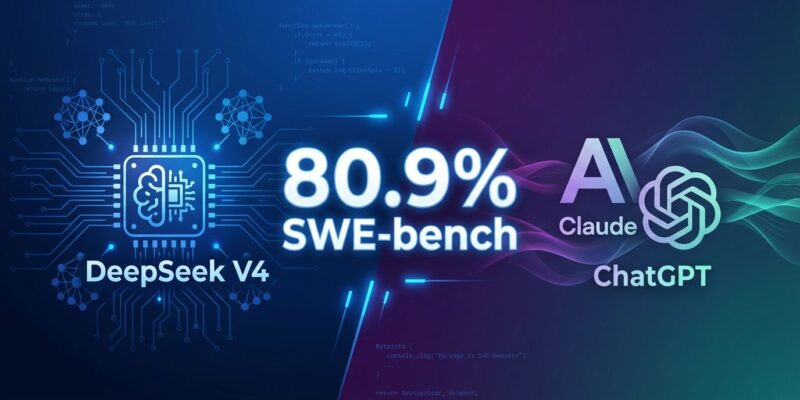
DeepSeek is launching V4 in mid-February 2026, and insider sources claim it will beat both Claude Opus 4.5 and ChatGPT at coding tasks. The target: surpass Claude’s 80.9% SWE-bench Verified score, the current industry record for AI coding assistants. If DeepSeek delivers, it could force a major pricing and performance reset in the AI coding market—a Chinese startup challenging Silicon Valley’s premium tools at 20-40x lower cost. But here’s the catch: no public benchmarks exist yet. We’re working with insider leaks, not verified data.
The Benchmark That Matters
SWE-bench Verified is the gold standard for evaluating AI coding assistants. It presents models with 500 real GitHub issues from popular open-source projects and asks them to generate patches that fix the bugs. Claude Opus 4.5 currently holds the record at 80.9%, becoming the first model to crack the 80% barrier. For context, GPT 5.1 scores 76.3% and Gemini 3 Pro hits 76.2%. Claude’s performance represents a 65% improvement over its predecessor, Claude 3.5 Sonnet, which managed only 49%.
Internal sources claim DeepSeek V4 beats Claude in testing, but without public verification, that’s just marketing. The AI industry has learned to demand receipts—insider claims mean nothing until the model ships and independent testers can reproduce results. DeepSeek hasn’t even officially confirmed V4’s existence, let alone its performance. Until February, this is speculation wrapped in hype.
Engram Memory: The Real Innovation
If V4 does outperform competitors, the secret weapon is likely Engram, a conditional memory system DeepSeek published on January 13, 2026. Engram enables efficient retrieval from contexts exceeding one million tokens—meaning the model can process entire enterprise codebases at once, not just code snippets. Most current AI coding assistants struggle with long-context tasks because they rely on expensive GPU high-bandwidth memory for all operations. Engram introduces O(1) memory lookup that offloads static knowledge to system RAM, reserving GPU power for complex reasoning.
In benchmarks, Engram-equipped models achieved 97% accuracy on the NIAH (Needle in a Haystack) test versus 84.2% for standard architectures. The practical implication: V4 could handle repository-scale understanding, multi-file refactoring with full dependency context, and legacy codebase analysis that current tools fumble. For developers working on sophisticated projects—think monolithic enterprise applications or large-scale migrations—this is the capability that actually matters. Beating Claude by two percentage points on SWE-bench is a headline. Processing million-token contexts efficiently is a workflow transformation.
Cost Disruption or Red Herring
DeepSeek has a track record of shocking the industry with cost efficiency. The company trained its V3 model for $6 million, compared to $100 million for GPT-4. Its latest models use 2,000 GPUs instead of ChatGPT’s 10,000, achieving similar performance at a fraction of infrastructure cost. DeepSeek’s API pricing runs 20-40x cheaper than OpenAI’s, a difference that reshapes enterprise TCO calculations. Add open-source availability under an MIT License, and you have a compelling pitch for budget-conscious engineering teams.
But cost advantages come with questions. DeepSeek is a Chinese AI startup facing heightened scrutiny over data security and privacy practices. Some enterprises block cloud-based AI assistants entirely over IP concerns—adding a Chinese provider doesn’t ease those worries. Performance and price matter, but so do integration ecosystems, enterprise SLAs, and regulatory compliance. GitHub Copilot commands 42% market share and runs in 90% of Fortune 100 companies not just because it works well, but because it integrates seamlessly with existing developer workflows. DeepSeek needs more than benchmark wins to crack that dominance.
A Crowded Market Gets More Crowded
DeepSeek V4 enters a mature landscape. By 2026, 91% of engineering organizations use AI coding tools. GitHub Copilot leads with 42% market share, Cursor has rapidly captured 18% with $1 billion ARR, and Claude Code claims 53% overall adoption in enterprise contexts. Developers aren’t asking whether to use AI—they’re debating which tool delivers the best token efficiency, context management, and first-pass accuracy.
The productivity data is mixed. Developers self-report 10-30% productivity gains and save an average of 3.6 hours per week. GitHub Copilot users complete 126% more projects weekly. But studies also show 48% of AI-generated code contains security vulnerabilities, and there’s ongoing debate about whether AI tools produce better outcomes or just churn out more code that creates long-term maintenance headaches. Adding another high-performance option to the mix doesn’t solve those fundamental questions.
What to Watch For in February
DeepSeek reportedly plans a mid-February launch, possibly targeting February 17 to coincide with Lunar New Year. When V4 drops, developers should evaluate it on evidence, not hype. Here’s what matters:
- Public SWE-bench Verified score: Does it actually beat 80.9%, or fall short?
- Long-context benchmarks: Can it handle million-token coding tasks in practice?
- Pricing transparency: What’s the real cost for API access and self-hosted deployment?
- Tool integration: Does it work with Cursor, VSCode, JetBrains, and other ecosystems developers rely on?
- Security audit results: Can it meet enterprise compliance requirements?
The AI coding market has matured past the point where vague performance claims drive adoption. Developers demand concrete benchmarks, transparent pricing, and proven integration paths. If DeepSeek V4 delivers on insider claims, it will force incumbents to justify premium pricing or cut costs. If it falls short, it becomes another overhyped launch that reinforces skepticism about Chinese AI providers.
February will tell us which story we’re living in. Until then, treat this as what it is: an unverified leak about a model that might reshape the AI coding landscape—or might just be noise.


