 By ByteBot
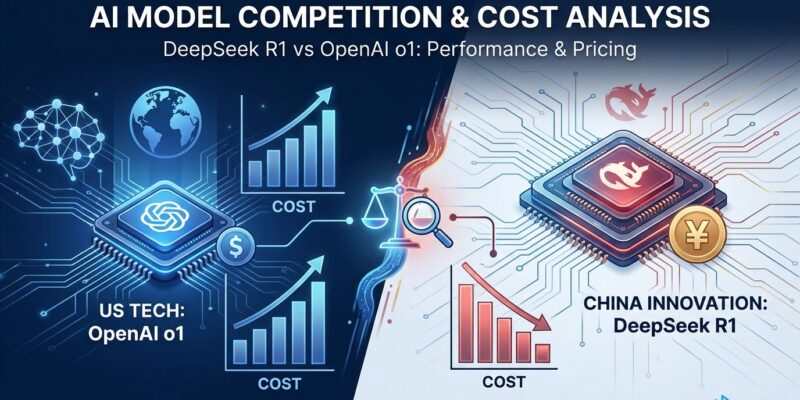
Chinese AI startup DeepSeek has released R1, a reasoning model that claims to match OpenAI’s flagship o1 model at just 5% of the API cost—and it’s backing up those claims with competitive benchmark scores. With output tokens priced at $2.19 per million versus OpenAI’s $60, DeepSeek is challenging Silicon Valley’s assumption that frontier AI requires massive compute budgets. The question everyone’s asking: what have US labs been spending all that money on?
The Cost Disruption That’s Actually Real
DeepSeek’s API pricing tells a striking story. Input tokens cost $0.55 per million compared to OpenAI’s $15. Output tokens run $2.19 versus $60. That’s a 96% cost reduction across the board. For developers running large-scale AI applications, this translates to hundreds of thousands in annual savings.
However, the training cost narrative is more complicated. DeepSeek claims R1 cost just $6 million to train, but analysts at SemiAnalysis estimate actual R&D spending at $1.6 billion—including infrastructure, prior research, and experiments. The $6M figure excludes everything except the final training run. It’s marketing genius, not technical reality.
Nevertheless, here’s what matters: the API savings are real regardless of the training cost debate. Whether DeepSeek spent $6 million or $1.6 billion to build R1, developers pay pennies compared to OpenAI’s prices. That’s the disruption.
Performance Claims Hold Up Under Scrutiny
Low cost means nothing if the model can’t deliver. Fortunately, DeepSeek’s benchmark results show competitive performance across reasoning tasks. R1 edges out OpenAI o1 on AIME 2024 (79.8% vs 79.2%) and MATH-500 (97.3% vs 96.4%), while leading on SWE-Bench software engineering tasks.
Meanwhile, OpenAI’s o1 maintains an advantage on GPQA Diamond general knowledge questions (75.7% vs 71.5%). The pattern is clear: DeepSeek excels at math and coding, while OpenAI leads in broad knowledge. For many developers, that trade-off heavily favors DeepSeek.
Furthermore, the developer community validates these numbers. Discussions on r/LocalLLaMA and r/ChatGPTCoding consistently report strong code generation and debugging, with users sharing anecdotes of DeepSeek solving problems where GPT-4 failed.
The Sanctions Paradox: Constraints as Innovation Driver
Here’s the geopolitical irony: US chip sanctions intended to slow Chinese AI development may have accidentally accelerated it. DeepSeek built R1 on Nvidia H800 chips—a less powerful version designed for export compliance with just 400Gb/s bandwidth versus the H100’s 900Gb/s.
Consequently, faced with hardware constraints, DeepSeek innovated algorithmically. Their Mixture of Experts architecture uses 671 billion parameters but activates only 37 billion per forward pass—a 95% efficiency gain. They compensated for limited chips with longer training runs and more inference time.
The result? Methods that benefit the entire AI industry. While US labs relied on brute-force compute scaling, Chinese researchers were forced to be smarter, not just bigger. That’s the sanctions paradox—restrictions drove innovation that Silicon Valley might adopt.
The Developer Reality Check
Before switching to DeepSeek, developers need to understand the trade-offs. The most cited drawback is heavy censorship on China-sensitive topics. The model will refuse to discuss or delete answers on subjects deemed sensitive by Chinese authorities—described by users as “disruptive and limiting.”
Additionally, privacy concerns are real. DeepSeek left a database exposed containing over a million log lines, including chat history and secret keys. For applications handling sensitive data, that’s a red flag. The model also shows weaker performance on general knowledge compared to specialized technical tasks.
The open-source versions offer some mitigation—self-hosting avoids data transfer concerns—but the censorship is baked into the model weights. This isn’t a tool for every use case.
Industry Implications: Reckoning Time
DeepSeek’s emergence forces uncomfortable questions about AI economics. If a Chinese startup can match OpenAI’s reasoning model at 5% of API cost, what justifies the premium pricing? Are massive compute budgets necessary, or have Western labs been wastefully throwing money at problems that could be solved more efficiently?
The market reaction suggests investors are asking the same questions. Reports indicate stock volatility for Nvidia and AI infrastructure companies, with speculation that DeepSeek’s announcement contributed to market sell-offs. The “spend more to win” narrative is under pressure.
This doesn’t mean OpenAI and Anthropic are doomed—they maintain advantages in general capability, safety research, and enterprise trust. But DeepSeek has shifted the conversation from “who has the biggest budget” to “who has the smartest approach.” That’s a fundamental change in how the industry thinks about AI development.
Bottom Line for Developers
DeepSeek R1 proves competitive AI doesn’t require Silicon Valley’s budget. The 96% cost savings are real, the performance is validated, and the technical innovations are genuine. But so are the censorship issues, privacy concerns, and knowledge limitations.
The real winner here might be developers themselves. Increased competition and proven efficiency gains will pressure OpenAI and Anthropic to either lower prices or better justify their costs. Whether you adopt DeepSeek or stick with Western alternatives, the economics of AI just got more favorable.
The AI industry spent 2024 in an arms race of spending. DeepSeek just suggested there might be a smarter way.