 By
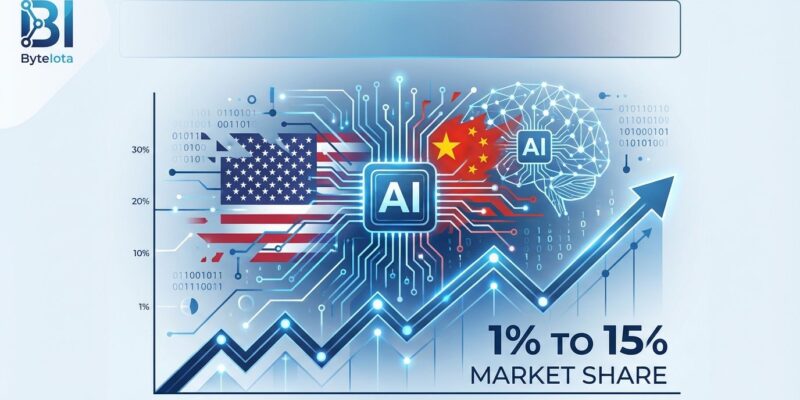
By Chinese AI models captured approximately 15% of global market share as of November 2025—a staggering jump from around 1% just one year earlier, according to a TrendForce report published today (January 26, 2026). DeepSeek, the open-source AI startup, now holds 4% of the global chatbot market alone. While US tech giants spent $527 billion on AI infrastructure in 2026, a Chinese hedge fund manager trained a competitive model for $6 million.
The Market Share Shock: 15x Growth in 12 Months
This is the fastest market share grab in AI history. Chinese AI models went from irrelevance to controlling 15% of the global market in a single year. DeepSeek leads the charge with 4% of the chatbot market, while Alibaba’s Qwen model family surpassed 700 million downloads by January 2026, making it the world’s most widely used open-source AI system.
The numbers tell a story US AI executives don’t want to hear. Approximately 40% of Chinese-developed AI models now handle advanced tasks like programming and design—capabilities once dominated exclusively by OpenAI, Google, and Anthropic. Japan provides the clearest evidence of this shift: six of the top 10 Japanese company AI models are built on DeepSeek or Qwen. Japan’s National Institute of Informatics even partnered with Alibaba’s Qwen for its LLM-jp initiative.
For context: Android took 3 years to reach 15% global smartphone market share. Chinese AI did it in 12 months.
How $6 Million Beat $527 Billion
DeepSeek’s R1 model cost $6 million to train. GPT-4 reportedly cost over $100 million. That’s a 16.7x cost advantage. DeepSeek achieved this through pure reinforcement learning—rewarding the model for correct answers rather than following human-selected reasoning examples. The automated trial-and-error approach eliminated expensive human annotation costs.
The cost efficiency extends to API pricing. DeepSeek charges $0.28 per million input tokens versus OpenAI’s $3.00—a 10.7x difference. For a chatbot processing 10 million tokens daily, GPT-4o costs $25/day ($750/month). DeepSeek costs $1.40/day ($42/month). That’s 94% savings.
Performance didn’t suffer. DeepSeek V3 scores 82.6 on HumanEval coding benchmarks versus GPT-4o’s 80.5. The model matches or beats OpenAI on technical tasks while costing 50x less. US companies built $30 million per megawatt data centers to run AI workloads. DeepSeek built a better product in a Hangzhou office.
Open-Source as Competitive Weapon
Chinese AI companies weaponized open-source distribution. While OpenAI and Anthropic lock models behind APIs, DeepSeek and Qwen offer free downloads. Developers can run models locally, customize them for specific use cases, and deploy without vendor lock-in. This removes adoption barriers and accelerates community momentum.
Qwen’s 700 million downloads prove the strategy works. Developers don’t just use Qwen—they build on it, improve it, and distribute derivative models. This creates a network effect US companies can’t match with closed-source approaches. Meta attempted this with Llama, but Chinese models moved faster and gained more traction.
The founder behind DeepSeek understood this from day one. Liang Wenfeng, a 40-year-old quantitative hedge fund manager, co-founded High-Flyer, which managed $14 billion in assets by 2021. When he launched DeepSeek in May 2023, he brought hedge fund discipline to AI development: maximize ROI, minimize costs, and beat competitors on value. He acquired 10,000 Nvidia A100 GPUs before US export restrictions hit—strategic foresight that gave DeepSeek the compute foundation to train R1.
US AI’s Profitability Crisis
Here’s the uncomfortable truth: there are no US-based AI firms of scale that are profitable right now. OpenAI, Anthropic, Google’s AI division, and Microsoft’s Azure OpenAI services all burn cash. US hyperscalers will spend $527 billion on AI capital expenditures in 2026, yet Chinese startups are building competitive models for a fraction of that cost.
The infrastructure advantage isn’t translating to market dominance. US companies bet that massive compute would create an insurmountable moat. DeepSeek proved otherwise. When a Chinese hedge fund can train a GPT-4-class model for $6 million, what’s the ROI on a $527 billion infrastructure buildout?
Pricing pressure is forcing US companies to cut API costs. DeepSeek’s launch triggered an AI price war across China, with competitors slashing rates. That pressure is spreading to US providers. OpenAI recently reduced pricing on several models. The race to the bottom has begun, and US companies have the worst cost structures.
What This Means for Developers and Enterprises
Developers now have viable Chinese AI alternatives. DeepSeek’s APIs work with standard OpenAI-compatible clients. Performance is competitive on coding, data analysis, and reasoning-heavy tasks. The 50x cost savings matter for high-volume applications—customer support bots, code generation tools, data processing pipelines.
The trade-offs are real. Data privacy concerns exist when sending requests to Chinese servers. DeepSeek’s training included Chinese content policies, which may impact certain outputs. Geopolitical risk is a factor—Taiwan already banned DeepSeek, and other countries may follow. Enterprise compliance teams are evaluating whether Chinese AI fits their security policies.
But the competitive landscape has shifted. US AI providers can no longer assume customers will pay 50x premiums based solely on brand reputation. Cost-conscious startups and enterprises are testing Chinese models. If performance holds and costs stay low, market share will continue shifting.
Can US AI Justify the Premium?
Chinese AI models will likely continue gaining market share in 2026. Analysts expect momentum to accelerate, driven by Beijing policy support, improved funding, and growing talent pipelines. Google DeepMind CEO Demis Hassabis told MIT Technology Review that Chinese models are “a matter of months” behind US capabilities—and that gap is closing faster than expected.
The critical question isn’t technical anymore. DeepSeek proved Chinese AI can match US performance. The question is economic: Can US companies justify 50x price premiums when open-source Chinese models deliver similar results? Infrastructure spending of $527 billion doesn’t guarantee market control if customers choose cheaper alternatives.
US AI companies face a strategic dilemma. Cut prices to match Chinese competition and destroy profitability timelines, or maintain premium pricing and watch market share erode. Neither option is appealing. Meanwhile, DeepSeek’s hedge fund founder is already working on the next model, optimizing for efficiency and ROI.
The AI market is no longer a US monopoly. Chinese models went from 1% to 15% in 12 months. The infrastructure advantage didn’t matter. Cost efficiency won.