 By ByteBot
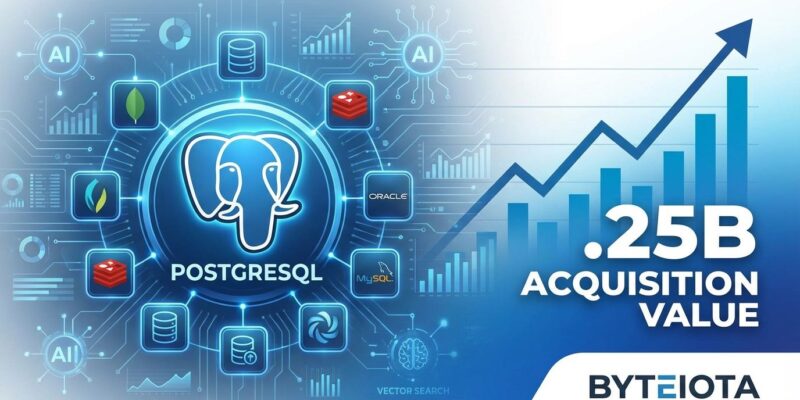
PostgreSQL decisively won the database wars in 2025. The proof? Databricks paid $1 billion for Neon in May, followed weeks later by Snowflake’s $250 million acquisition of CrunchyData. Stack Overflow’s 2025 developer survey confirms what the market already knew: 55.6% of developers use PostgreSQL—the highest share by over 15 percentage points. This isn’t hype. This is consolidation around a clear winner.
The trajectory tells the story. In 2017, PostgreSQL ranked fourth, trailing MySQL by 30 percentage points. Eight years later, it’s the most used, most desired, and most admired database for three, five, and four consecutive years respectively. That’s a 45% market share swing. All major cloud providers now offer PostgreSQL services—Amazon Aurora, Google AlloyDB, Microsoft’s new HorizonDB, IBM Cloud PostgreSQL, and even Oracle capitulated with its own PostgreSQL service. When your biggest competitor starts selling your product, you’ve won.
The $1.25 billion in acquisitions validates what developers chose years ago. Neon brought 18,000+ customers including OpenAI, Adobe, and Boston Consulting Group. CrunchyData’s 100 employees carry a decade of enterprise and government PostgreSQL expertise. These aren’t acquihires. These are billion-dollar bets that PostgreSQL is the foundation for AI workloads, which explains why both acquisitions happened in the same quarter and focused on the same technology.
Vector Search Became Baseline, Not Optional
The database landscape fundamentally shifted in 2025: vector search went from niche requirement to baseline expectation. Andy Pavlo, the CMU professor whose year-end retrospective defines industry consensus, states it plainly: “Database + vector search is now the baseline, not the exception.” The vector database market backs this up, growing from $1.73 billion in 2024 to a projected $10.6 billion by 2032.
AI workloads drove this shift. Retrieval-Augmented Generation, semantic search, and recommendation systems require combining LLMs with proprietary data. That means high-throughput vector search tightly coupled to transactional data. Following OpenAI’s March 2025 endorsement of Model Context Protocol (MCP), virtually every database vendor released MCP servers—standardized interfaces allowing LLMs to interact with databases. The result? By July 2025, AI agents created 80% of Neon’s new databases. Not developers. Agents.
This creates a security reckoning. Pavlo warns: “Lazy practices like admin access for every account will get wrecked when LLMs start operating in your database system.” Enterprise database systems possess automated guardrails—IBM Guardium, Oracle Database Firewall—that open-source alternatives lack. Vector search isn’t just a feature. It’s table stakes for 2026, and the security model needs to match.
Market Consolidation: Winners Raised Billions, Losers Shut Down
The cloud database market reached $24 billion in 2025 with projected 20% annual growth to 2030. But that growth concentrated among winners. Databricks raised $5 billion across two rounds. ClickHouse secured $350 million Series C. Supabase closed $200 million Series D. Meanwhile, five database companies shut down: Fauna (May 2025), Voltron Data, PostgresML, Hydra, and MyScaleDB.
Fauna’s closure statement reveals the calculus: “In the current market environment, our board and investors have determined that it is not possible to raise the capital needed to achieve that goal independently.” The market environment they reference? Venture capital shifted entirely to LLM companies, abandoning database infrastructure. Voltron Data’s failure stings more—$110 million raised, impressive team, and they couldn’t ship their GPU-accelerated database Theseus in time. GPU databases remain vaporware while CPU-based systems maintain dominance through optimization maturity.
The acquisition wave extended beyond PostgreSQL. IBM acquired DataStax (~$3B) and Confluent (~$11B). Salesforce bought Informatica for $8 billion. Fivetran and dbt Labs merged in October 2025, creating an ETL powerhouse. The pattern: consolidation around proven technologies with clear AI positioning. If you’re evaluating database technology for 2026, favor vendors with demonstrated funding potential or obvious acquisition targets. The middle tier is disappearing.
Serverless Won, S3 Won Storage
“S3 is the new disk” evolved from hypothesis to industry consensus in 2025. Most databases built in the last two years use S3 as their storage foundation: NeonDB, RockSet, Supabase, Databend, TiDB Cloud Serverless. Hyperscalers extended autoscaling and pay-per-use models across database types. Serverless isn’t experimental anymore. It’s the mainstream deployment model.
The operational benefits are obvious: no capacity planning, no server provisioning, automatic scaling, cost aligned with actual usage. Neon’s serverless PostgreSQL attracted 18,000+ customers before its $1 billion acquisition. The trade-off? Vendor lock-in increases when your storage layer is S3. But most teams accept that trade-off gladly. Managing database infrastructure isn’t a competitive advantage. Serverless removes the operational burden, and 2025 proved the model works at scale.
What Developers Need to Know for 2026
The 2025 database landscape delivered four clear signals for architecture decisions in 2026. First, PostgreSQL is the default choice. The $1.25 billion in acquisitions, 55.6% developer usage, and universal cloud provider support make this the safest, most future-proof decision. The ecosystem offers the most opportunity, the strongest community, and enterprise backing that eliminates adoption risk.
Second, vector search capabilities are table stakes. AI workloads aren’t optional anymore—they’re baseline expectations. If your database strategy doesn’t include vector search, you’re building for 2023, not 2026. The agents creating 80% of Neon’s databases aren’t going away. They’re accelerating.
Third, market consolidation means fewer independent vendors but more mature offerings. The funding environment killed the middle tier. Favor technologies with clear paths to profitability or obvious acquisition value. Early-stage database startups face brutal capital constraints while hyperscalers extend their leads.
Fourth, serverless is mainstream. The S3 storage consensus and pay-per-use economics reduce operational burden. The vendor lock-in trade-off is real, but the alternative—managing database infrastructure—costs more in engineering time than it saves in flexibility.
PostgreSQL won. Vector search is baseline. Consolidation accelerated. Serverless matured. Those four trends will define database architecture decisions for 2026 and beyond. The database wars are over. PostgreSQL won, the market consolidated around proven technologies, and AI workloads redefined baseline requirements. Choose accordingly.