
 By ByteBot
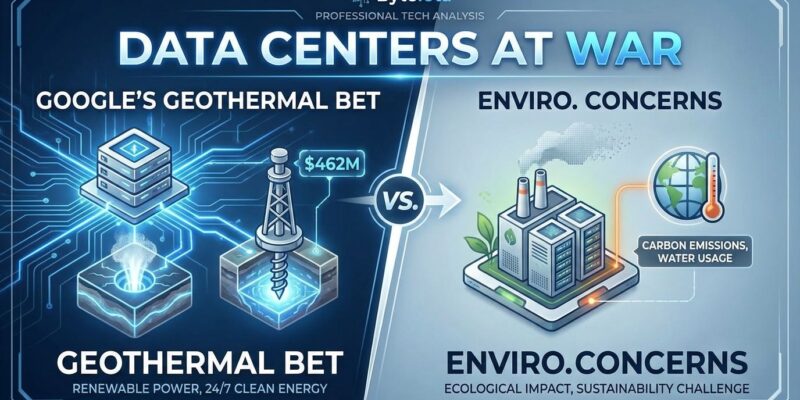
While 230+ environmental groups sent Congress a letter demanding a total halt to data center construction on December 8, Google had other plans. Two days later, the tech giant invested in Fervo Energy’s $462 million funding round—to build more data centers. The clash isn’t subtle: one side says “stop everything,” the other says “full speed ahead, but with geothermal energy.” Can the AI boom be sustainable, or are we accelerating toward an environmental crisis with green marketing spin?
The Environmental Case: Numbers Don’t Lie
The environmental groups aren’t crying wolf. U.S. data centers consumed 183 terawatt-hours of electricity in 2024—over 4% of the country’s total—and that figure is expected to triple by 2035. Virginia alone dedicates 26% of its electricity to data centers. Electricity prices jumped 13% this year, the largest annual increase in a decade.
Water consumption is equally staggering. Large data centers gulp down 5 million gallons daily, equivalent to a town of 10,000 to 50,000 people. AI chips generate ten times more heat than predecessors, demanding liquid cooling systems that evaporate 80% of the water they draw.
The letter from Food & Water Watch, Greenpeace, Friends of the Earth, and 227 other organizations demands a national moratorium until adequate regulations exist. Protests erupted in Detroit against an OpenAI/Oracle facility, and three people were arrested at a Wisconsin council meeting over a data center project.
Tech’s Answer: Geothermal Energy at Scale
Tech giants have a response: enhanced geothermal energy. Fervo Energy’s $462 million Series E round, led by B Capital with Google and 25+ other investors, will complete the 500-megawatt Cape Station plant in Utah and launch development on multiple new sites. The first phase targets 2026 for operational status.
Enhanced geothermal works like fracking for heat. Fervo drills 8,500 feet down to reach rocks at 450°F, then uses horizontal drilling to access more hot rock per well. Cold water gets injected, hot water gets collected, and the same fluid recirculates for 20 to 30 years. The pitch: “always-on” clean energy, unlike solar and wind’s intermittency.
The Rhodium Group projects that geothermal could economically meet 64% of new data center power demand by the early 2030s. Meta signed a 150-megawatt geothermal agreement in June. Google’s Project Red in Nevada is already operational.
The Timeline Problem: Is Geothermal Fast Enough?
Here’s the problem: Cape Station delivers 500 megawatts in 2026. McKinsey estimates the AI boom needs 156 gigawatts by 2030—that’s 312 Cape Stations in five years. Companies are spending $375 billion on AI infrastructure in 2025 alone, a 67% surge. The demand is now, not “early 2030s.”
Geothermal isn’t without issues. It requires water for injection and can trigger low-level seismic activity. And 53% of Americans oppose expanding hydraulic fracturing for any reason, even clean energy. Calling it “enhanced geothermal” instead of “geothermal fracking” is clever marketing.
The Data Center Coalition counters that halting construction would “jeopardize digital infrastructure essential to contemporary life” and risk U.S. economic competitiveness. But environmental groups ask: why not pause until the clean energy infrastructure actually exists?
Developers Caught in the Middle
For developers, this isn’t abstract. Every app, every ML model, every CI/CD pipeline runs in a data center. Cloud revenues are projected to hit $2 trillion by 2030, with generative AI accounting for $200 to $300 billion. Hyperscale companies spent $81 billion on capex in Q1 2025, a 71% year-over-year jump. Those costs get passed down.
A construction moratorium could slow innovation and spike prices. But the status quo isn’t working either. Rising utility bills, water scarcity, and climate impact are real concerns.
What Happens Next
Congress is unlikely to impose a moratorium. The industry has framed this as economic competitiveness—fall behind on AI, lose to China. State-level regulations are more probable. Virginia, Pennsylvania, and other hubs are already tightening water permits and grid requirements.
Geothermal is the litmus test. If Fervo and others scale from gigawatts to hundreds by 2030, tech giants claim vindication. If they can’t, environmental groups were right: this was buying time to build fossil-fuel-powered centers while waving a green flag.
Tech giants are betting $462 million that geothermal is the answer. Environmental groups bet it’s not enough, not fast enough. Developers? We’ll find out which side was right—and feel the impact either way, whether through constrained infrastructure, higher costs, or consequences of unchecked growth.
The question isn’t whether we need data centers. It’s whether we can build them fast enough to satisfy the AI boom and sustainably enough to avoid an environmental reckoning. Right now, nobody has a convincing answer.


