
 By ByteBot
The Infrastructure Wall
The AI boom promised unlimited cloud capacity. Instead, it’s hitting a $64 billion wall—and it’s not technical, it’s political.
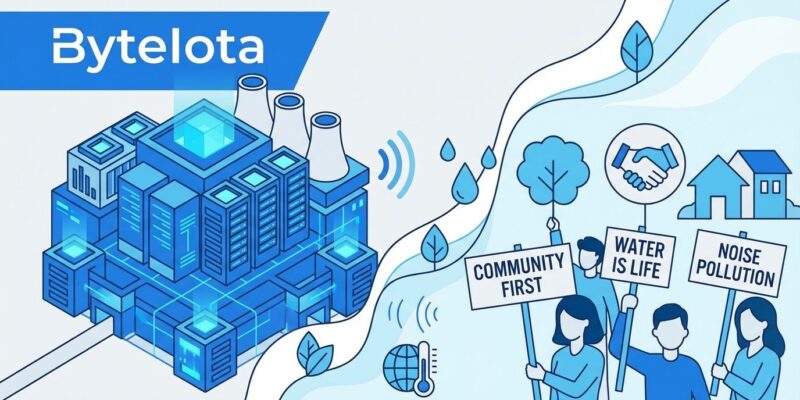
Data Center Watch reports $64 billion in data center projects have been blocked or delayed due to grassroots opposition in 2025. Opposition grew 125% in Q2 alone, with 142 activist groups across 24 states organizing against new facilities. Between March and June, $98 billion in investments stalled in a single quarter.
This isn’t typical NIMBY opposition. It’s bipartisan, systematic, and has real implications for cloud pricing and availability. Cloud infrastructure isn’t abstract—it’s physical data centers that need water, power, and community approval. When communities say no, developers’ deployment options shrink.
The Numbers Behind the Pushback
The scale is unprecedented. According to TechCrunch’s year-end analysis, 66% of tracked data center projects are currently stalled or blocked. The resistance crosses political lines—Michigan’s Democratic Attorney General Dana Nessel rallied alongside Republican State Rep. Jim DeSana at a December 16 protest demanding a statewide moratorium.
Communities aren’t opposing data centers on ideology. They’re opposing measurable impacts.
Water consumption leads the concerns. A single data center can consume up to 5 million gallons of drinking water per day—enough to supply thousands of households. Texas data centers will use 49 billion gallons in 2025, projected to reach 399 billion gallons by 2030. Meta’s facility in Newton County, Georgia uses 500,000 gallons daily, accounting for 10% of the entire county’s water consumption.
Noise pollution from backup diesel generators reaches 100 decibels—harmful to hearing above 85 dB. These generators, tested weekly for 10 minutes to an hour, can sound like “45 locomotive engines” according to local reports. One Virginia resident described the constant hum of cooling systems as “living beside a perpetually idling airplane.”
Air quality data reveals diesel backup generators pollute 200-600 times more than natural gas-fired power plants, per a University of California, Riverside study. They emit nitrogen oxides and fine particulates while remaining exempt from Clean Air Act regulations during “emergencies.”
These aren’t abstract concerns. They’re measurable impacts that explain why opposition is bipartisan—everyone near a data center deals with the same water bills, noise, and air quality.
When Political Pressure Fails
Chandler, Arizona’s city council voted 7-0 against a proposed $2.5 billion AI data center on December 11, 2025. Public comments ran 25 to 1 against the project. Cheers and applause erupted after the unanimous vote.
Former U.S. Senator Kyrsten Sinema had lobbied for the project, warning city officials that the Trump administration could force approval. The council rejected it anyway. Mayor Kevin Hartke called it “refreshing to see so many people involved and voicing their opinions.”
In Michigan, over 100 people rallied at the State Capitol on December 16 for a statewide moratorium on new AI data centers. Bipartisan legislators are sponsoring a three-bill package to repeal sales and use tax exemptions. Wisconsin saw coordinated protests across six cities on December 1-2, opposing a $15 billion OpenAI and Oracle campus in Port Washington.
Virginia, home to 13% of the world’s data center operational capacity with nearly 600 facilities, has seen 9 of 16 blocked or delayed projects nationwide. Governor Glenn Youngkin vetoed a bill in November requiring land assessments for projects within 500 feet of homes and schools—but opposition continues growing.
When a city council votes 7-0 against a project despite a former Senator’s lobbying, that’s not NIMBY. That’s a trend.
Cloud Economics Under Pressure
Developers assume cloud scales infinitely. Physical and political limits challenge this assumption.
Cloud spending is already growing—$723.4 billion globally in 2025, up 21.5% year-over-year. Infrastructure-as-a-service is growing 25.6%, platform-as-a-service 20.6%. Demand is surging while supply faces systematic constraints.
If data centers can’t be built, cloud capacity tightens. Virginia holds 13% of the world’s capacity and is the epicenter of opposition. When key regions can’t expand, geographic distribution becomes a problem. Reduced competition as fewer new facilities launch means higher costs passed to developers.
Data center electricity consumption is expected to double from 17 gigawatts in 2022 to 35 GW by 2030. Making a five-second AI-generated video uses as much electricity as running a microwave nonstop for over an hour. The infrastructure demands are real, but so is the resistance.
Budget planning needs to account for potential price increases. Deployment strategies may need geographic redundancy as some regions become hostile to data center expansion. Cloud infrastructure isn’t just a technical problem—it’s a political one.
The Distributed Alternative
Infrastructure constraints often drive innovation. Opposition may inadvertently accelerate architectural shifts already underway.
Edge computing brings computation closer to users through distributed nodes rather than centralized megafacilities. The model reduces reliance on large data centers that trigger community opposition. It’s already gaining traction for latency reduction—infrastructure opposition adds economic incentive.
Hybrid models mixing cloud, edge, and on-premise infrastructure reduce dependency on any single type. What started as a technical optimization may become a necessity if data center expansion remains systematically blocked.
The push toward distributed architectures isn’t just about performance anymore. It’s about navigating political and social constraints that make centralized infrastructure harder to build.
The Physical Reality of Cloud
Cloud infrastructure isn’t abstract. It’s diesel generators loud enough to cause hearing damage, water consumption rivaling small cities, and air pollution hundreds of times worse than alternatives.
TechCrunch characterized the political dynamic as “not Democrats on one side and Republicans on the other. It’s often disparate local interests banding together against state-level or corporate decision-makers.” When opposition crosses party lines and grows 125% in a single quarter, developers need to pay attention.
The $64 billion in blocked projects represents more than construction delays. It signals a fundamental tension between tech’s infrastructure demands and the communities bearing the costs. Whether through edge computing, hybrid architectures, or improved data center efficiency, the industry will need to adapt.
The AI boom isn’t just constrained by chip supply or model improvements. It’s constrained by whether people want these facilities in their backyards—and increasingly, they’re voting no.


