
 By ByteBot
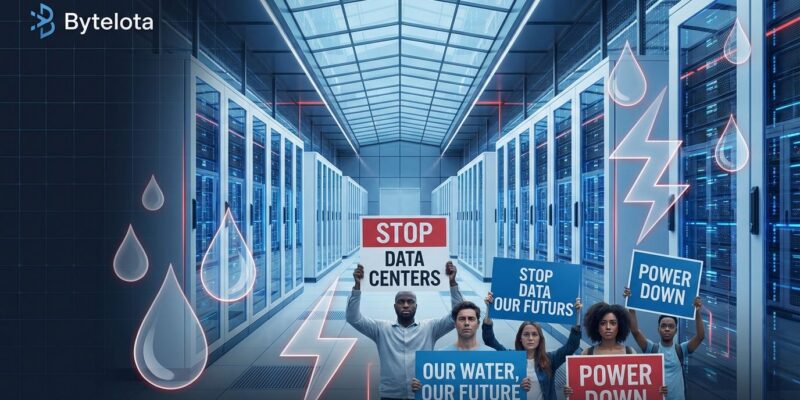
A grassroots movement opposing AI data center construction blocked or delayed $64 billion in projects across the United States in 2025, according to a December report by Data Center Watch. The opposition grew from isolated complaints to 142 organized activist groups across 24 states, culminating in Senator Bernie Sanders (I-VT) becoming the first member of Congress to endorse a national moratorium on December 17. He doubled down on CNN’s State of the Union on December 28, arguing data centers benefit “the 1%” while communities pay through higher utility bills and environmental degradation.
This isn’t just environmental activism—it’s forcing a fundamental rethink of cloud infrastructure. AWS, Microsoft Azure, and Google Cloud all reported capacity constraints in 2025. The data center moratorium movement could exacerbate supply issues, driving up cloud costs and pushing developers toward edge computing alternatives.
From NIMBY to National Movement
Data Center Watch identified 142 activist groups across 24 states successfully blocking or delaying $64 billion in data center investments from May 2024 through December 2025. In Q2 2025 alone, nearly $98 billion in projects were blocked or delayed—more than all disruptions tracked since 2023.
Bernie Sanders’ December 17 moratorium endorsement marked a political inflection point. “We need to be thinking about who is aggressively pushing AI… people like Elon Musk, Jeff Bezos, Mark Zuckerberg, Bill Gates,” Sanders said on CNN December 28. “The data center moratorium will give democracy a chance to catch up, and ensure benefits work for all of us, not just the wealthiest people on Earth.”
Moreover, more than 200 organizations—faith groups, physicians, environmental coalitions—now back the nationwide halt. Coordinated protests erupted across Wisconsin in December, while Michigan activists rallied against a $7 billion data center project.
Water, Power, and Broken Promises
Communities cite three primary grievances. Large data centers consume up to 5 million gallons of water daily—equivalent to a town of 10,000 to 50,000 people. Meta’s Newton County, Georgia facility uses 500,000 gallons per day, accounting for 10% of the county’s water consumption.
Furthermore, power grid strain is equally severe. U.S. data centers consumed 183 terawatt-hours in 2024, representing 4% of national electricity. In Virginia, data centers consume 26% of the state’s electricity. The PJM grid operator, serving 65 million customers, warned it “can’t handle more data centers” and urged federal regulators to block new projects.
Residents face rising bills. The PJM capacity market saw a $9.3 billion price increase, translating to $18 per month increases in western Maryland. Meanwhile, promised jobs rarely materialize—automated facilities deliver 50 employees instead of 500.
When Opposition Wins: AWS Retreats
In July 2025, Amazon Web Services withdrew its application for a 7.2 million square foot data center in Louisa County, Virginia after community pushback. Roughly 100 residents packed a June town hall, raising concerns about noise, traffic, water, and energy bills.
AWS rarely backs down. An attorney for the company stated they “heard the community.” The withdrawal proves organized local opposition can defeat the world’s largest cloud provider.
Cloud Capacity Crunch Ahead
AWS, Microsoft Azure, and Google Cloud all reported capacity constraints in 2025 due to hardware shortages and power limitations. Microsoft expects to remain capacity-constrained through H1 2026, with CapEx exceeding $30 billion in Q1 alone. Google increased 2025 CapEx by $10 billion to $85 billion.
The data center moratorium movement compounds supply issues. Blocked projects mean less capacity, driving up costs and restricting regional availability. Global cloud spending is projected to exceed $679 billion in 2025, up from $563 billion in 2023.
For developers, the moratorium represents a new risk factor. Regional restrictions are likely, particularly in the PJM grid area spanning Illinois to North Carolina. If you’re betting on AWS expanding capacity in Virginia or Wisconsin, organized resistance could delay or cancel those plans.
Edge Computing as Alternative
Gartner predicts that by 2025, 75% of enterprise data will be processed outside traditional data centers. The edge computing market is estimated at $164.7 billion in 2025, with edge data centers projected to grow from $20.62 billion in 2024 to $109.78 billion by 2034.
Additionally, edge infrastructure offers lower water and power consumption—air-cooled systems using 1-10 megawatts versus 100+ megawatts for centralized data centers. Edge deployments also avoid regulatory opposition. When hyperscalers hit capacity limits in 2025, “neocloud” providers offering GPU-as-a-Service captured market share.
Edge computing isn’t the future—it’s a strategic hedge against regulatory risk now. Developers should evaluate whether workloads can run closer to users, bypassing massive centralized facilities that trigger community opposition.
Democracy Catches Up
When 100 residents can force AWS to retreat, something fundamental has changed. Cloud giants spent $380 billion on infrastructure in 2025, and communities responded with organized resistance backed by a U.S. Senator. The $64 billion in blocked projects suggests the current hyperscale model faces existential challenges. Cloud providers that adapt to edge architectures win. Those betting on hyperscale expansion may find themselves fighting 142 activist groups and a hostile political environment.


