 By
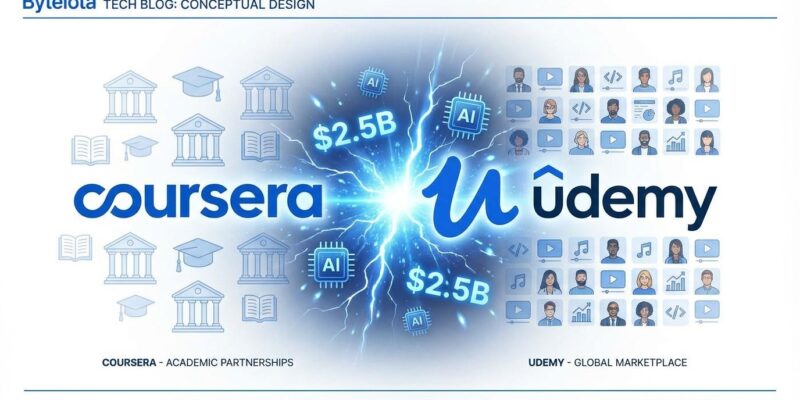
By Coursera announced on December 17, 2025, that it’s acquiring Udemy in a $2.5 billion all-stock merger, combining the two largest online learning platforms into a single giant serving 270 million learners and 19,000 enterprise customers. The deal explicitly targets the corporate AI skills training market, with “AI” mentioned 11 times in the press release. However, the stock market didn’t buy it—Coursera shares fell 7-11% on the announcement, signaling investor skepticism about the merger’s value and integration challenges.
The Market’s Verdict: Not Convinced
When Coursera announced the merger, shares dropped 7-11% while Udemy jumped 22%. Stock prices are truth detectors, and this reaction reveals investor doubts about the deal’s strategic value. Both companies have struggled this year—Udemy is down 35% year-to-date, Coursera down 7%—suggesting this is defensive consolidation in a struggling market, not a growth opportunity.
The concerns are real. The all-stock structure dilutes existing Coursera shareholders, and both companies face sector headwinds including uncertain returns from AI investments and growing competition from free alternatives like ChatGPT and Claude. Moreover, the merger combines two fundamentally different business models that have never coexisted successfully. Investors are right to be skeptical.
Oil and Water: Two Business Models That Don’t Mix
Udemy operates as an open marketplace where anyone can create and sell courses. With 26,000+ instructors and 250,000+ courses, it prioritizes breadth over depth. Instructors range from world-class experts to enthusiastic amateurs, creating quality inconsistency but offering hands-on, practitioner-led content at lower price points ($10-200).
Coursera, by contrast, runs a curated platform with partnerships from 325 universities and institutions. Only professors and verified experts teach. Courses emphasize academic rigor, credentials, and career advancement, with prices ranging from $30 to $80,000 for full degrees. It’s quality-controlled, accredited, and focused on credentials over casual learning.
How do you merge these? Will Coursera’s quality standards exclude 26,000 Udemy instructors? Will the platform lose the practical, hands-on courses that developers actually use? Integration will mean course pruning, instructor attrition, and likely a shift toward enterprise-focused, credential-heavy content. Udemy instructor Maximilian Schwarzmüller captured the uncertainty: “Learning a brand that was THE main part of my professional life for the last 10 years will go away is really very, very sad.”
The AI Skills Gold Rush (Or Just Marketing Hype?)
The official narrative is clear: this merger will “empower the global workforce with skills for the AI era.” Coursera and Udemy are betting on exploding corporate demand for AI training. In 2025, enterprises invested $18 billion in AI infrastructure, and enterprise learning platforms are pricing at $15-30 per user. With 90% of organizations facing critical skills gaps, the market opportunity seems real.
But here’s the problem: every edtech platform is chasing the same “AI skills training” narrative right now. LinkedIn Learning, Pluralsight, O’Reilly—all pivoting to AI. And the biggest threat? Free AI tutors like ChatGPT and Claude can teach developers anything they want, on demand, without a subscription. Why pay $15-30 per user for structured courses when you have an LLM personal tutor in your pocket?
The stock market’s 7-11% drop suggests investors aren’t convinced the AI skills narrative justifies a $2.5 billion bet. The World Economic Forum stat that “39% of workers’ core skills will become outdated by 2030” sounds compelling until you realize that doesn’t mean those workers will turn to paid MOOCs for retraining.
Less Competition, Higher Prices Ahead
The merger consolidates the top two MOOCs into a single entity, reducing competitive pressure. Fewer alternatives typically mean higher prices, and 19,000 enterprise customers now face a platform with monopoly-like pricing power. The projected $115 million in “cost synergies” translates to layoffs and platform consolidation, not lower prices for customers.
Meanwhile, competitors are all losing market share year-over-year. Pluralsight dropped from 34.5% to 28.6%, LinkedIn Learning from 7.6% to 7.3%, and O’Reilly from 8.2% to 7.9%. This suggests market fragmentation or growth in alternative pathways like bootcamps, micro-credentials, and free resources. The Coursera-Udemy merger looks less like growth strategy and more like two struggling giants clinging together for survival.
Developers should diversify platforms now. Don’t lock into the Coursera-Udemy ecosystem expecting stable pricing or course variety. LinkedIn Learning, Pluralsight, and O’Reilly remain viable alternatives, and bootcamps offer faster, job-focused training for specific skills.
What Developers Should Expect
Nothing changes immediately. The deal won’t close until the second half of 2026, pending regulatory approval and shareholder votes. But once approved, expect a messy 2-3 year integration starting in 2027.
Platform consolidation will mean duplicate courses removed, unified UI/UX, and forced account merges. Pricing is uncertain, but reduced competition suggests increases are likely—especially for enterprise contracts. The 26,000+ Udemy instructors face potential course removal, revenue changes, and quality standardization that may exclude niche or hands-on content.
For developers, the smart move is simple: don’t commit to long-term Coursera or Udemy subscriptions until post-merger clarity emerges. Download certificates for completed courses now in case account migrations go poorly. And explore alternatives—LinkedIn Learning’s integration with Microsoft, Pluralsight’s strong dev/IT focus, or O’Reilly’s extensive tech library all offer competitive options without the merger uncertainty.
The stock market’s reaction tells the real story here. When a company announces an “AI skills for the workforce” merger 11 times and the stock drops 7-11%, investors aren’t convinced. This isn’t a growth play—it’s two struggling platforms consolidating in a market increasingly dominated by free AI tutors and alternative pathways. Developers should watch closely, but they shouldn’t bet their learning budgets on it.