 By ByteBot
Addy Osmani, a Google engineering leader, published a blog post in March 2026 introducing “comprehension debt”—a new category of technical debt specific to AI-generated code. Unlike traditional technical debt that announces itself through slow builds and tangled dependencies, comprehension debt is invisible. Tests pass, code looks clean, PRs get merged, but nobody understands how the system works. This false confidence compounds until teams can’t make simple changes without breaking something unexpected.
The Speed Asymmetry Nobody’s Talking About
AI coding agents generate code 5-7x faster than humans can comprehend it. The numbers are stark: AI produces 140-200 lines of meaningful code per minute while focused developers write 20-40 lines per minute. This creates a review bottleneck where junior developers using AI can generate code faster than senior developers can audit it.
The traditional peer review model acted as a productive bottleneck—writing speed matched review capacity. AI flips this equation. Teams now merge 98% more pull requests but experience 91% longer review times. PRs are 18% larger and have 24% more incidents. Senior engineers spend 4.3 minutes reviewing each AI suggestion compared to 1.2 minutes for junior developers. The bottleneck shifted from writing to understanding, and review capacity stayed flat while PR volume climbed.
Anthropic Study: 17% Comprehension Decline
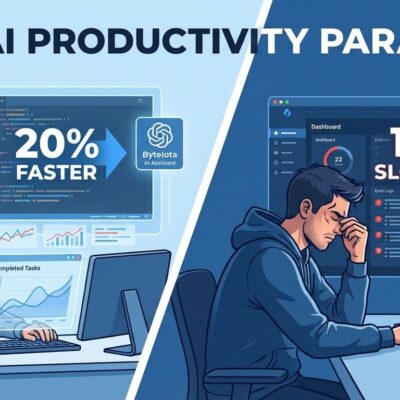
An Anthropic study published in January 2026 tracked 52 junior engineers learning Python’s Trio library. The results challenge the AI productivity narrative. Engineers using AI assistance scored 50% on comprehension quizzes versus 67% for the manual coding group—a 17% decline in understanding. The AI-assisted group completed tasks only 2 minutes faster, a difference that wasn’t statistically significant.
Debugging skills showed the steepest decline—precisely the critical skill needed when AI-generated code breaks. The pattern of AI usage mattered more than whether developers used AI at all. Developers who used AI for passive delegation (just generating code) scored below 40% on comprehension tests. Those who used AI for active inquiry (asking questions, exploring tradeoffs) scored 65% or higher. Organizations assume AI coding tools boost productivity, but the research shows minimal speed gains while comprehension needed for long-term maintenance quietly erodes.
Why Comprehension Debt Is Worse Than Technical Debt
Technical debt announces itself through mounting friction. Slow builds signal architectural problems. Tangled dependencies create known pain points. Developers feel the “creeping dread” when touching certain modules. These visible signals let organizations manage technical debt through prioritized refactoring.
Comprehension debt operates differently. The codebase looks clean. Tests are green. Formatting is impeccable. Code passes review. These signals historically triggered merge confidence because they indicated quality in human-written code. With AI-generated code, surface correctness masks systemic problems nobody understands.
Technical debt accumulates through conscious tradeoffs—teams deliberately take shortcuts knowing they’ll pay later. Comprehension debt accumulates invisibly through hundreds of “looks fine” reviews. Organizations can’t manage what they can’t see. By the time comprehension debt surfaces—when nobody can explain how the system works or make changes without breaking it—the damage is systemic.
The Week 7 Wall: When Teams Hit the Ceiling
Margaret-Anne Storey documented a student team that used AI assistance throughout their project. By week 7, they hit a wall: “The team could no longer make simple changes without breaking something unexpected because nobody understood the system’s design rationale or how components interacted.” Rapid initial progress gave way to maintenance paralysis.
This pattern appears across the industry. An anonymous developer described the experience: “The tests passed. But every new feature felt like performing surgery with a chainsaw. I was solving problems without understanding systems. I was optimizing locally while destroying globally.” Another admitted, “I skimmed it, nodded, merged. Three days later I couldn’t explain how it worked.”
Teams optimize for velocity metrics—”tests pass, ship it”—without maintaining the understanding needed to modify systems safely. Short-term velocity gains create long-term maintenance crises. The week 7 wall isn’t a distant future problem. Teams are hitting comprehension ceilings right now.
How to Maintain Understanding With AI Tools
Osmani recommends treating comprehension as a structural constraint, not an afterthought. Organizations can gain AI’s speed benefits without accumulating invisible debt if they implement comprehension gates.
Score your comprehension before merging. Rate understanding on a 1-5 scale: 5 means you could teach this to a colleague right now, 3 means you understand the main approach but need time on edge cases, 1 means you have no idea how it works. Reject merges below 3. This simple gate prevents comprehension debt from entering the codebase.
Apply the three-file protocol after each AI agent session. Fully read—don’t skim—the three files with the largest diffs. Trace complex paths end-to-end. This is where actual comprehension happens, not in reviewing green test results.
Use AI for active inquiry, not passive delegation. The Anthropic study proves the pattern matters. Ask questions, explore tradeoffs, request explanations. Don’t just generate code. Developers using this approach score 65%+ on comprehension while passive users score below 40%.
Read specs first, not code. Before reviewing any AI-generated implementation, articulate what the code should do, what constraints it should respect, and what patterns it should follow. Then trace the implementation against those expectations.
Making code cheap to generate doesn’t make understanding cheap to skip. The comprehension work is the job. AI handles the translation.
Key Takeaways
- AI generates code 5-7x faster than humans can comprehend it—the review bottleneck is real, not theoretical
- Anthropic study documents 17% comprehension decline with AI assistance, with debugging skills most affected
- Comprehension debt is invisible until crisis, unlike technical debt’s obvious friction
- Score understanding 1-5 before merging and reject anything below 3 to prevent debt accumulation
- Active inquiry (asking questions, exploring tradeoffs) yields 65%+ comprehension scores versus 40% for passive delegation
- Organizations must change metrics to track comprehension, not just velocity, for sustainable AI adoption