 By ByteBot
The University of Washington’s Paul G. Allen School of Computer Science & Engineering just declared “coding is dead.” Director Magdalena Balazinska told GeekWire in December 2025 that “coding, or the translation of a precise design into software instructions” has been killed by AI. The same week, Microsoft announced its final 2025 layoffs—15,000 employees total, with 40% targeting developers—as CEO Satya Nadella revealed GitHub Copilot now writes 30% of the company’s new code. Amazon followed with 14,000 cuts, citing AI’s ability to shrink its workforce. Developers everywhere are panicking. However, here’s the paradox both camps miss: coding IS dead, but programming has never been more valuable.
Coding vs Programming: The Line That Determines Your Future
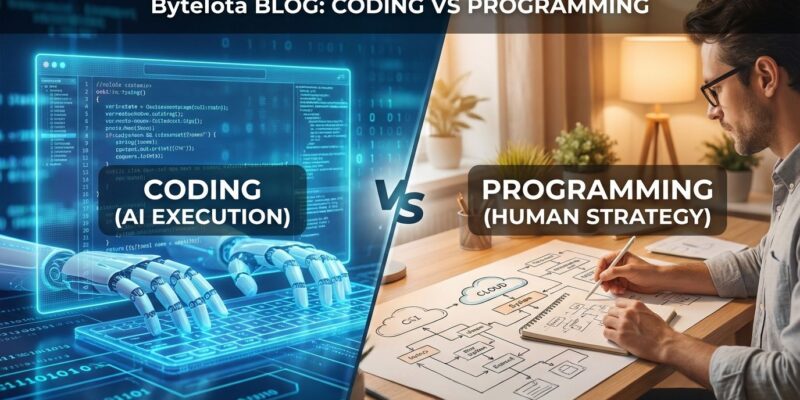
“Coding” is the mechanical translation of clear specifications into syntax. It’s taking a Jira ticket and writing the React component. Converting a Figma design into CSS. Implementing a straightforward API endpoint from documentation. AI has won this game completely. Tools like Cursor and GitHub Copilot generate boilerplate faster and more consistently than 80% of developers.
“Programming” is something else entirely. It’s taking a messy pile of human problems, vague requirements, budget constraints, and legacy systems—then converting that chaos into working software. It’s deciding whether a startup should use microservices or a monolith. Balancing performance against maintainability. Predicting where technical debt will bite hardest. Most critically, it’s owning the outcome when your architectural decisions fail at 3 AM.
Consequently, AI dominates well-defined problems with clear examples. It fails spectacularly at ambiguity. As one engineering blog put it: “Programmers who communicate, ship outcomes, and own responsibility are making $500k-$1M+ or building profitable businesses. Coders are competing with a $20/month subscription.”
Universities and Trillion-Dollar Companies Are Acting Now
This isn’t theoretical. The University of Washington—a top-10 computer science program—is completely rethinking its curriculum because “coding is dead.” Students now must use GPT tools in assignments and cite AI as a collaborator, just like crediting a fellow student. Moreover, the school added courses in AI ethics and natural language processing while shifting focus to “nimble problem-solvers who understand computing fundamentals.”
The message is clear: UW is graduating software engineers, not coders. Magdalena Balazinska emphasized, “We have never graduated coders. We have always graduated software engineers.” The curriculum changes reflect what the market already knows.
Meanwhile, corporate layoffs confirm it. Microsoft cut 15,000 roles in 2025, with 40% specifically targeting developers. The company’s internal data shows AI tools now perform many tasks previously done by junior programmers. Amazon’s 14,000 cuts came with CEO Andy Jassy’s warning that “AI will shrink the company’s workforce and we’ll need fewer people doing some of the jobs being done today.” Across the U.S. tech sector, 55,000 AI-related layoffs hit in 2025 alone—the highest number since the COVID-19 pandemic.
Some engineers reported being instructed months earlier to increase their reliance on AI tools, only to be replaced by those same tools they helped integrate. The irony is brutal, but the pattern is clear: companies are eliminating coding roles while increasing demand for programming expertise.
Why Both Camps Are Wrong About AI Replacing Developers
The debate has split into two camps, and both miss the point. Camp A panics: “Coding is dead, all developers are doomed.” They’re defending manual coding skills and arguing AI can’t write “good code.” Camp B dismisses AI entirely: “This is overhyped, nothing will fundamentally change.” They refuse to adopt AI tools and insist human coding remains superior.
Camp A is right that AI threatens their jobs, but wrong to defend coding. You cannot out-code Cursor. The tool reportedly writes better boilerplate than 80% of developers, and it’s improving every month. Defending coding speed as your core skill is like defending arithmetic speed after calculators arrived.
In contrast, Camp B is falling behind while congratulating themselves on “real developer” skills. Yes, AI has limitations. Yes, it makes mistakes. However, ignoring AI tools as “overhyped” while the market shifts under you is career suicide. Microsoft didn’t lay off 40% of developers because AI is overhyped.
The correct take: use AI for 80-90% of typing while maintaining 100% of judgment. Stop competing on coding speed. Focus on what AI cannot do—handling ambiguity, making architectural decisions, understanding business context, and owning production systems when they fail.
The Skills That Command $400k-$900k (And Those That Don’t)
Salary data reveals the bifurcation already happening. High-end programming roles emphasize problem-solving and system ownership with zero mention of coding ability. These positions command $400k-$900k or higher. Mid-tier “convert Figma to code” roles still exist at $80k-$140k, but they’re declining rapidly as companies automate them away.
Furthermore, the skills that matter in 2026 are the opposite of traditional CS education. Syntax memorization is worthless. Coding speed doesn’t pay. What commands premium salaries: system architecture, trade-off analysis between competing constraints, problem decomposition when requirements are vague, communication between business and technical stakeholders, and ownership—carrying the pager when production breaks at 3 AM.
AI-proof skills share a common thread: they require judgment under uncertainty. Should we optimize for read or write performance? Is this technical debt worth taking? Will this architecture scale to our projected growth? These questions have no single correct answer. They demand understanding of business context, team capabilities, timeline pressures, and long-term implications. AI can suggest options, but it cannot make the call.
Meanwhile, AI-automatable skills are exactly what traditional CS programs emphasized: syntax memorization, boilerplate writing, simple CRUD implementations, UI component translation from designs, and basic test generation. Every one of these tasks is now faster and more reliable when AI-generated.
Adapt or Disappear: The Choice Developers Face
The transition is happening whether developers like it or not. The choice is simple: become a programmer who uses AI tools, or become obsolete.
Stop defending manual coding as superior. Stop measuring your value by lines of code or pull requests merged. Stop competing on syntax knowledge or coding speed. These battles are already lost.
Start using AI for all boilerplate and repetitive patterns. Start measuring your impact by problems solved, not code written. Start practicing system design and architecture decisions. Start owning production deployments instead of throwing code over the wall. Start focusing on clarifying vague requirements before any code gets written. Therefore, use AI for 80-90% of the typing while maintaining 100% of the judgment.
The University of Washington has it right: graduate nimble problem-solvers who understand computing fundamentals and use AI as a collaborator, not a competitor. Developers who make this shift will command the premium salaries. Those who cling to “coding” as an identity will compete for shrinking roles against tools that cost $20 per month.
Consequently, the market is deciding now, not in five years. The question isn’t whether coding is dead—the University of Washington, Microsoft, and Amazon have already answered that. The question is: which side of the line are you on?