 By ByteBot
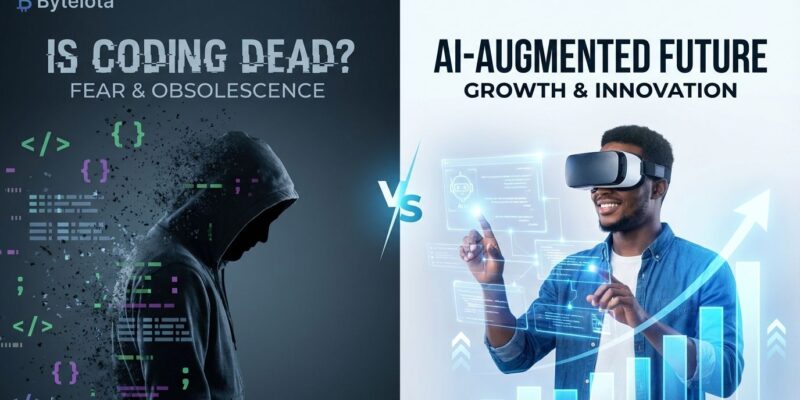
March 2026 and the “Is Coding Dead?” articles are flooding tech blogs again—Medium, DEV Community, Reddit all debating whether AI has finally killed programming careers. This is the same debate that’s cycled every six months since early 2023. Each time, a new AI capability or bold CEO prediction triggers fresh panic. But here’s what’s revealing: The answer matters less than why developers keep asking the question.
The Predictions That Keep Failing
Let’s start with the alarmist case. NVIDIA’s CEO claimed in February 2024 that “nobody will need to learn to code” thanks to generative AI. Anthropic’s CEO went further, predicting AI would replace software engineers within 6-12 months. Dario Amodei even stated, “I don’t write any code anymore. I just let the model write the code.”
However, these predictions have been consistently wrong. As one developer put it, “Software engineering has been within 6 months of being dead continually since early 2023″—yet here we are, with the U.S. Bureau of Labor Statistics projecting 15-17% job growth for software developers through 2034. That’s five times faster than the 3% average for all occupations, translating to 129,200 new job openings annually.
Moreover, the pattern isn’t new. Every major programming tool in history sparked identical fears—high-level languages in the 1950s, spreadsheets in the 1980s, visual programming in the 1990s, no-code platforms in the 2010s. AI is just the latest iteration. Each time, abstraction raised the level of programming but expanded what was possible, increasing rather than eliminating demand.
Is Coding Dead? What’s Actually Changing
Coding isn’t dying, but the work is fundamentally transforming. The data tells two stories that seem contradictory but aren’t: 84% of developers now use AI tools, and roughly 50% of code is AI-generated as of early 2026. Developers using AI see an average 31.4% productivity boost. Nevertheless, only 30% of AI-suggested code gets accepted—human review remains critical.
The real shift is in who’s affected. Junior developers face genuine challenges. “The junior developer role, as it was defined five years ago, has been completely absorbed by artificial intelligence,” according to industry analysis. Entry-level hiring at major tech firms dropped 25% from 2023 to 2024. McKinsey found that 25-30% of tasks previously handled by junior developers are now automated. Recent computer science graduates face unemployment rates of 6-7.5%, compared to the overall U.S. rate of 4.3%.
But senior developers? They’re insulated. AI can’t make architecture decisions, assess security trade-offs, or understand business context the way experienced engineers do. Furthermore, the skills commanding $150K-$400K+ salaries in 2026—system design, strategic judgment, AI oversight—remain firmly in human hands. AI handles 80-90% of typing and boilerplate. The remaining 10-20% that requires judgment? That’s where the value is.
Why the “Is Coding Dead” Debate Won’t Die
Every six months, the cycle repeats: alarmist article, counter-article, nuanced take, then silence until the next AI breakthrough reignites the panic. Why? Because the anxiety is rational even if the conclusion is wrong.
Change is visible and fast. Every new AI capability gets publicized. The entry-level market genuinely is tougher. Skill requirements are shifting in real-time. Consequently, for students deciding whether to pursue computer science or junior developers wondering if they’ll have careers in five years, the uncertainty is real.
Then there’s the clickbait economy. “Coding Is Dead” drives traffic, so the cycle perpetuates itself. In March 2026 alone, you can find contradictory headlines side by side: “Is Coding Dead in 2026?” next to “Think Coding Is Dead? Here’s Why You’re Wrong” next to “In 2026, Coding Is Dead—But Software Development Isn’t.” Each article gets clicks, each triggers anxiety, each misses the point.
The question “Is coding dead?” is really asking “Will I have a job in five years?” That’s a harder question to answer—and a worse headline. The debate persists because the transformation is real, but the timeline and nature are misunderstood.
Stop Asking If Coding Is Dead. Ask How It’s Changing.
Here’s the reframe developers need: The future isn’t about whether you’ll have a job, but what that job will look like. AI is a tool that amplifies capabilities, not a replacement that eliminates roles. Indeed, the developers thriving in 2026 aren’t the ones resisting AI—they’re the ones who mastered it early and shifted their focus upward.
The skills that matter now are different. System architecture matters more than syntax memorization. Problem decomposition—breaking complex challenges into AI-solvable pieces—matters more than typing speed. Domain expertise that provides business context AI can’t grasp matters more than knowing every framework. Additionally, security and compliance judgment, which AI can’t reliably provide, command premium salaries.
Meanwhile, skills losing value are exactly what you’d expect: boilerplate code generation, syntax recall, routine debugging, manual documentation. These are the 80-90% of tasks AI handles well. If that’s where you’re adding value, you’re vulnerable. But if you’re operating at the architecture, strategy, and judgment level? You’re more valuable than ever.
The market signals support this. LinkedIn and Indeed show strong demand for AI-proficient developers in 2026. Salaries for experienced developers remain stable or growing. The compression effect is real—companies hire smaller teams because AI amplifies productivity—but they’re hiring the right people at higher rates. Therefore, the bar for entry-level roles has risen, but the opportunities at mid and senior levels are expanding.
Key Takeaways
- The anxiety is justified, the panic isn’t: Software developer jobs are growing 17% through 2034, not disappearing.
- Junior roles are transforming, not dying: Entry-level market is tougher, but overall demand remains strong.
- AI amplifies capabilities: 84% of developers use AI tools, but only 30% of AI code gets accepted without review.
- Skills are shifting upward: Architecture, judgment, and domain expertise matter more than syntax memorization.
- Focus on adaptation: Master AI tools, shift skills toward high-value work, stop asking if coding is dead.
- Historical pattern repeats: Every major tool sparked identical fears. Each time, abstraction expanded rather than eliminated demand.
The “Is coding dead?” debate won’t end because it’s not really about coding. It’s about professional identity in an era of rapid technological change. Understanding this reframes everything: The profession is evolving, not dying. Developers who adapt will thrive. Those who resist will struggle. The question isn’t survival—it’s adaptation.