 By ByteBot
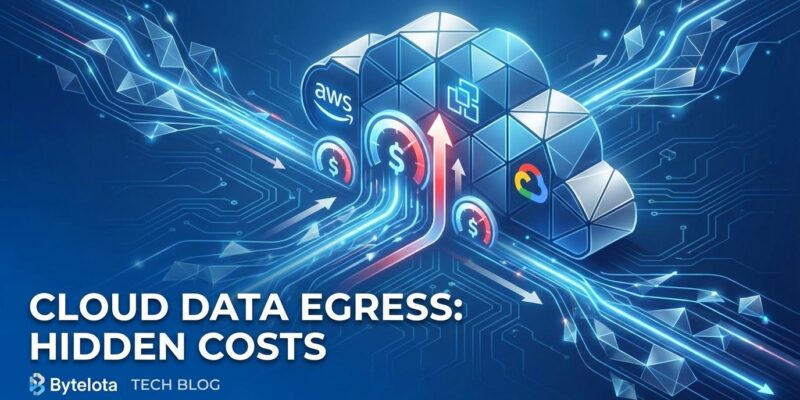
Cloud egress fees operate as a hidden tax costing enterprises 6% of their total storage spend—roughly $43 billion globally in 2025 as cloud spending hits $720 billion. While providers charge nothing for data entering their infrastructure, moving data out costs $0.085-$0.12 per GB across AWS, Azure, and Google Cloud. Companies like Vim faced $50,000 monthly bills for file distribution, while Data Canopy paid $20,000/month before optimization. These aren’t edge cases. One SaaS company saw egress costs jump from $200 to $3,500 monthly in 8 months, surpassing compute costs by 40%. The EU Data Act, which took effect September 12, 2025, mandates “at cost” pricing and complete abolition of switching-related egress fees by January 2027—but provider responses reveal just how little has actually changed.
Lock-In By Design, Not Accident
The “data is free to enter, but expensive to exit” pricing model serves dual purposes: revenue generation and vendor lock-in. By making data movement economically prohibitive, providers create what HyperFRAME Research characterizes as “significant commercial and technical barriers to multi-cloud strategies”—a quiet yet effective form of vendor lock-in that has operated unchallenged for years.
The numbers prove this isn’t accidental. When a fintech company expanded to EU and APAC regions, cross-region egress costs exploded from $900 to $4,300/month—a 380% increase despite user growth under 2x. That’s not infrastructure cost recovery. That’s migration deterrence priced into the service.
EU regulators agree. Google faced €11.2 billion in fines over anti-competitive practices including lock-in mechanisms. The regulatory message is clear: egress fees aren’t neutral pricing—they’re strategic tools for customer retention that penalize multi-cloud strategies and migration.
Cloud providers position egress fees as infrastructure cost recovery. But when migration barriers generate billions in revenue while stifling competition, that’s lock-in masquerading as pricing policy.
Regulatory Pressure Meets Compliance Theater
The EU Data Act, effective September 12, 2025, represents the first major regulatory constraint on egress fees. It mandates “at cost” pricing immediately and complete abolition of switching-related fees by January 2027. Providers responded with migration waivers that look generous but preserve operational egress fees untouched.
Google Cloud launched Data Transfer Essentials for EU/UK markets, offering no-cost data movement for multi-cloud workloads. Microsoft Azure confirmed EU users get “at cost” pricing for transfers to competitors. AWS offers egress fee waivers for migrations—but requires a 60-day exit, full data removal, and warns repeated requests face “additional scrutiny.”
The critical limitation: these waivers apply only to one-time migrations when leaving the platform. Normal operational egress fees ($0.085-$0.12/GB) remain unchanged. A developer running multi-cloud workloads, replicating data across regions, or serving content globally still pays full egress rates.
Provider “generosity” on migration waivers is regulatory compliance theater. The real test comes January 2027 when EU mandates full abolition of switching fees. Will providers extend changes globally or maintain fragmented policies that comply with the letter of the law while preserving the lock-in mechanism?
When Egress Costs More Than Compute
Egress fees aren’t a minor line item. For data-intensive applications, they often represent the largest single cloud expense, frequently surpassing compute costs.
The SaaS company that saw egress costs hit $3,500/month discovered those charges exceeded compute by 40%. An analytics platform found egress represented 25% of total cloud spend when automated BigQuery exports scaled from $150 to $2,800/month in six months. A marketing analytics firm discovered 60% of their egress fees—around $5,000/month—came from automated API exports they barely noticed.
IDC reports egress charges make up 6% of total storage spend across enterprises. For streaming and media services, egress can represent 50-70% of the cloud bill. A single disaster recovery test cost one manufacturing company $1,200 to restore 15TB of archived data—an unbudgeted surprise that wasn’t accounted for in DR planning.
The cost impact scales with business size:
- Small SaaS (1K-5K users): $50-$180/month (15-25% of cloud bill)
- E-Commerce (10K-50K users): $350-$1,700/month (20-30% of cloud bill)
- Enterprise Data (100K+ users): $2,500-$17,000/month (30-45% of cloud bill)
- Streaming/Media: $5,000-$85,000/month (50-70% of cloud bill)
Cloud cost optimization focuses heavily on compute—rightsizing instances, spot pricing, reserved capacity. But if your application moves significant data through analytics exports, content delivery, or cross-region replication, egress fees aren’t a footnote in your cloud budget. They’re the headline.
Alternative Providers Prove Egress Fees Aren’t Inevitable
While traditional cloud providers defend egress fees as infrastructure cost recovery, alternative object storage providers prove the model isn’t inevitable. Cloudflare R2, Wasabi, and Backblaze B2 offer zero-egress storage that can reduce costs by 80-100% for storage-heavy workloads.
Cloudflare R2 charges $0.015/GB for storage (35% cheaper than AWS S3’s $0.023/GB) with $0 egress fees and S3-compatible APIs. Wasabi offers even cheaper storage at $0.00699/GB with zero egress, though it requires 90-day minimum retention. Vim avoided a $50,000/month egress bill by shifting software artifact distribution to Cloudflare R2, completely eliminating charges that were making their operations unsustainable.
The existence of profitable zero-egress providers proves egress fees aren’t necessary for sustainable infrastructure. They’re a choice—one that favors lock-in over customer value.
The trade-offs are real. Alternative providers offer limited feature sets compared to full cloud platforms. They’re not replacements for AWS/Azure/GCP infrastructure, but complementary solutions for specific use cases: file distribution, backups, media delivery, and high-egress workloads.
Strategic use of alternative providers for high-egress workloads can eliminate costs entirely while maintaining traditional cloud infrastructure for compute and managed services. That’s not theoretical optimization—it’s what companies like Vim are already doing to survive.
Architectural Decisions Carry Hidden Costs
Where you put your data and how you move it determines whether your cloud bill is manageable or catastrophic. Multi-region architectures and cross-cloud integrations magnify egress costs exponentially.
The fintech company that expanded to EU and APAC regions saw egress costs jump 380% ($900 to $4,300/month) with less than 2x user growth. The analytics platform that automated BigQuery exports watched costs scale from $150 to $2,800/month in six months, reaching 25% of total cloud spend.
Egress cost multipliers operate invisibly:
- Cross-region transfers within the same provider: $0.02-$0.09/GB
- Cross-cloud transfers: $0.08-$0.12/GB
- CDN delivery: $0.08-$0.12/GB (region-dependent)
- API-driven exports: Costs accumulate silently, as the $5,000/month marketing analytics example demonstrates
Cloud architecture courses teach compute optimization, containerization, and microservices—but rarely egress cost modeling. Yet a single architectural decision like multi-region deployment or cross-cloud integration can cost more than all compute savings combined.
Egress-aware architecture isn’t optional anymore. If you’re designing multi-cloud systems, data lakes, or global CDN delivery without modeling egress costs, you’re architecting blind. The FinOps market is valued at $11-14 billion in 2025, growing at 34.8% annually—enterprise demand for cost optimization expertise signals that egress fees are a critical focus area, not a footnote.
Key Takeaways
- Egress fees operate as lock-in mechanisms by design, creating “significant commercial and technical barriers” to multi-cloud strategies while generating $43 billion in annual costs globally.
- EU Data Act (Sept 12, 2025) mandates “at cost” pricing now and complete abolition of switching fees by Jan 2027, but provider migration waivers are narrow exceptions that preserve operational egress charges.
- For data-intensive workloads, egress costs often exceed compute expenses—one SaaS company paid 40% more for egress than compute, while media services can see egress represent 50-70% of cloud bills.
- Alternative providers like Cloudflare R2 and Wasabi offer zero-egress storage that eliminated Vim’s $50,000/month bill, proving egress fees aren’t infrastructure necessities but strategic pricing choices.
- Architectural decisions have massive cost implications: multi-region expansion caused one fintech’s egress costs to jump 380% despite less than 2x user growth, making egress-aware design critical for cost control.