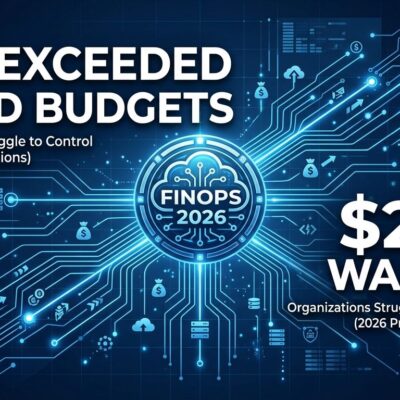
Organizations worldwide are wasting 30-40% of their cloud infrastructure spending—roughly $200 billion annually—on resources that sit idle, are massively overprovisioned, or have been orphaned and forgotten. With global cloud spending hitting $723.4 billion in 2025, this represents one of the largest efficiency failures in enterprise IT history. The culprits aren’t technical limitations. They’re fear-driven overprovisioning, poor cost visibility, and a DevOps culture that prioritizes speed over efficiency.
As budgets tighten across the industry in 2026, cloud waste has shifted from a finance problem to an engineering competency issue. Developers and engineering teams are increasingly held accountable for cloud costs, yet most lack real-time visibility into spending. However, organizations implementing FinOps practices are proving waste is solvable, achieving 30-50% savings through systematic optimization.
Where Cloud Waste Hides: The Three Main Sources
More than 60% of cloud waste comes from three operational failures: overprovisioning accounts for 40% of waste, idle or underused resources represent 35%, and orphaned infrastructure like forgotten snapshots and detached volumes make up 10-15%. These aren’t edge cases—they’re the norm across enterprises.
Studies by Flexera and ParkMyCloud show organizations exceeding cloud budgets by an average of 17%, with 32% of that spend identified as pure waste. In Kubernetes environments, the problem is particularly absurd: 68% of pods request 3-8x more memory than they actually use, based on analysis of 3,042 production clusters in January 2026. One company’s overprovisioning habit cost them $2.1 million annually.
The typical pattern: 30-40% of EC2 instances run at under 20% utilization, yet teams refuse to rightsize them. Development environments run 24/7 when they’re only used during business hours. Storage volumes remain attached to long-terminated instances, silently billing month after month. This isn’t sophisticated technical debt—it’s operational neglect at scale.
Fear-Driven Overprovisioning Culture
Why do teams overprovision resources 3-8x beyond actual needs? They’re terrified of performance issues. 64% of engineering teams admitted to adding “just to be safe” headroom of 2-4x after experiencing a single out-of-memory incident. This “spray and pray” approach wastes millions while providing false confidence.
The root cause isn’t technical—it’s cultural. DevOps teams have been trained to prioritize speed and uptime over cost efficiency. Without real-time cost feedback during development, they have no incentive to optimize. Kubernetes pods requesting 8GB of memory while using 1GB? That’s not a configuration mistake—that’s the culture working as designed.
Organizations that show developers real-time cost data and make efficiency part of engineering KPIs see dramatic improvements. The problem isn’t that developers don’t care about costs. They genuinely don’t see them until the monthly bill arrives, weeks after the damage is done.
Cloud Providers Profit From Your Waste
Here’s the uncomfortable truth: cloud providers profit directly from customer overprovisioning through usage-based pricing models. When customers waste 30% of their spend, that’s 30% more revenue for AWS, Azure, and GCP. They have no incentive to help you optimize.
In 2026, providers quietly shifted pricing strategies—adding IPv4 address charges and increasing egress fees—to capture revenue from optimization-resistant cost categories. They’re no longer competing on compute prices. Instead, they’re monetizing networking and IP addresses, which are harder to optimize and easier to overlook. Meanwhile, native cloud cost tools like AWS Cost Explorer and Azure Cost Management provide basic visibility but lack autonomous optimization capabilities.
This isn’t conspiracy theory—it’s business model reality. Third-party FinOps platforms exist precisely because of this incentive gap. Cloud providers build infrastructure; they’re not motivated to reduce your consumption. Developers need to understand they’re fighting against the business model, not just technical complexity.
FinOps: The Cloud Cost Optimization Solution
Organizations implementing FinOps practices—bringing together engineering, finance, and business teams to optimize cloud spending—consistently achieve 30-50% savings compared to unmanaged spending. This isn’t theory. Sky Group found $1.5 million in savings through BigQuery, Compute Engine, and Cloud Storage optimization. OpenX reduced per-unit costs by 60% in nine months.
The FinOps framework includes real-time cost visibility dashboards, automated tagging for resource allocation tracking, budget guardrails with alerts, and cost accountability assigned at the team level. Quick wins like idle resource cleanup and auto-shutdown schedules for dev/test environments (nights and weekends) typically yield 15-25% immediate savings. Development environments alone can save 65-75% with basic automation.
The key insight: FinOps isn’t a finance initiative or an engineering initiative—it requires collaboration. Engineering-only approaches lack budget authority. Finance-only approaches lack technical understanding. Cross-functional teams that make cost visible, assign ownership, and celebrate optimization wins consistently outperform both.
Quick Wins: 15-Minute Cloud Cost Audit
Not every organization is ready for a full FinOps program. Quick wins provide immediate value and build momentum for larger optimization efforts. Developers can identify 20-30% of cloud waste in under 15 minutes with simple audits: find idle EC2 instances with CPU utilization under 5% for seven consecutive days, locate unattached EBS volumes still billing for storage, identify orphaned snapshots with no parent instance, spot Elastic IPs not attached to running instances, and review stopped instances still incurring attached storage charges.
Tools like Cloud-cost-CLI (launched on Hacker News in January 2026) enable 60-second scans to identify AWS and Azure waste locally with your credentials. The community-built Zero Waste Cloud project claims to find 20-40% savings by identifying idle EC2 instances and oversized RDS databases. A Hacker News catalog documenting “200 ways you’re wasting money in the cloud” provides a comprehensive checklist built by 70+ cloud engineers.
These tactical audits require no budget approval and no organizational change—just 15 minutes and cloud console access. They won’t solve systemic overprovisioning, but they prove waste is real, build credibility for larger optimization initiatives, and deliver immediate ROI.
Key Takeaways
- Cloud waste at 30-40% isn’t a technical problem—it’s operational neglect driven by fear-based overprovisioning culture and poor cost visibility during development.
- The biggest waste sources are overprovisioning (40%), idle resources (35%), and orphaned infrastructure (10-15%). Kubernetes environments waste spectacularly, with 68% of pods requesting 3-8x more memory than they use.
- Cloud providers profit from your waste through usage-based pricing and have shifted to monetizing harder-to-optimize categories (IPv4, egress) in 2026.
- Organizations implementing FinOps achieve 30-50% savings through cross-functional collaboration, real-time cost visibility, and making efficiency part of engineering KPIs.
- Start with a 15-minute audit to identify idle resources, unattached storage, and orphaned infrastructure. Quick wins build momentum for systematic optimization programs.
Cloud promised cost savings through pay-as-you-go pricing. Instead, it created a $200 billion waste crisis because “pay as you go” became “pay for what you provision and forget.” The solution isn’t better cloud providers—it’s better operational discipline, real-time cost feedback, and cultural change that makes efficiency as important as uptime.