 By ByteBot
Anthropic launched Claude for Healthcare on Sunday, January 12, 2026, just five days after OpenAI unveiled ChatGPT Health. Both AI giants timed their announcements around the JPMorgan Healthcare Conference in San Francisco, marking an aggressive competitive race in the healthcare AI market projected to hit $45 billion this year. The rapid-fire timing wasn’t coincidence—it was strategic urgency.
Healthcare AI adoption exploded from 3% to 22% in two years. With 79% of healthcare organizations now using AI and $504 billion in market value forecast by 2032, neither company could afford to cede first-mover advantage. Anthropic’s five-day response window suggests they couldn’t wait weeks for a polished announcement.
Five-Day Response Reveals Strategic Urgency
OpenAI announced ChatGPT Health on Wednesday, January 7. Anthropic countered on Sunday, January 12. Consequently, the five-day gap reveals the stakes in healthcare AI—a vertical both companies see as existential.
This follows a broader market reversal. Anthropic now commands 32% of the enterprise LLM market versus OpenAI’s 25%, a sharp turnaround from 2023 when OpenAI held 50% and Anthropic had just 12%. Moreover, the healthcare launch mirrors this competitive dynamic: OpenAI moved first with consumer momentum, Anthropic responded with enterprise firepower.
The timing around JPMorgan Healthcare Conference was deliberate. However, Anthropic’s Sunday announcement—outside the conference’s main schedule—reads as reactive rather than coordinated.
Enterprise HIPAA vs Consumer Convenience: Two Markets, Two Winners?
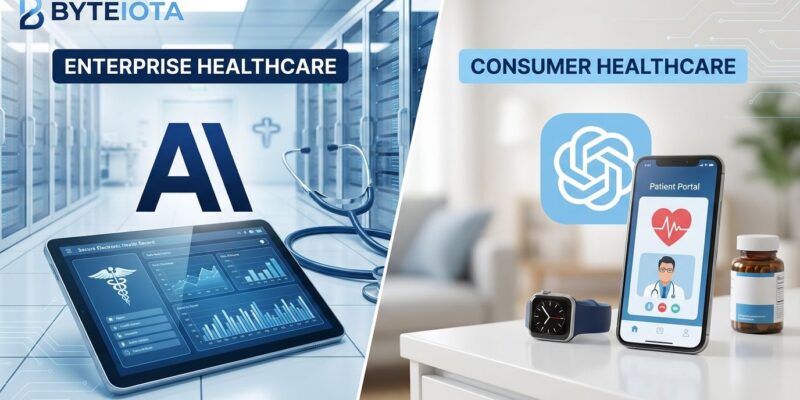
Anthropic and OpenAI are fighting different battles. Claude for Healthcare targets enterprise providers, payers, and pharma with HIPAA-ready infrastructure and medical database connectors. In contrast, ChatGPT Health targets consumers with personal health record integration and 230 million existing weekly health queries.
Claude for Healthcare connects to the Centers for Medicare & Medicaid Services Coverage Database, ICD-10 diagnostic codes, the National Provider Identifier Registry, and PubMed’s 35 million medical sources. Furthermore, enterprise partners include Banner Health, Stanford Healthcare, and pharmaceutical giants Novo Nordisk, Sanofi, AbbVie, and Genmab. The play: automate prior authorizations, clinical trial protocols, and claims appeals.
Related: Anthropic Cowork Brings Claude Code to Non-Technical Users
ChatGPT Health takes a different approach. It connects Apple Health, Android Health Connect, MyFitnessPal, and the b.well health records platform. The use case: help consumers understand lab results, prepare for doctor appointments, and track wellness data. Additionally, OpenAI’s 230 million weekly health queries prove product-market fit already exists.
This isn’t winner-take-all. Enterprise workflows—prior authorizations, regulatory filings, clinical coordination—favor Anthropic’s HIPAA compliance and database integrations. Meanwhile, consumer health literacy—explaining cholesterol numbers, tracking fitness goals—favors OpenAI’s massive user base and smartphone integrations. Both can win in their respective markets. The question is which scales faster.
Privacy Promise: “Not Used for Training” – But Can You Verify?
Both companies promise health data is “not used for training” and excluded from model memory. However, consumer products lack HIPAA Business Associate Agreements, meaning health data sits outside HIPAA protection. Privacy is policy-based, not technically guaranteed—and policies can change.
The Hacker News community immediately raised concerns: “ChatGPT Health is a marketplace, guess who is the product? Despite privacy reassurances, health data sits outside HIPAA protection.” OpenAI’s partnership with b.well—whose primary clients are insurance companies—amplifies worries about monetization. Consequently, could ChatGPT Health become a channel for insurers to reach users with detailed health profiles?
Related: OpenAI Admits Prompt Injection Attacks Are Unsolvable
The HIPAA Journal warns that AI models can inadvertently retain training data through model memorization. “Not used for training” is a promise, not a technical impossibility. Furthermore, Harvard Law’s biotech department labeled HIPAA “outdated and inadequate” for AI privacy concerns.
Enterprise products offer stronger guarantees. Anthropic’s HIPAA-ready infrastructure includes Business Associate Agreements for healthcare providers and payers. Therefore, these contracts lock in privacy terms and create legal accountability. Consumer products don’t provide that protection—trust relies on vendor promises alone.
Healthcare AI Explodes: 3% to 22% Adoption in Two Years
Healthcare AI adoption jumped sevenfold from 3% in 2023 to 22% in 2025. Today 79% of healthcare organizations use some form of AI, and 66% of physicians use health AI tools—up 78% from just 38% two years ago. This isn’t speculative. It’s happening now.
The market follows the adoption curve. Healthcare AI reached $39.25 billion in 2025 and projects to $45.2 billion in 2026, growing at 38.6% annually toward $110.61 billion by 2030 and $504.17 billion by 2032. Moreover, healthcare leads AI adoption at 8x year-over-year growth, second only to the tech industry’s 11x. ROI data justifies the investment: $3.20 returns for every $1 spent, with 14-month payback periods.
First-mover advantage matters when adoption accelerates this fast. Anthropic and OpenAI are racing to lock in enterprise customers and consumer users before the market consolidates. Therefore, the five-day launch gap shows neither company wanted to fall behind. With 60% of healthcare organizations growing AI budgets faster than IT budgets overall, the window for dominance is closing.
Key Takeaways
Anthropic launched Claude for Healthcare just five days after OpenAI’s ChatGPT Health announcement. The rapid response reveals healthcare AI as a strategic priority worth $45 billion in 2026, growing to $504 billion by 2032.
The market is bifurcating along enterprise versus consumer lines. Anthropic targets providers and payers with HIPAA infrastructure and medical database connectors. Meanwhile, OpenAI targets consumers with 230 million weekly health queries and smartphone app integrations. Both strategies can succeed in different segments.
Privacy concerns persist despite vendor promises. “Not used for training” is policy-based, not technically guaranteed—and consumer products lack HIPAA Business Associate Agreement protection. However, enterprise deployments offer stronger privacy guarantees, but most users will access consumer versions without legal safeguards.
Healthcare AI adoption exploded from 3% to 22% in two years. With 79% of organizations now using AI and physicians adopting at 66% rates, the land grab is happening now. First-mover advantage matters when markets consolidate this quickly.
Distribution determines the winner. Anthropic leverages Microsoft partnerships and pharma giants. In contrast, OpenAI leverages smartphone penetration and existing user base. The race comes down to who reaches customers first—and keeps them.