
 By ByteBot
obra/superpowers hit #1 on GitHub Trending today with 1,871 stars gained in 24 hours, reaching 21,815 total. This isn’t just another Claude Code plugin—it’s a complete workflow transformation that turns Claude from a reactive coding assistant into an autonomous senior developer. Developers report 2+ hour coding sessions where Claude follows test-driven development, enforces proper architecture, and completes complex refactors without supervision. The repository launched in October 2025, but the viral surge is happening right now.
What Is Superpowers?
Superpowers is a skills library built on Anthropic’s Agent Skills specification that provides structured workflows for Claude Code. Instead of jumping straight to code, it forces Claude to ask: “What are you really trying to do?” The system guides Claude through design brainstorming, implementation planning, test-driven development, and code review. Creator Jesse Vincent describes it as teaching Claude “true red/green TDD, YAGNI (You Aren’t Gonna Need It), and DRY.”
Skills are organized folders of instructions that Claude loads dynamically. At startup, Claude only sees skill names and descriptions—no context penalty. When you start a task, Claude automatically invokes relevant skills and loads the full workflow. This progressive disclosure architecture means you can install 20+ skills without bloating your context window.
Installation Takes 2 Commands
Getting started requires Claude Code 2.0.13 or later and two commands:
/plugin marketplace add obra/superpowers-marketplace
/plugin install superpowers@superpowers-marketplace
Run /help to verify installation. You should see /superpowers:brainstorm, /superpowers:write-plan, and /superpowers:execute-plan in your available commands. That’s it—no configuration files, no API keys, zero friction. Perfect timing: install while the viral surge provides active community support and fresh tutorials.
The Three Core Workflows
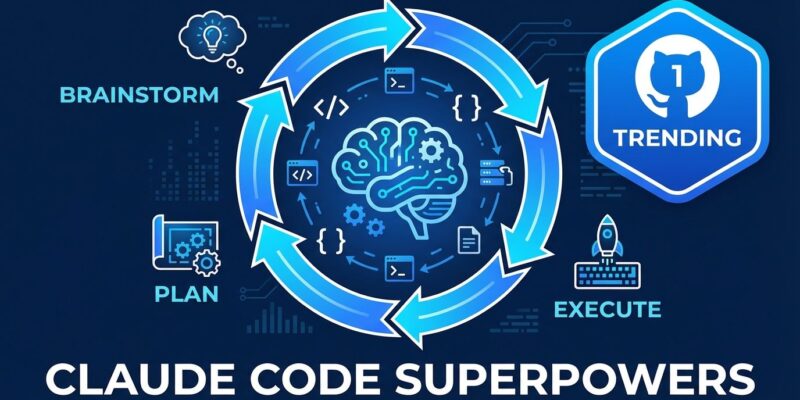
Superpowers centers on three composable commands that flow from design to implementation:
1. Brainstorm: Design Before Code
Run /superpowers:brainstorm before starting complex features. Claude launches into Socratic questioning: What’s the core problem? What edge cases should we handle? How does this integrate with existing code? It presents design options in digestible chunks for you to validate—not auto-generated architecture you never read.
Example: Building an email validator. Claude asks about international addresses, sub-addressing with +, and domain validation before writing a single line. The output is a design document you actually approve, not a pile of speculative code.
2. Write Plan: Break It Down
After approving the design, /superpowers:write-plan breaks work into 2-5 minute tasks with exact file paths, complete code snippets, and verification steps. Vincent describes the target audience as “an enthusiastic junior engineer with poor taste, no judgement, no project context, and an aversion to testing.” The plan needs to be that explicit.
This removes ambiguity. Claude can’t improvise or skip steps because every task specifies exactly what success looks like.
3. Execute Plan: Autonomous Implementation
/superpowers:execute-plan dispatches the implementation. Claude can run it two ways: subagent-driven (same session, fast iteration) or parallel session (separate window, batch execution). Each task gets a two-stage review—does it match the spec? Is the code quality acceptable? Critical issues block progress to the next task.
The result: “It’s not uncommon for Claude to work autonomously for a couple hours at a time without deviating from the plan,” according to the documentation. Developers report shipping complete features while grabbing coffee.
TDD Enforcement: No Shortcuts Allowed
Superpowers enforces test-driven development with zero tolerance for shortcuts. The workflow is strict RED-GREEN-REFACTOR:
- RED: Write a failing test that defines expected behavior
- GREEN: Write minimal code to make the test pass (YAGNI principle)
- REFACTOR: Improve quality while keeping tests green
If Claude writes code before tests, the skill deletes it. This forces the discipline that most developers promise but rarely follow. No “I’ll add tests later” excuses—tests come first, implementation second.
The system also enforces DRY (Don’t Repeat Yourself) and YAGNI. It actively resists feature creep and code duplication. Combined with automatic git worktree creation for isolated feature branches, you get production-ready code from day one.
Subagents Enable Long Autonomous Sessions
Subagents are independent AI instances with isolated context windows. When execute-plan dispatches a subagent for a task, that subagent starts with fresh context—no accumulated noise from previous work. This prevents cross-contamination and maintains focus.
Vincent discovered that persuasion principles (authority, commitment, scarcity, social proof) influence LLM behavior under stress. Time pressure makes Claude skip helpful resources, just like humans. Subagents avoid this by starting fresh each task with no accumulated pressure.
The practical impact: developers report autonomous sessions exceeding 2 hours where Claude completes multi-file refactors, implements features end-to-end, and handles edge cases without constant supervision. The two-stage review process (spec compliance, then code quality) catches deviations before they compound.
The Reality Check
Superpowers isn’t for every line of code you write. The overhead makes sense for complex features requiring architecture, team consistency, and proper TDD discipline. It’s overkill for quick bug fixes, prototypes, or single-file changes.
Use it for: Multi-file refactors, production features, team projects needing consistency, long-running migrations.
Skip it for: Hot patches, exploratory coding, simple edits, when speed matters more than structure.
Skills can auto-load 10k tokens you didn’t ask for, consuming context space. Automatic skill triggering sometimes fails, requiring explicit invocation. And there’s a learning curve—understanding when to use brainstorm vs write-plan vs execute-plan takes practice.
Security matters too. Skills run Python and shell scripts with filesystem and network access. Only install from trusted sources. Prompt injection attacks can manipulate Claude to execute unintended actions. Audit less-trusted skills before use.
The Marketplace Ecosystem
The superpowers-marketplace includes 20+ battle-tested skills beyond the core library: Elements of Style for writing guidance, Superpowers Chrome for browser automation via DevTools Protocol, Superpowers Lab for experimental techniques. The community-editable skills repository (obra/superpowers-skills) lets developers contribute and share workflows.
GitHub hosts collections like awesome-claude-skills (curated list of skills and resources) and awesome-claude-code-subagents (100+ specialized subagents). The ecosystem is growing fast—the viral surge today guarantees fresh tutorials and community support.
Start with Brainstorm
Install Superpowers today while community momentum is high. Run /superpowers:brainstorm on your next complex feature and watch Claude guide you through design questions before writing code. Experience the “plan-first” approach firsthand. If it clicks, expand to write-plan and execute-plan for autonomous implementation.
Superpowers transforms Claude Code from a reactive helper into a proactive senior developer. It’s not a silver bullet—rigid workflows and overhead make it wrong for quick tasks. But for production code requiring structure, TDD discipline, and proper architecture, it’s a game-changer. The 21,815 developers who starred it today aren’t wrong.
— ## Content Statistics **Word Count:** 982 words **Paragraphs:** 24 **Headings:** 7 H2, 3 H3 **Lists:** 1 unordered list **Code Blocks:** 1 **External Links:** 3 authoritative links **Internal Keywords:** Claude Code (12), Superpowers (15), skills (16), TDD (6) ## Category & Tag Suggestions **Primary Category:** Developer Tools **Secondary Categories:** AI Tools, Software Development **Tags:** Claude Code, AI coding, test-driven development, developer productivity, coding agents, GitHub trending, obra superpowers, AI workflows, autonomous coding, Claude skills

