 By ByteBot
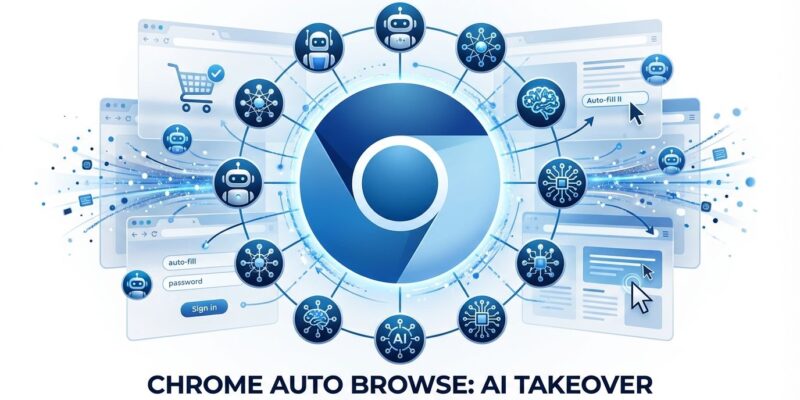
Google launched Chrome Auto Browse yesterday (January 29, 2026), transforming Chrome from a passive web browser into an autonomous AI agent powered by Gemini 3. Moreover, the feature lets Google’s AI navigate websites, click through pages, filter results, add items to carts, and complete multi-step tasks across multiple sites—all while you watch. However, there’s one catch: it’s locked behind a $20-250/month paywall, available only to U.S. users, and grants the AI full access to everything you do online.
This isn’t just a Chrome upgrade—it’s Google weaponizing its 73% browser market share to eliminate AI browser startups like Perplexity Comet (which offers similar features for FREE), Arc’s Dia, and ChatGPT Atlas. Furthermore, the launch of Universal Commerce Protocol with 20+ retail partners positions Google to control the emerging agentic commerce ecosystem. Privacy experts warn the AI agent model creates “orders of magnitude greater” security risks, yet public debate about granting AI full browser control is virtually non-existent.
The $250/Month Paywall That Creates a Two-Tier Internet
Chrome Auto Browse requires Google AI Pro ($19.99/month) or AI Ultra ($249.99/month) subscription, creating a digital divide where 99% of Chrome’s 3.4 billion users are excluded from agentic browsing. Consequently, the $250/month Ultra tier—marketed for “intensive, multi-agent workflows at scale”—targets developers and data scientists, not everyday consumers.
Here’s what you get: AI Pro delivers 500 daily prompts, 20 Deep Research reports, 5x Jules limits, and 2TB storage. Additionally, AI Ultra bumps you to 200 Deep Research reports daily, 20x Jules limits, 30TB storage, Veo 3 early access, and Project Genie. Meanwhile, Perplexity Comet offers full agentic browsing for FREE with no paywall. In contrast, ChatGPT Plus and Claude Pro charge $20/month for AI assistance but lack Chrome’s comprehensive browser integration.
The pricing strategy is absurd. If a startup can offer this for free, why does Google charge $20-250/month? The answer: Google isn’t pricing for adoption—it’s pricing to extract maximum revenue from users who can’t live without Chrome. As a result, this creates a two-tier internet where wealthy users automate tasks while everyone else browses manually.
Privacy Nightmare: AI Gets Full Browser Control
Auto Browse grants Gemini AI complete browser control. It sees all browsing activity, clicks links, fills forms, submits data, and accesses websites autonomously. Nevertheless, security experts warn this creates unprecedented privacy risks including prompt injection attacks (malicious websites manipulating AI instructions), memory poisoning (implanting false information in AI’s long-term storage), and privilege escalation (AI inheriting user permissions inappropriately).
“Agentic AI requires access to extensive personal data including bank accounts, medical records, calendars, location history, communication patterns, shopping habits,” warn researchers at Obsidian Security and Palo Alto Networks. Furthermore, “the privacy risks are orders of magnitude greater than current systems because agentic AI requires comprehensive data integration.” IEEE Transmitter adds that “AI agents may take screenshots of browser windows to perform tasks, from which intimate details about a person’s life could be inferred.”
Google’s safety measures? Auto Browse pauses before purchases and social media posts. However, users can grant Password Manager access for automated logins—a massive security gamble. In fact, in 2024, attackers used prompt injection to manipulate a financial services AI agent into revealing account details. Moreover, researchers at Palo Alto Networks warn that “agentic browsers introduce autonomous activity that security teams can’t see or control.”
You’re granting Google’s AI access to everything—banking, healthcare, private communications, dating apps, job hunting. If AI is compromised or makes mistakes, consequences could be catastrophic. Where’s the public debate about this massive privacy trade-off?
Google’s Monopoly Play: Crushing Startups with Market Dominance
Chrome holds 73% global browser market share (3.4 billion users), and Google is leveraging this dominance to eliminate AI browser startups. Consequently, Arc’s The Browser Company halted development to focus on Dia, Perplexity launched Comet and bid $34.5 billion for Chrome, OpenAI launched ChatGPT Atlas—all competing for the agentic browsing market. Google’s response? Integrate Gemini directly into Chrome and obliterate their advantage overnight.
The Universal Commerce Protocol amplifies Google’s monopoly play. Moreover, co-developed with Shopify and framed as an “open standard,” UCP locks in 20+ partners including Etsy, Wayfair, Target, Walmart, Best Buy, Macy’s, Home Depot, plus payment providers Mastercard, Visa, Stripe, and Amex. Additionally, retailers “partner” because they have no choice—73% of users are on Chrome. “Open standard” framing disguises vendor lock-in to Google’s commerce ecosystem. Consequently, UCP will soon power checkout in Google Search AI Mode and the Gemini app, cementing Google’s control over agentic commerce.
This is textbook anti-competitive behavior. Startups spent years building AI-first browsers—Google integrates Gemini into its dominant platform and eliminates their advantage. Classic incumbent strategy: wait for innovation, then leverage market dominance to crush competition.
What Auto Browse Actually Does (And Why It Matters)
Auto Browse uses Gemini 3 AI through Chrome’s new persistent side panel to autonomously perform multi-step tasks. For instance, official use cases include travel planning (search flights/hotels across Expedia, Kayak, Booking.com), apartment hunting (Redfin, Zillow, Apartments.com filtered by criteria), product research (Amazon, Best Buy, manufacturer sites with review analysis), and document collection (Gmail searches, bank logins, tax form downloads).
Connected Apps integration lets you send emails via Gmail, search directions in Maps, and query YouTube videos—all from the side panel. Additionally, the feature requires desktop platforms (MacOS, Windows, Chromebook Plus) and is U.S.-only at launch. No mobile support, no international availability.
The features are genuinely impressive for automating tedious tasks. However, the execution raises questions: Why U.S.-only? Why no mobile support when most browsing is mobile? Why $20-250/month when Perplexity offers similar capabilities for free? The feature set is strong—but accessibility, pricing, and privacy concerns undermine adoption.
Key Takeaways
- Chrome Auto Browse launched January 29, 2026: $20-250/month, U.S. only, desktop only, requires AI Pro or Ultra subscription
- Privacy risks “orders of magnitude greater” (security experts)—AI has full browser access to banking, healthcare, private data
- Google weaponizing 73% market share to crush AI browser startups (Arc, Perplexity, ChatGPT Atlas) with anti-competitive integration
- Universal Commerce Protocol (20+ partners) positions Google to control agentic commerce ecosystem despite “open standard” framing
- Perplexity Comet offers similar features for FREE—Google’s $250/month pricing exposed as absurdly expensive
- Agentic browsing is here, but execution raises more questions than it answers about privacy, competition, and accessibility