 By ByteBot
OpenAI just opened ChatGPT to third-party app submissions. On December 17, 2025, developers gained the ability to build and publish apps directly in ChatGPT, transforming the AI assistant from a closed product into an open platform. This is OpenAI’s “App Store moment” – the strategic shift that made Apple untouchable in mobile.
Why This Is OpenAI’s Platform Play
When Apple opened the App Store in 2008, it created a self-reinforcing cycle: more apps brought more users, more users brought more developers. Competitors couldn’t catch up. OpenAI is betting the same playbook works for AI.
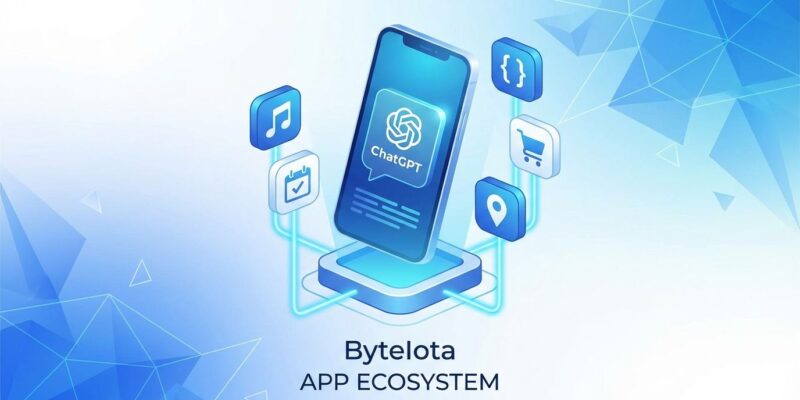
Apps extend ChatGPT beyond conversation. Developers can now build integrations that bring context and enable actions – order groceries through OpenTable, create slides, search apartments on Zillow, or deploy code via Replit. The Apps SDK, now in beta, uses the Model Context Protocol (MCP), an open standard for connecting AI to external tools.
Launch partners signal enterprise readiness: Adobe, Apple Music, Replit, Salesforce.
ChatGPT already has the largest user base in the AI assistant market. By opening a developer ecosystem, OpenAI amplifies that advantage. Every app built exclusively for ChatGPT increases switching costs to Claude or Gemini. The more developers invest in ChatGPT-native apps, the harder competitors catch up.
This is exactly how platform economics work. Microsoft’s Windows ecosystem became the greatest network effect ever because the ecosystem on top created compounding value. Apple’s App Store generated $138 billion in revenue in 2025, built on a 70/30 revenue split that became the industry standard.
What Developers Can Actually Build
Apps appear inline during ChatGPT conversations, creating a chat-native experience. Pilot partners from October included Booking.com, Canva, Expedia, Figma, Spotify, and Zillow. December added Replit and Salesforce.
Apps can read data or perform destructive actions (create posts, send emails, delete files). OpenAI requires labeling – read-only tools get one annotation, write operations another. This is a safety mechanism so ChatGPT knows which tools alter external state.
The submission process mirrors Apple’s review: five steps covering app info, connectivity, testing, screenshots, and release notes. Requirements include HTTPS, sub-3-second responses, and minimal data collection with clear privacy policies.
The Competitive Landscape Shifts
Platform strategies differ sharply. ChatGPT pursues consumer dominance through ecosystem openness. Claude targets enterprise coding with safety-first positioning. Gemini doubles down on Google ecosystem lock-in.
OpenAI’s platform play is partly defensive. ChatGPT’s market share declined in 2025 as smaller competitors gained traction. The AI assistant market is projected to reach $21.11 billion by 2030 with 44.5% CAGR – high growth, but fragmenting.
A developer ecosystem changes the game. Once developers invest in ChatGPT-native apps, switching costs rise. That’s the moat. But success depends on fair economics.
The Revenue Model Question
OpenAI hasn’t announced how it will split revenue with developers.
Apple’s 30% cut became the industry standard, but courts ruled it “unjustified” without real competition. The EU forced Apple to 17% plus per-install fees. If OpenAI follows 30%, expect developer backlash. If it undercuts at 15-20%, it could attract developers fleeing mobile app stores.
The economics will determine whether this becomes a thriving ecosystem or a walled garden. That variable matters most.
What This Means for Developers
OpenAI is executing the Apple playbook: build a platform, let developers extend it, capture value through network effects. The strategy is proven.
The unanswered questions are execution. Will the revenue model be fair? Can OpenAI maintain quality control at scale? Will developers multi-home or commit exclusively?
Early movers have an opportunity. The AI app ecosystem is nascent. Developers who build compelling ChatGPT-native apps now could capture market share before saturation.
The real test isn’t the announcement. It’s whether OpenAI can build a thriving ecosystem without repeating mobile app store mistakes – high cuts, slow reviews, arbitrary rejections, spam proliferation.
If they get it right, ChatGPT becomes more than an AI assistant. It becomes a platform. And platforms, as Apple proved, are very hard to displace.