 By ByteBot
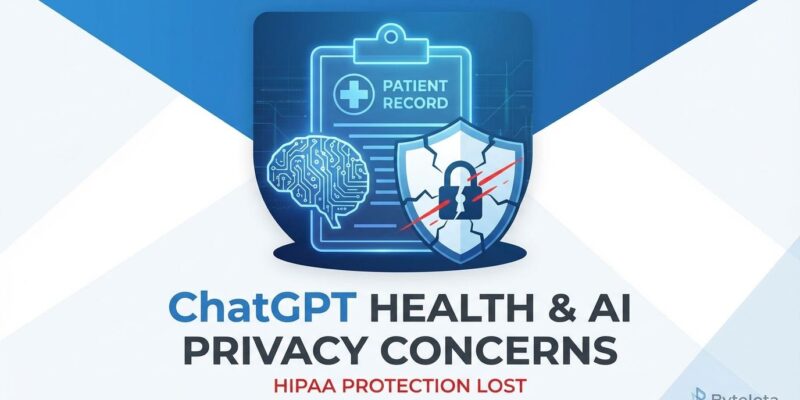
OpenAI launched ChatGPT Health on January 7, 2026, letting users connect medical records and wellness apps for AI-powered health insights. With 230 million users already asking ChatGPT health questions weekly, OpenAI is betting big on healthcare AI. However, privacy advocates warn that sharing medical records with ChatGPT means waiving federal HIPAA protections—a trade-off that raises serious questions about the future of medical privacy.
The HIPAA Problem: Legal Protections Vanish
When you share medical records with ChatGPT Health, those records lose HIPAA protection. OpenAI isn’t a “covered entity” under HIPAA—it’s not a healthcare provider, payer, or clearinghouse. That means the federal health privacy law that shields your data at hospitals doesn’t apply to data you voluntarily give to ChatGPT.
“Individuals sharing their electronic medical records would remove the HIPAA protection from those records, which is dangerous,” warns Sara Geoghegan, Senior Counsel at the Electronic Privacy Information Center (EPIC). Instead of federal law, OpenAI can only be bound by its own Terms of Service, which can change at any time. Furthermore, the US has no comprehensive privacy law like Europe’s GDPR to fill this gap.
This creates a privacy paradox: AI needs data to be useful, but medical data is uniquely sensitive. Consequently, patients must choose between legal protections and AI-powered convenience. That’s not a choice most people should have to make.
Why OpenAI Avoids the EU (Regulatory Arbitrage)
ChatGPT Health isn’t available in the EU, UK, or Switzerland—regions with the world’s strongest privacy protections under GDPR. Privacy advocates call this “kind of telling.” If OpenAI’s privacy model were truly robust, why avoid markets with strict privacy laws?
The answer: regulatory arbitrage. GDPR requires explicit consent, data minimization, breach notification within 72 hours, and gives users ironclad rights to access and delete their data. Meanwhile, OpenAI’s privacy-by-promise approach doesn’t meet that bar. Instead, OpenAI launches in the US where privacy laws are weaker and enforcement is lighter.
For developers building healthcare AI, this is a critical lesson: ask yourself, “Would this pass GDPR?” If the answer is no, your privacy model isn’t strong enough—regardless of what jurisdiction you’re targeting.
The Developer Reality Check: HIPAA Compliance Is Brutal
Building HIPAA-compliant AI isn’t just hard—it’s where most implementations fail. Moreover, the two biggest failure points are audit logging and consent.
HIPAA’s Security Rule requires comprehensive audit trails of all access to electronic Protected Health Information (ePHI). AI models, however, make thousands of data access requests during normal operation. Standard logging infrastructure can’t handle this at the required level of detail. This is where most AI deployments fall short.
Real-world failures confirm this. In November 2025, a class action lawsuit hit Sharp HealthCare after its ambient AI scribe allegedly recorded over 100,000 patients without proper consent—and false consent statements appeared in medical records. One mistake, and you’re facing class action litigation plus reputation destruction.
There’s also a fundamental tension between HIPAA’s “minimum necessary” standard (access only the PHI you absolutely need) and AI’s data hunger (models perform better with comprehensive datasets). Balancing regulatory compliance with model performance is a constant trade-off with no easy answers.
Privacy Promises Aren’t Enough
OpenAI promises “purpose-built encryption and isolation” for health data, separate storage from regular ChatGPT conversations, and a commitment not to train foundation models on health information. Additionally, users can delete their data at any time.
These promises sound reassuring. However, the problem is they’re contractual commitments, not legal requirements. OpenAI can change its Terms of Service whenever business incentives shift. As Public Citizen’s J.B. Branch notes, “Self-policed safeguards are simply not enough to protect people from misuse, re-identification, or downstream harm.”
Privacy promises without legal enforcement are worthless when business priorities change. Trust isn’t a business model—it’s a legal framework. And right now, that framework doesn’t exist for consumer health AI.
What’s Next: Unanswered Questions
OpenAI has been silent on critical questions. What happens when law enforcement requests health data? Will reproductive health information be protected post-Dobbs? These aren’t hypothetical concerns—they’re real risks without clear policies.
The regulatory landscape for 2026 is chaos. New state privacy laws took effect in Indiana, Kentucky, and Rhode Island on January 1, but a Trump executive order aims to preempt state AI regulation with a federal framework. Meanwhile, HIPAA hasn’t been updated to cover AI companies operating in healthcare.
Competition is heating up fast. Amazon launched its Health AI assistant for One Medical members on January 21, just two weeks after ChatGPT Health. Google Health, Epic, and Oracle are all building healthcare AI products. The race is on: who can build patient trust first? Because the first company to lose that trust will fail catastrophically.
The Bottom Line
ChatGPT Health is too new to judge definitively, but the privacy concerns are valid. Innovation is great—but not at the expense of medical privacy. OpenAI’s privacy-by-promise model isn’t strong enough for healthcare, especially when GDPR-level protections are available but deliberately avoided.
For developers, healthcare AI represents a massive market opportunity coupled with brutal regulatory complexity. Audit logging is where you’ll fail. Consent is where you’ll get sued. Plan accordingly, and ask the GDPR question before you ship.
The verdict: Watch this space. Regulators will determine whether OpenAI’s approach survives, or whether stronger privacy laws force a rethink. Until then, sharing your medical records with ChatGPT means trusting promises over laws.