 By ByteBot
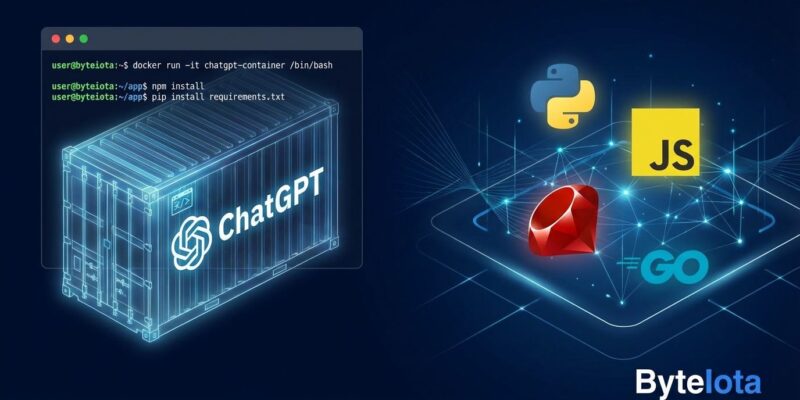
No press release. No blog post. No changelog. But ChatGPT just became a multi-language development environment.
OpenAI quietly upgraded ChatGPT containers with bash support, npm and pip package installation, and support for 11+ programming languages. The discovery came January 26, 2026, not from OpenAI, but from independent AI researcher Simon Willison who documented the features after investigating environment variables. The kicker? It works on free accounts.
This transforms ChatGPT from a Python-only sandbox into a genuine development environment where you can install dependencies, run bash scripts, and code across JavaScript, Ruby, Go, Java, and more. All without OpenAI telling anyone.
What Actually Changed
ChatGPT containers previously ran Python code in isolation. You could execute Python scripts, but bash commands required subprocess workarounds, package installation didn’t work, and other languages were off-limits.
Now you can run direct bash commands, install packages via npm install or pip install, execute code in 11+ languages including JavaScript/Node.js, Ruby, Perl, PHP, Go, Java, Swift, Kotlin, C, and C++, and download files from URLs using a new container.download tool.
Before, you’d write Python subprocess hacks to simulate bash. After, you type bash commands directly. Before, you couldn’t install packages mid-conversation. After, you install any npm or Python package and use it immediately. Before, switching languages meant starting over. After, you move between Python data processing and JavaScript visualization in one session.
How ChatGPT Containers Work Behind the Scenes
All package requests route through OpenAI’s internal proxy at applied-caas-gateway1.internal.api.openai.org. Environment variables redirect pip and npm to this gateway instead of external registries. The proxy sits between ChatGPT containers and package repositories, providing a validation checkpoint before installation.
Registry references in the code hint at future support for Rust (Cargo), Docker, Go modules, Maven, and Gradle, though these aren’t active yet. The technical architecture builds on OpenAI’s Code Interpreter but expands far beyond Python-only execution.
The security model layers network isolation (containers can’t make outbound requests independently), proxy mediation (all packages go through OpenAI’s gateway), URL restrictions (file downloads only work for URLs already viewed in the conversation), and sandboxing (execution isolated from the host system).
This prevents data exfiltration. You can’t construct arbitrary URLs to phone home. You can’t bypass the proxy to install unvalidated packages. You can’t escape the sandbox to access OpenAI’s infrastructure.
Why Free Tier Access Matters
GitHub Copilot costs $10 per month. Cursor costs $20 per month and requires migrating your entire IDE setup. ChatGPT containers with multi-language execution and package installation? Free.
This removes the financial barrier to coding education. Students worldwide get a professional development environment without subscription fees. Prototyping doesn’t require local setup or cloud IDE credits. The playing field levels for learners who can’t afford paid tools.
OpenAI is leveraging distribution advantage. ChatGPT has 100 million plus users. Copilot and Cursor serve developers specifically. By making containers free, OpenAI threatens paid coding assistants and cloud IDEs like Replit and GitHub Codespaces. As comparative analysis between coding assistants shows, the free tier creates a significant competitive moat.
The strategic implication: free tier becomes a competitive moat. Hard for competitors to match when their business model depends on subscriptions.
The Silent Rollout
Why didn’t OpenAI announce this? Features rolled out “in the past few months” according to Willison’s analysis. No official documentation exists. The Hacker News thread that hit number one today is full of developers asking the same question.
One theory: avoiding the hype cycle. ChatGPT Plugins launched with fanfare in 2023, overpromised, and underdelivered. Maybe OpenAI learned to ship quietly, iterate based on real usage, and announce when features stabilize rather than when they ship.
Another theory: trust through delivery. Let developers discover capabilities organically rather than managing expectations through marketing. If it works, people find it. If it breaks, fewer people notice.
The pattern shift is notable regardless of motive. OpenAI used to announce everything. Now they’re shipping major features silently. That raises a fair question: if you’re not telling us about this, what else are you shipping without announcement?
Security Questions
The proxy provides a validation layer, but trust questions remain. How does OpenAI validate packages before installation? Are there allowlists or denylists for known malicious packages? What prevents supply chain attacks through typosquatting on npm or PyPI? Can developers audit which packages were installed in their session?
Package installation carries inherent risk. Malicious packages exist. Dependency confusion attacks happen. Backdoors get smuggled into popular libraries. OpenAI’s proxy theoretically catches some of this, but without documentation on validation logic, developers are trusting a black box.
Network isolation helps. Even if a malicious package gets installed, it can’t phone home. Sandboxing limits blast radius. But perfect security doesn’t exist, and transparency about validation mechanisms would build more trust than silence.
What’s Coming
Environment variables in the code reference Rust’s Cargo package manager, Docker registries, Go modules, Maven, and Gradle. These aren’t functional yet, but the infrastructure exists. Rust support is likely next given the registry configuration already in place.
Future possibilities include official API access to container execution, IDE extensions that connect to ChatGPT containers for remote execution, enterprise features like package allowlists and audit logs, and team sharing of development environments.
The competitive response will be interesting. Will Microsoft react to the free tier threat to Copilot? Can Cursor differentiate on IDE integration alone when ChatGPT offers execution for free? Does this accelerate consolidation in AI coding assistants?
Long-term, this positions ChatGPT as a primary development environment for beginners and a prototyping tool for professionals. Conversational interfaces for deployment, testing, and monitoring become viable. The line between coding assistant and development platform blurs.
The Bigger Picture
Eighty-five percent of developers use at least one AI tool in their workflow according to a 2025 Pragmatic Engineer survey. The market is crowded: Copilot for autocomplete, Cursor for multi-file refactoring, ChatGPT for conversational guidance. Now ChatGPT adds execution and package installation, encroaching on territory others thought secure.
The silent rollout matters because it signals strategy shift. OpenAI isn’t playing the announcement game anymore. They’re shipping, iterating, and letting adoption speak. Whether that builds or erodes trust depends on whether features work.
For developers, the value proposition is clear: free multi-language execution with package installation and zero setup friction. For competitors, the threat is equally clear: how do you compete with free when your moat was convenience?
OpenAI didn’t announce this. Developers discovered it anyway. That might be the point.