 By ByteBot
OpenAI launched a ChatGPT App Store on December 18, 2025, opening third-party app submissions for the first time. Developers can now build apps that reach 800 million ChatGPT users instantly—apps that extend conversations with actions like ordering groceries, booking travel, creating presentations, and searching for apartments. This is OpenAI’s platform play, shifting ChatGPT from a closed chat product to an extensible ecosystem where third-party developers compete for user attention. First approved apps roll out in January 2026.
But here’s the catch: OpenAI controls app discovery, approval, and featured status. It’s the Apple App Store gatekeeper model, except OpenAI still hasn’t delivered on revenue-sharing promises from its 2024 GPT Store launch. Developers get access to 800 million users but lose control of the distribution funnel. Early-mover advantages are real, but so are platform lock-in risks.
What Developers Can Build with ChatGPT Apps
ChatGPT apps extend conversations by bringing in context and enabling actions. OpenAI’s Apps SDK, built on the open Model Context Protocol standard, lets developers control both app logic and interface. Apps can connect to backend systems, support user logins, and offer premium features—all embedded directly in ChatGPT conversations.
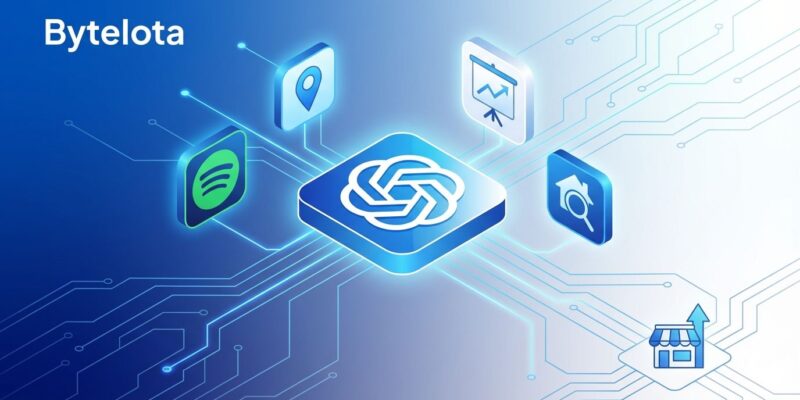
Launch partners demonstrate the range of possibilities. Spotify builds playlists and suggests podcasts based on genre or mood. Canva transforms text documents into presentations and pitch decks. Zillow searches homes by price, bedrooms, and neighborhoods. Expedia plans trips with natural-language search refinement and map-based results. These aren’t simple API calls—they’re interactive experiences blending chat with familiar UI elements like maps, playlists, and search filters.
The Apps SDK is in beta, with developer mode available for testing in ChatGPT settings. OpenAI published documentation, a UI library for chat-native interfaces, example apps, and best practices. Developers submit apps via the OpenAI Developer Platform for review and approval. A public developer webinar is scheduled for January 21, 2026.
How App Submissions Work
Developers submit apps at platform.openai.com/apps-manage and track approval status. OpenAI reviews submissions before publication. Approved apps appear in the app directory inside ChatGPT, accessible via the tools menu or chatgpt.com/apps. The first wave of approved apps launches gradually in January 2026.
The submission process mirrors mobile app stores: build, submit, await approval, iterate based on feedback. OpenAI hasn’t detailed approval criteria beyond “strong guardrails” and content policy compliance. This opacity creates uncertainty—developers don’t know what gets approved until they try.
Platform Control: The 800 Million User Distribution Trap
Here’s the trade-off. Developers gain instant distribution to 800 million ChatGPT users. ChatGPT proactively suggests relevant apps during conversations, creating discovery without marketing spend. But OpenAI owns that discovery. Featured status depends on OpenAI’s algorithms and editorial decisions. Apps inherit ChatGPT’s design system, content policies, and ranking logic. If ChatGPT drives 80 percent of your app’s traffic, you’re locked in—leaving means redesigning for a different platform and losing your user base.
OpenAI’s GPT Store, launched in early 2024, promised revenue sharing for custom GPT builders. Developers are still waiting. GPT creators report zero substantive revenue from the platform. The ChatGPT App Store currently offers no in-app monetization. Developers must link externally to their own apps or websites to charge users. OpenAI says it’s “exploring internal monetization options” but hasn’t committed to revenue sharing or timelines.
The Model Context Protocol offers some escape. MCP is an open standard managed by the Linux Foundation, with 97 million monthly SDK downloads and support across ChatGPT, Claude, Gemini, Microsoft Copilot, and VS Code. Apps built on MCP are theoretically portable to other platforms. But distribution lock-in persists. OpenAI controls access to 800 million users, and competitors like Anthropic or Google can’t replicate that reach overnight. Technical portability doesn’t solve business dependency.
Should Developers Rush to Build ChatGPT Apps?
The strategic calculus depends on risk tolerance. Early-mover advantages are significant. The first app in a category may dominate forever due to network effects, user habit formation, and featured status. January 2026 is the window to claim territory before the market saturates. If you can monetize externally and accept platform risk, building now makes sense.
But the downside is real. No revenue model. Approval uncertainty. Design constraints. Discovery dependence. If OpenAI changes guidelines, builds competing features, or adjusts rankings, your business shifts overnight. Apple’s App Store history shows this pattern: arbitrary rejections, rule changes, and platform competition that disadvantages third parties.
The smart hedge is multi-platform. Build on MCP so your app works across ChatGPT, Claude, and Gemini. Don’t optimize solely for ChatGPT-specific features. Maintain independent user acquisition channels. Treat ChatGPT distribution as a growth accelerator, not your sole distribution strategy.
OpenAI’s app store launch is a major platform shift. It creates genuine opportunity—800 million users, early-mover advantages, novel chat-native UX. But it also introduces familiar platform risks: gatekeeping, revenue uncertainty, and vendor lock-in. Developers should evaluate whether the distribution upside justifies the control trade-off. For many, the answer will be yes. Just don’t bet your entire business on OpenAI’s continued goodwill.