 By ByteBot
ChatGPT just became a platform. On December 18, OpenAI opened its ChatGPT app store to third-party developers, transforming the 800-million-user chatbot into a full developer ecosystem. This is the “iOS moment” for AI—and it changes how we think about ChatGPT entirely.
The Platform Play
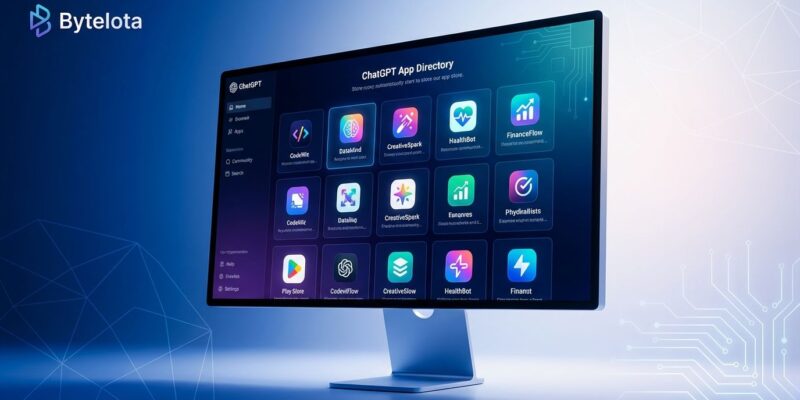
Developers can now submit apps for review through the OpenAI Developer Platform, with a new app directory live at chatgpt.com/apps. Unlike separate downloads, these apps run directly inside the chat window—think Spotify playback, DoorDash ordering, or Canva design tools embedded in your conversation.
Launch partners include Spotify, DoorDash, Canva, Figma, Apple Music, and Zillow. The apps leverage OpenAI’s SDK with embedded UI components, OAuth authentication, and real-time actions. Moreover, it’s not just text anymore—it’s visual, interactive, and alive.
OpenAI’s vision? Become the “universal interface to our digital lives.” With 800 million weekly active users and a 73.9% AI chatbot market share, they’ve got the scale to pull it off.
The Developer Dilemma
Here’s where it gets interesting. For developers, this looks like the opportunity of a lifetime: 800 million users, early mover advantage, and featured placement in a brand-new directory. TechCrunch notes the message is clear—”any business software not present in ChatGPT apps risks falling behind.”
However, developers aren’t naive. On Hacker News, one developer cut to the chase: “No way to own distribution while building on top of the platform.” You get OpenAI’s massive reach—and all their risks—while they control the entire relationship with your users.
Sound familiar? It should. OpenAI is running the Apple playbook: build the platform, attract developers, take a cut (likely 30%, though they haven’t disclosed it yet), and lock everyone in. Critics are already calling it “Walled Garden 2.0″—a classic Silicon Valley move to capture and monetize a developer ecosystem.
Furthermore, OpenAI’s track record here isn’t great. Remember OpenAI Plugins? They flopped due to complexity. The GPT Store? Flooded with low-quality submissions. So why should this time be different?
Apps vs. Custom GPTs
Quick clarification: Apps are not Custom GPTs. Custom GPTs are no-code persona-style assistants you configure with instructions and knowledge bases—they still exist. Apps are full SDK-based applications with visual UI, embedded components, and OAuth sign-ins. Think of GPTs as pre-configured chatbots; apps are actual software running inside ChatGPT.
What can developers build? E-commerce (order groceries), productivity tools (turn outlines into slide decks), entertainment (play music), and services (book travel, search real estate). The potential is broad—if the platform holds up.
The Money Question
Currently, developers can only monetize by linking out to their own websites or native apps for transactions. OpenAI is “exploring” internal monetization, including the Agentic Commerce Protocol (an open standard for instant checkout) and revenue sharing.
Nevertheless, the problem? No clarity on when this happens or what OpenAI’s cut will be. Developers are being asked to build on faith, with promises of future monetization that may or may not materialize. The lack of transparency is a red flag.
The Competitive Race
OpenAI isn’t alone. Google Gemini has 650 million users riding on default placement in Search and Android, and just announced a competing protocol called AP2. Microsoft Copilot has 20 million weekly users (stagnant compared to ChatGPT’s 800 million). Amazon and Meta are building similar systems.
Everyone wants to be the OS for AI agents. The stakes are enormous—if ChatGPT’s app ecosystem succeeds, OpenAI believes “you won’t need a browser at all.” That’s the vision: total platform control, zero-click answers, integrated commerce, and users who never leave.
What Happens Next
For developers, this is a classic platform dilemma. Massive distribution versus permanent dependency. Early opportunity versus long-term lock-in. The question isn’t whether to build on ChatGPT—it’s how much to bet on it.
As Fly.io points out, building critical business systems on an external platform means “you get all their risks and none of their financial benefits.” That’s the trade-off.
Ultimately, December 18, 2025 might be remembered as the day ChatGPT became a platform—or as another overhyped launch that fizzles like Plugins and the GPT Store. Time will tell which playbook OpenAI is following: iOS or Google+.