
 By ByteBot
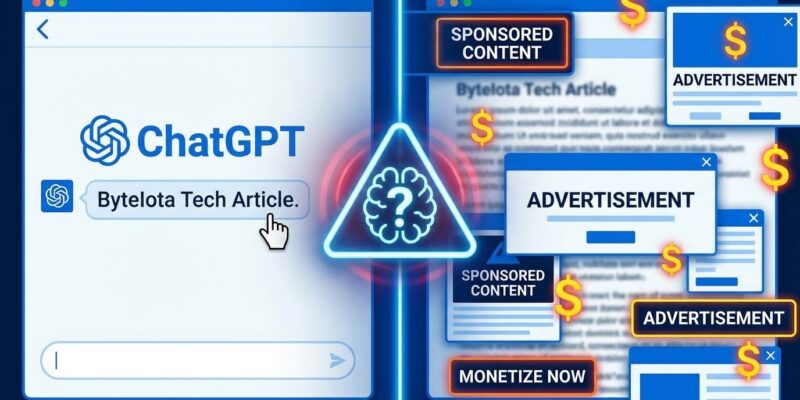
OpenAI confirmed the inevitable on January 3, 2026: ChatGPT is getting advertisements. But here’s where it gets controversial. Internal discussions revealed by The Information show OpenAI plans to prioritize sponsored content over non-sponsored results. Ask ChatGPT about headache relief? It might recommend Advil over generic ibuprofen—not because it’s medically superior, but because Advil pays more. This is AI’s Google AdWords moment, and it’s a trust crisis in the making.
The Business Pressure Behind ChatGPT Ads
OpenAI’s finances tell the story. The company faces $7 billion in annual operating costs. Of 800 million monthly users, only 5% pay—that’s 760 million people using ChatGPT for free. The company lost $8 billion in the first half of 2025 despite doubling revenue. CEO Sam Altman even admitted OpenAI is “losing money” on the $200-per-month ChatGPT Pro tier. When your business model bleeds cash and 95% of users refuse to pay, advertising becomes the escape hatch.
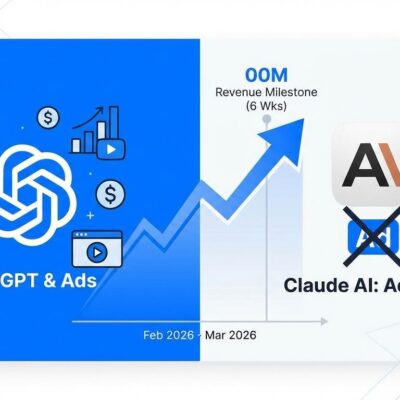
OpenAI projects $1 billion in new revenue from ads in 2026, scaling to $25 billion by 2029. Those numbers require more than sidebar banners. They require prioritizing advertisers in responses—exactly what internal discussions describe.
How ChatGPT Ads Will Work
The rollout follows a phased approach. Q1 2026 brings beta testing of search ads. Q2-Q3 expands the program. Q4 2026 introduces sidebar sponsored content. But the real shift is algorithmic: OpenAI’s internal teams are exploring how to rank sponsored content based on relevance while maintaining “trust.” Translation: your ChatGPT answers will factor in who paid, not just what’s accurate.
One thing is clear—ChatGPT Plus subscribers paying $20 per month will likely remain ad-free. The $200-per-month Pro tier is virtually guaranteed protection. Free users are the product, and advertisers are the customers.
The Peloton Incident: A Trust Crisis Preview
This isn’t OpenAI’s first attempt at monetizing user attention. In December 2025, a $200-per-month ChatGPT Pro subscriber received an unprompted Peloton app suggestion during an unrelated conversation. The screenshot went viral with 462,000 views. Users erupted. TechCrunch reported the backlash, and OpenAI scrambled to clarify the Peloton placement wasn’t an ad—just a “bad and confusing experience.”
Marc Chen, OpenAI’s Chief Research Officer, admitted: “I agree that anything that feels like an ad needs to be handled with care, and we fell short.” OpenAI disabled app suggestions entirely. But here’s the problem: if it looks like an ad and interrupts like an ad, users don’t care what you call it. And sentiment analysis showed 68% of Reddit commenters reacted negatively to the prospect of ChatGPT advertising, with trust erosion as the primary concern.
Developer and User Concerns
Developers building on OpenAI’s platform face a different risk: bias creep. If ChatGPT’s API responses start favoring sponsored content, apps integrating those APIs inherit that bias. Beta code in the ChatGPT Android app already references ad slots, dynamic insertion, and performance tracking. Hacker News discussions reveal developers are exploring “ad auctions” similar to Google AdSense, with ranking algorithms that balance relevance against revenue.
The trust question is simple: if ChatGPT recommends a product, is it the best answer or the best-paying answer? Users can’t tell the difference. That ambiguity is corrosive.
The Competitive Landscape
Google isn’t rushing to follow OpenAI’s lead. The company delayed Gemini chatbot ads to 2026 in private client briefings, taking a cautious approach while OpenAI absorbs the backlash. Anthropic’s Claude remains ad-free, relying on $20-per-month subscriptions and enterprise deals. If OpenAI succeeds, Google will follow. If users revolt, Anthropic wins by default.
This sets the precedent for AI chatbot monetization. OpenAI is the test case. The industry is watching.
What Happens Next
OpenAI is making a calculated bet: users will tolerate ads if the alternative is paywalls. That worked for Google Search. It worked for Facebook. But those platforms established trust before introducing ads. ChatGPT is asking users to accept sponsored bias while the technology is still proving itself. The Advil-over-generic-ibuprofen scenario isn’t hypothetical—it’s exactly what prioritized sponsored content means in practice.
For developers, the calculus is harder. Integrating ChatGPT’s API comes with reputation risk. For free users, the experience degrades. For OpenAI, the $25 billion revenue target depends on users accepting something they’ve already rejected once. The Peloton incident was a preview. The 2026 rollout is the real test. And if trust is the cost of monetization, OpenAI is about to find out what that price tag looks like.








[…] Layer moves up-stream to platforms like ChatGPT. In order to offset its impending deficit, Take a look. (OpenAI plans to feature sponsored content) in chat responses. By 2026, OpenAI expects to generate […]